

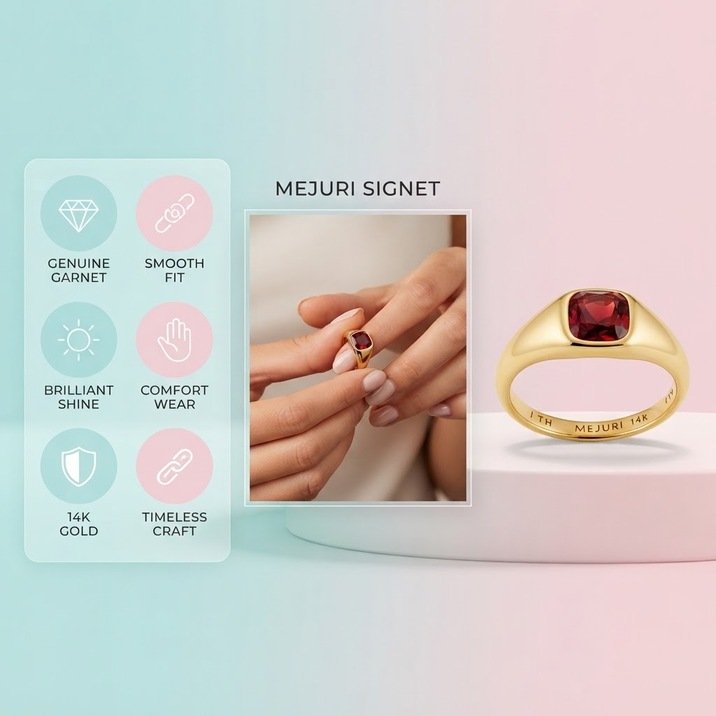
Jude Pinky Signet Ring
The Jude Pinky Signet Ring gives the traditional signet shape a more colorful identity by setting a substantial gemstone into a compact ring designed specifically for the pinky. Its 6 × 6 mm stone occupies most of the visible top, while a 7 mm top width and slimmer 1.8 mm shank keep the ring from feeling uniformly bulky around the finger. Current sizes run from 3 through 7.
Rather than appearing in only one material combination, the Jude design is offered across several gemstone and metal variations. Current listings include sterling-silver versions with amethyst, champagne quartz, and lab-grown white sapphire, alongside selected 14k yellow-gold versions featuring stones such as prasiolite, garnet, and London blue topaz.
About Jude Pinky Signet Ring
Signet rings traditionally concentrate visual weight on a larger upper surface. Jude keeps that recognizable architecture but replaces the plain engraved face associated with classic signets with a square-cushion-style gemstone.
That stone-first construction makes it useful for someone who wants the compact proportions of pinky jewelry without choosing an entirely plain metal ring. The design remains structured, but color becomes the focal point.
For a broader look at different ring and metal directions, the Jewellery collection brings together rings, earrings, bracelets, necklaces, and other pieces in one place. The current assortment includes both gemstone-focused designs and sculptural metal jewelry.
Jude Pinky Signet Ring Features
- Jewelry type: Gemstone pinky signet ring
- Design: Compact signet profile with a prominent gemstone face
- Stone dimensions: Approximately 6 × 6 mm
- Top width: Approximately 7 mm
- Shank width: Approximately 1.8 mm
- Current size range: 3–7
- Sterling-silver construction: 925 sterling silver on applicable variants
- Recycled silver claim: 91% recycled material in current sterling-silver versions
- Other metal option: Selected variants are offered in 14k yellow gold
- Gemstone choices: Current assortment includes amethyst, champagne quartz, lab-grown white sapphire, prasiolite, garnet, and London blue topaz
- Finish: Smooth polished signet-style band
- Manufacturer positioning: Hypoallergenic, with sterling-silver versions described as durable for regular jewelry wear
A Gemstone Becomes The Signet Face
One of the more interesting details is how closely the gemstone dimensions relate to the ring’s overall top width.
The stone measures approximately 6 × 6 mm, while the complete upper section is approximately 7 mm wide. That leaves relatively little visible metal around the stone and makes color a major part of the ring’s identity.
This differs considerably from a traditional blank signet where the polished metal surface itself is the focal point.
It also separates Jude from Hotscope’s Topaz Ring in Sterling Silver. That piece uses a more conventional gemstone-ring composition with a decorative center stone and detailed surrounding setting, while Jude keeps the silhouette closer to a compact signet.
Sterling Silver And 14k Gold Create Two Different Looks
The Jude design is not tied to a single metal.
Current sterling-silver versions use 925 sterling silver, which contains 92.5% silver. The manufacturer states that its sterling-silver jewelry is made using 91% recycled material.
The Federal Trade Commission’s precious-metal jewelry guidance provides standards around descriptions such as sterling silver, gold, and laboratory-created gemstones so shoppers can distinguish actual material composition from surface appearance alone.
Selected Jude variants are instead constructed in 14k yellow gold. The change is more than a color variation. Silver gives the signet a cooler, brighter frame, while yellow gold creates warmer contrast around stones such as garnet, prasiolite, or London blue topaz.
This makes the chosen metal part of the overall design rather than a secondary specification.
Choosing Between The Jude Gemstone Variations
Because the ring architecture remains consistent, gemstone choice has a particularly strong effect on its personality.
Amethyst brings a purple tone to the sterling-silver version. Champagne quartz creates a softer neutral appearance, while lab-grown white sapphire moves toward a clear, light-reflecting look.
The yellow-gold versions create different contrasts again. Garnet introduces deeper reddish color, prasiolite gives the ring a pale green direction, and London blue topaz creates a stronger blue focal point. Current Jude listings show all of these combinations within the same design family.
GIA identifies amethyst as a member of the quartz family and notes that its color can range through different purple intensities. Its amethyst information provides useful background for shoppers comparing purple gemstone jewelry.
For blue versions, GIA’s topaz information explains characteristics of topaz and the role color plays when evaluating the gem.
The important point is that the Jude name refers to the ring design, not one single stone specification.
Natural Gemstone Variation Is Expected
The manufacturer specifically notes that natural gemstones can show slight differences in color.
That is relevant for stones such as amethyst, quartz, garnet, topaz, and prasiolite because natural gem material is not produced with the visual uniformity of molded synthetic components. Tone, saturation, internal features, and subtle color distribution can vary from stone to stone.
That does not mean every difference indicates poorer quality. It means product photography should be treated as representative rather than as a guarantee that every naturally occurring stone will be visually identical.
The exception within the current Jude assortment is the explicitly identified lab-grown white sapphire option, which should be described as laboratory-grown rather than natural. FTC jewelry guidance makes clear identification of laboratory-created gemstones an important part of accurate jewelry representation.
What Lab Grown White Sapphire Means
Lab-grown sapphire is not simply glass given a gemstone name.
Laboratory-created gemstones are manufactured rather than mined but are identified according to the gem material they reproduce. This distinction should remain visible in a product description so a shopper does not confuse a lab-grown sapphire with either natural sapphire or a sapphire-colored imitation material.
GIA’s sapphire guidance provides additional information about sapphire characteristics and durability. Sapphire belongs to the corundum mineral family and is well suited to jewelry applications because of its hardness.
For Jude, the lab-grown white sapphire variant provides a clear-stone alternative to the more visibly colored natural gemstone versions.
Pinky Proportions Change The Ring’s Presence
Jude is specifically positioned as a pinky ring, and its available sizes 3–7 reflect that smaller-finger focus.
The proportions are particularly well considered for that placement. A 7 mm signet face is large enough to remain clearly visible on the smallest finger but avoids the much broader top found on oversized traditional signet rings.
The 1.8 mm shank also reduces visual bulk underneath and beside the finger. The result is a ring that looks substantially wider from above than it does around the underside of the finger.
Anyone comparing several small-finger styles can also browse the Pinky Rings selection within the third Jewellery collection page, where pinky-focused designs appear alongside sculpted bands and mixed-metal jewelry.
Getting The Pinky Size Right
Pinky sizing deserves more attention than simply ordering the smallest ring size you normally see.
Finger circumference can differ noticeably between the dominant and non-dominant hand, and the pinky often has a more pronounced difference between the knuckle and the base of the finger than larger fingers do.
The ring should pass over the knuckle without excessive force but remain secure enough at the base that the heavier gemstone top does not rotate constantly.
Because Jude has a 7 mm top compared with a 1.8 mm shank, a poor fit may be more noticeable than with a completely uniform thin band.
Measure the exact pinky where the ring will be worn rather than assuming a size from another finger. It is also sensible to measure when hands are at a normal temperature because fingers can temporarily change circumference with heat and cold.
A Signet Ring That Works Well Solo
Jude does not need another ring directly beside it.
The 6 mm gemstone already creates a clear focal point, while the 7 mm signet face gives the smallest finger enough visual weight to balance jewelry worn elsewhere on the hand.
Wearing Jude alone on the pinky can work particularly well when several slimmer rings are worn on the middle or index fingers. The different placement creates separation instead of making every ring compete within one stack.
For a more sculptural comparison, the ring selection on Jewellery Page 3 also includes the Sculpted Cable Band Ring. That piece emphasizes metal texture and band volume, while Jude uses a gemstone face to create its visual weight.
Mixing Jude With Diamond Jewelry
A colored signet can also provide contrast within a jewelry collection dominated by clear stones.
The diamond-focused Jewellery selection currently includes a Grown Diamond Engagement Ring alongside other jewelry styles. Placing a colored Jude ring on the pinky rather than stacking it immediately beside a diamond ring can let each gemstone retain its own identity.
The same principle works across earrings and necklaces. Matching every gemstone color is unnecessary. Repeating the metal tone while allowing the center stones to differ often creates a more natural-looking jewelry combination.
Caring For The Stone According To Its Type
Because Jude is available with several gemstones, one universal aggressive cleaning routine would not be appropriate.
Warm, mild soapy water is a sensible conservative approach for many of the current options, but individual stones have different responses to heat, ultrasonic cleaning, treatments, and sudden temperature changes.
GIA’s amethyst care guidance, for example, advises warm soapy water and warns against steam and excessive heat. Its topaz care guidance likewise recommends warm soapy water while advising against steam and ultrasonic cleaning because topaz can be vulnerable to cleavage and sudden temperature change.
Sapphire has different durability characteristics, although GIA still identifies warm soapy water as a safe cleaning method in its sapphire care information.
For that reason, cleaning should follow the exact gemstone variant owned rather than treating every Jude ring identically.
Protecting The Polished Signet Surface
The polished metal surrounding the gemstone can accumulate fine surface marks through normal contact with desks, door handles, bags, other rings, and harder jewelry.
Store the ring separately when possible, particularly from diamonds and other harder gemstones that could rub against the metal surface.
For sterling-silver variants, occasional tarnish can also occur naturally as silver reacts with its environment. Gentle cleaning is preferable to unnecessarily aggressive polishing.
The manufacturer’s recycled-silver statement can be understood within the broader context of responsible precious-metal sourcing. The Responsible Jewellery Council’s Chain of Custody standard covers traceability approaches for gold, silver, and platinum-group metals moving through jewelry supply chains.
A recycled-content claim should still be kept precise: the current Jude sterling-silver specification states 91% recycled sterling silver, rather than implying that every component of every variant has identical recycled content.
What Makes Jude Pinky Signet Ring Distinctive
Jude sits between two familiar jewelry categories.
It has the broad upper profile and structured appearance of a signet ring, but its 6 × 6 mm gemstone makes color and stone choice far more important than the blank metal face associated with traditional signets. The 7 mm top and 1.8 mm shank create enough contrast in width to give the ring presence without making the entire band equally heavy.
Its strongest advantage is also the reason the exact variant needs to be checked before buying. Jude can mean purple amethyst in recycled sterling silver, a pale champagne quartz, clear lab-grown white sapphire, or one of several gemstones framed in 14k yellow gold.
That range lets the same pinky-ring architecture move from cool silver and subtle color to warmer gold with stronger gemstone contrast. For shoppers comparing that construction with other materials, center stones, and ring profiles, the Hotscope Jewellery collection and the Topaz Ring in Sterling Silver provide useful internal reference points without treating every gemstone ring as though it has the same structure.


Reviews
There are no reviews yet.