EXO HAIR Red Light LED Hair Brush
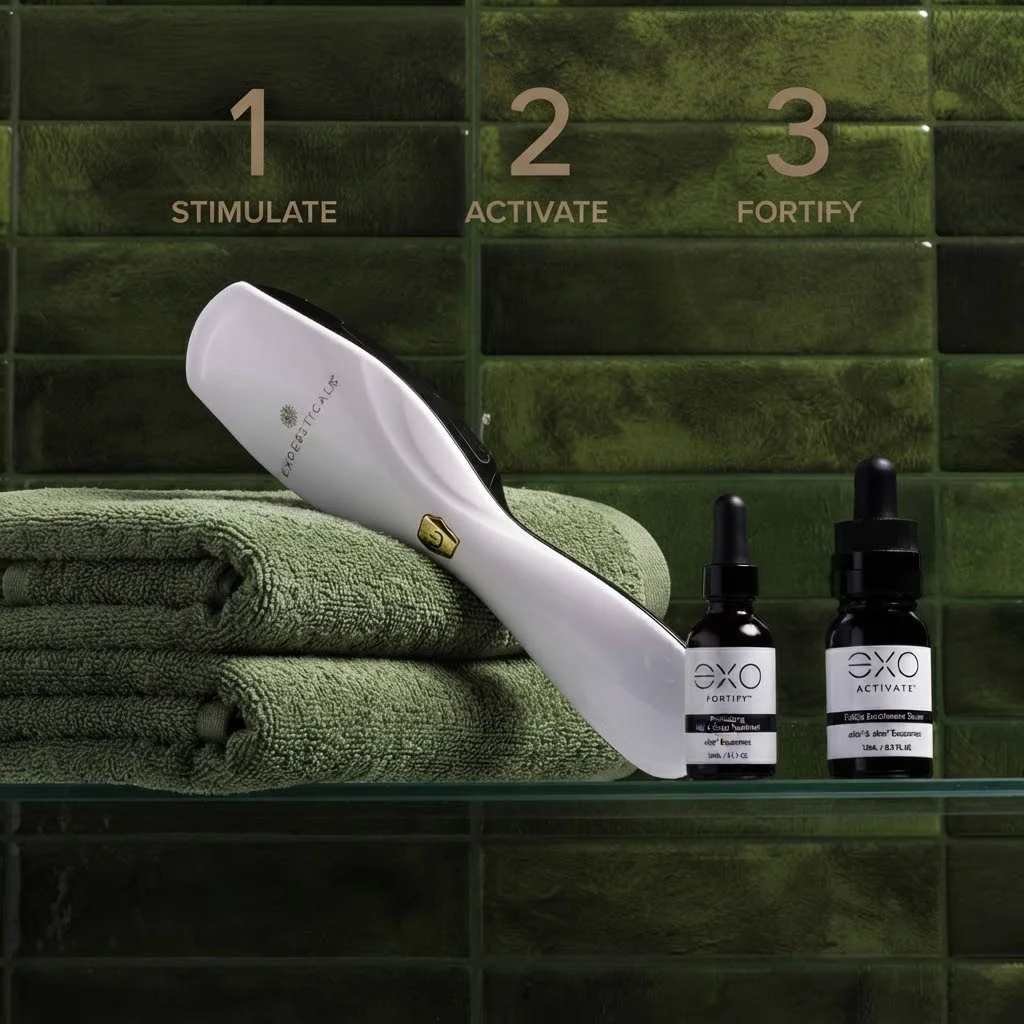
Exoceuticals EXO HAIR Red Light LED Hair Brush combines 650 nm red LED light, 465 nm blue light, soft silicone scalp bristles, and a cordless rechargeable design in one handheld hair-care device. Rather than working like an ordinary detangling brush, it is designed to bring light directly across the scalp while providing gentle mechanical massage.
The manufacturer positions the device primarily for people concerned about thinning-looking hair, shedding, or scalp condition. Current specifications call for treatment sessions of approximately 15 to 20 minutes, up to three or four times per week, with an automatic shut-off at 30 minutes and a rechargeable lithium battery rated by the brand for around one to two weeks between charges.
Within HotScope, the device fits most naturally alongside the broader Hair Care collection rather than ordinary styling brushes because its main purpose is scalp-directed light treatment rather than shaping or detangling hair.
EXO HAIR Red Light LED Hair Brush Features
- Brand: Exoceuticals
- Product type: Handheld LED scalp and hair device
- Red-light wavelength: 650 nm
- Blue-light wavelength: 465 nm
- Scalp contact: Soft silicone bristles
- Design: Cordless handheld brush
- Battery: Rechargeable lithium battery
- Brand-estimated battery duration: Approximately 1–2 weeks between charges
- Typical session: 15–20 minutes
- Suggested frequency: Up to 3–4 sessions per week
- Timer: Automatic shut-off at 30 minutes
- Primary positioning: Thinning-looking hair, hair shedding, scalp care, and androgenetic alopecia
- Topical-care positioning: Manufacturer recommends integrating the brush with its scalp-serum regimen
- Ulta item number: 77000467
The current Ulta listing and Exoceuticals product information agree on the two wavelengths, silicone bristles, treatment duration, rechargeable battery, and 30-minute automatic timer.
Why 650 nm Red Light Is The Main Technology To Understand
The most technically important specification is 650 nanometers.
A wavelength tells us where light sits within the electromagnetic spectrum. A 650 nm output falls within the visible red portion and is within the general range used by a number of photobiomodulation and low-level light devices studied for pattern hair loss.
Photobiomodulation is not the same thing as heating the scalp. The aim is to expose tissue to relatively low-intensity light so that cellular processes may respond without the thermal tissue effects associated with high-powered medical lasers.
The American Academy of Dermatology’s overview of red light therapy notes that randomized controlled studies have shown some hair regrowth, thickness, and length improvements with repeated red-light treatment in people with hereditary hair loss. It also emphasizes that results vary and not everyone experiences regrowth.
More specifically, a 2025 controlled study indexed by the National Library of Medicine on 650 nm photobiomodulation found improved hair-density measurements in its 650 nm treatment group over follow-up compared with the control group. That study evaluated photobiomodulation generally, however, not this particular EXO HAIR brush.
That distinction prevents a common ecommerce mistake: evidence supporting a wavelength or treatment category should not automatically be converted into a guaranteed result for every device using that wavelength.
Red Light Evidence Is Most Relevant To Pattern Hair Loss
The research around low-level red light is strongest for specific forms of hair loss, particularly androgenetic alopecia, often called male-pattern or female-pattern hair loss.
A systematic review and meta-analysis of randomized trials has evaluated home-use low-level light devices for pattern hair loss, while the American Academy of Dermatology describes at-home laser and light devices as promising options for some patients with hereditary thinning.
The important word is some.
Hair loss is not one single condition. Sudden shedding, nutritional deficiency, scalp disease, medication-related shedding, alopecia areata, traction-related loss, hormonal changes, and hereditary pattern loss can have very different causes.
The AAD’s hair-loss diagnosis and treatment guidance explains that identifying the cause is important before deciding which treatment is appropriate. At-home light devices may have a role for some people, but studies have not established that they solve every form of shedding or thinning.
Someone looking for supporting cosmetic scalp care within HotScope can compare the device with Hair Tonic Revitalizing. A tonic and an LED device work through completely different mechanisms, so they should not be treated as interchangeable simply because both are marketed toward scalp and thinning-hair concerns.
What The 465 nm Blue Light Adds
EXO HAIR also contains a 465 nm blue-light mode.
Exoceuticals says this wavelength is intended to improve scalp condition and create a healthier environment for hair. That claim should be separated from the evidence supporting red-light photobiomodulation for androgenetic alopecia.
The stronger clinical hair-regrowth literature currently centers on red and low-level laser or LED wavelengths rather than establishing 465 nm blue light as an equivalent hair-regrowth treatment.
For this reason, the blue-light component is more appropriately described as a scalp-care feature claimed by the manufacturer, while the 650 nm red-light component has the clearer connection to the wider hair-growth photobiomodulation literature.
This distinction gives shoppers a more technically accurate picture than combining both wavelengths under one broad “hair growth light” claim.
Silicone Bristles Help Bring The Device Closer To The Scalp
Hair itself can interfere with light reaching the scalp, particularly when hair is dense or long.
The brush format addresses that practical problem by using soft silicone bristles that move through sections of hair while helping position the device closer to the scalp. Exoceuticals specifically describes the bristles as designed to massage gently without encouraging tangling or breakage.
This makes EXO HAIR different from a stationary helmet or cap. A helmet provides broad fixed coverage, whereas a handheld brush lets the user spend more time around selected areas.
That flexibility also means consistency of coverage depends more heavily on the person holding the device. Moving rapidly across the scalp may expose an area differently from holding the brush consistently over each section.
Commercial light devices can also differ substantially in LED number, irradiance, energy dose, distance from the scalp, beam geometry, and session duration. Wavelength alone therefore does not tell the complete story about treatment performance.
Treatment Routine And Session Timing
The manufacturer’s current instructions call for using the brush on a clean scalp that can be dry or damp, then moving it gently across the scalp in small circular motions or along the hair. Treatment is specified at approximately 15 to 20 minutes per session, up to three or four times each week.
The device shuts itself off automatically at 30 minutes, adding a practical limit if a session runs longer than intended.
Regularity matters more with photobiomodulation than with an ordinary styling brush. The AAD notes that at-home red-light treatment is not a one-time procedure and usually requires repeated sessions over time. Results can also take months rather than days to become apparent.
That means the brush is better suited to someone prepared for a consistent routine than someone expecting an immediate cosmetic transformation after one treatment.
Scalp cleansing also remains a separate part of that routine. Shoppers can compare cleansing formulas through HotScope’s Shampoo & Conditioner collection, particularly if styling buildup or excess oil makes it difficult to expose the scalp evenly.
Hair Growth And Instant Volume Are Different Goals
An LED scalp device should not be evaluated in the same way as a volumizing shampoo.
A volumizing cleanser can change the immediate appearance of hair by removing oil, reducing coating, or improving the way strands separate and lift. Photobiomodulation is intended to interact with biological processes around the follicle and therefore works on a much longer timeline.
HotScope’s Bamboo and Hibiscus Volumizing Shampoo illustrates the difference well. That product is designed around cleansing and fuller-looking hair after washing, whereas EXO HAIR is a repeated scalp-device treatment.
A shampoo can make hair appear more voluminous without increasing follicle count. Likewise, an LED device should not be expected to provide immediate styling lift simply because its longer-term marketing mentions thicker-looking hair.
The Topical Absorption Claim Needs Context
Exoceuticals promotes EXO HAIR as part of a larger regimen and states that the brush can help optimize the application or absorption of its scalp treatments.
That claim deserves more cautious wording on an independent product page.
The published evidence supporting low-level light therapy and hair growth does not automatically prove that this particular brush meaningfully increases delivery of every topical serum applied afterward. Absorption depends on the formulation, ingredient, skin barrier, application method, and other variables.
It is therefore more accurate to say that the manufacturer designed the brush to be paired with topical scalp products rather than promising that it will make unrelated hair serums substantially more effective.
The light therapy remains the device’s primary technically interesting feature.
FDA Language Should Be Used Carefully
The current Exoceuticals description uses the phrase “FDA-approved red LED technology.” That wording should not automatically be rewritten as “the EXO HAIR brush is FDA approved.”
The FDA distinguishes between several medical-device pathways. Its device approvals and clearances guidance explains that a 510(k) clearance is a substantial-equivalence pathway, whereas Premarket Approval, or PMA, is a different and more stringent approval route.
Numerous home-use light devices for hair regrowth have received FDA clearance, and the AAD specifically notes the availability of FDA-cleared combs, caps, and helmets.
However, a search of the FDA materials available under the exact EXO HAIR / EXO LIGHT BRUSH / Exoceuticals names did not surface a product-specific clearance number that could be reliably tied to this exact retail device.
For a HotScope listing, the safer wording is therefore to describe the 650 nm red LED technology and the manufacturer’s regulatory claim without independently labeling the exact brush FDA-cleared or FDA-approved unless Exoceuticals provides the relevant device number.
A Rechargeable Device Rather Than A Corded Treatment Tool
EXO HAIR uses a rechargeable lithium battery, allowing treatment without keeping the brush connected to a wall outlet.
The manufacturer estimates one to two weeks of operation per charge, although actual battery endurance can vary with session length, frequency, battery age, and charging habits.
The cordless format makes it easier to move systematically across the scalp, particularly around the crown and back of the head.
It also means the device should be treated as electronic equipment rather than cleaned like an ordinary waterproof hair brush unless the supplied manual specifically states otherwise. The electrical housing and charging components should be handled according to the manufacturer’s current care instructions.
Light Therapy Does Not Replace Gentle Hair Care
A light-based device can address a different part of a hair-care routine, but repeated mechanical damage can still undermine the appearance of fragile hair.
Aggressive detangling, tight hairstyles, excessive heat, chemical processing, and rough handling can cause breakage independently of what is happening inside the follicle.
The soft silicone bristles on EXO HAIR are therefore a useful design choice, but they do not make pulling or forceful brushing harmless.
Hair that is already thinning or fragile benefits from controlled handling around the scalp and lengths. The brush should glide rather than catch, and areas with active irritation, wounds, or significant scalp discomfort deserve more caution than routine massage.
Safety And Light Sensitivity
The American Academy of Dermatology describes short-term red-light treatment as generally safe, with temporary irritation or mild discomfort among the reported effects. Long-term effects of repeated home red-light use are still being studied.
Extra care is appropriate for people with medical conditions that cause photosensitivity or who use medications that increase sensitivity to visible light. AAD guidance recommends discussing home red-light treatment with a dermatologist in those situations.
Eye protection should follow the device’s own instructions. If the current EXO HAIR manual specifies protective eyewear, that instruction should be followed rather than substituting ordinary sunglasses.
A painful, increasingly irritated, or otherwise abnormal scalp reaction is not evidence that the light is working and should not simply be ignored.
Realistic Expectations Matter With An LED Hair Device
The strongest reason to consider EXO HAIR is not that light therapy guarantees hair restoration. It is that the device packages an established area of photobiomodulation research into a targeted, handheld format.
Red-light research provides reasonable evidence that repeated low-level light exposure may improve hair measures in some people with pattern hair loss. The research also makes clear that response differs between individuals and that devices are not interchangeable simply because they emit red light.
The AAD notes that even FDA-cleared home light devices will not restore a completely full head of hair for every person, and identifying the underlying cause of hair loss remains important.
That context is particularly important when a product is marketed around shedding caused by multiple situations. A device studied primarily through the broader androgenetic-alopecia evidence base should not automatically be presented as proven for every temporary, hormonal, inflammatory, medication-associated, or nutritional cause of shedding.
What Makes EXO HAIR Red Light LED Hair Brush Different
EXO HAIR combines several technologies that would normally appear in separate scalp tools. Its 650 nm red LEDs provide the photobiomodulation component, 465 nm blue light adds the manufacturer’s scalp-care mode, and soft silicone bristles create physical scalp contact while helping move hair away from the treatment area. A rechargeable battery and 30-minute automatic shut-off make the design suitable for repeated home sessions.
The 650 nm wavelength is its most evidence-relevant specification. Red-light and low-level light studies suggest potential benefits for some forms of hereditary pattern hair loss, but those findings should be viewed as support for the treatment category rather than proof that every person using this exact brush will achieve the same result.
For shoppers building a broader scalp routine, HotScope’s Hair Tonic Revitalizing represents a topical approach, while the Hair Care collection covers the cleansing, conditioning, and cosmetic side of maintaining the strands themselves.
Final Note
EXO HAIR Red Light LED Hair Brush is best understood as a rechargeable at-home photobiomodulation and scalp-care device, not simply a premium hair brush. The combination of 650 nm red light, 465 nm blue light, silicone massage bristles, a cordless battery, repeated 15-to-20-minute sessions, and automatic timing gives it a more technical role than an ordinary styling accessory.
The strongest independent evidence relates to red and low-level light therapy for androgenetic or pattern hair loss. The blue-light scalp claims and promises about enhanced topical absorption should be treated more cautiously unless stronger product-specific clinical data becomes available.
For a shopper comparing scalp devices, the most useful questions are therefore not simply whether a brush “uses red light,” but which wavelength it produces, how consistently it reaches the scalp, what condition the evidence actually covers, what session schedule is required, and whether the regulatory claim can be verified for the exact device being sold.
:::


Reviews
There are no reviews yet.