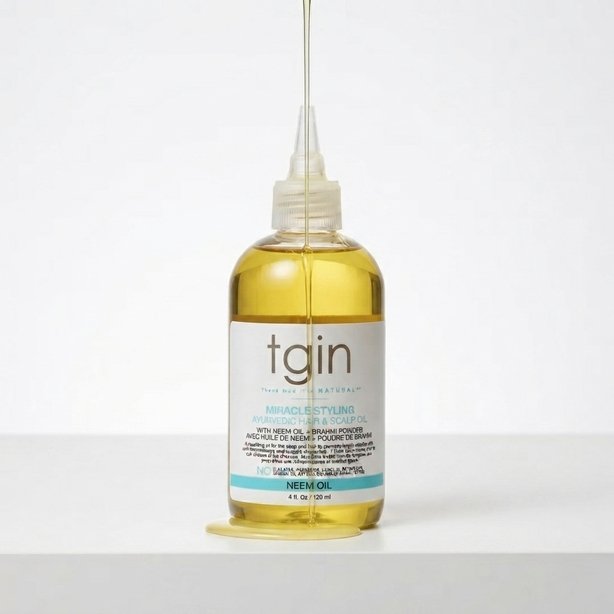
Miracle Styling Ayurvedic Hair & Scalp Oil
tgin Miracle Styling Ayurvedic Hair & Scalp Oil is a 4 oz multi-oil treatment for both the scalp and hair lengths, built around avocado, sesame, castor, neem and grapeseed oils with brahmi and amla powders, tea tree oil and green tea extract. tgin positions it for moisturizing dry hair, improving softness and shine, conditioning the scalp and helping rough or frizzy sections feel more manageable.
The formula is especially interesting because it is not simply a bottle of one carrier oil. The first four ingredients are avocado oil, sesame seed oil, castor seed oil and neem seed oil, followed by a mixture of botanical extracts, powders and supporting ingredients. That creates a richer styling oil than a lightweight silicone serum while still allowing small amounts to be distributed selectively through dry areas.
Within HotScope, it fits naturally into the Hair Care collection alongside scalp treatments, conditioners and styling products. Someone primarily interested in leave-on scalp care can also compare the concept with Hair Tonic Revitalizing, while a more complete wash-and-scalp routine is represented by the Healthy Hair Goals Kit. The current HotScope Hair Care category includes both Hair Tonic Revitalizing and Healthy Hair Goals Kit among its scalp and hair-care options.
Miracle Styling Ayurvedic Hair & Scalp Oil Features
- Brand: tgin, Thank God It’s Natural
- Product type: Leave-on hair and scalp oil
- Size: 4 oz
- Primary oils: Avocado, sesame, castor, neem and grapeseed
- Ayurvedic-inspired botanicals: Brahmi powder and amla fruit powder
- Additional botanicals: Tea tree oil, green tea extract, patchouli oil and European larch wood extract
- Supporting ingredients: Glycine, glycerin and zinc chloride
- Primary cosmetic goals: Softness, shine, scalp conditioning, reduced dry feel and smoother-looking frizz
- Hair placement: Scalp and hair lengths
- Sulfates: Formulated without harsh sulfates
- Parabens: Formulated without parabens
- Petrolatum: None according to tgin
- Lanolin: None according to tgin
- Artificial colors: None according to tgin
- Fragrance: Yes
- Cruelty-free positioning: tgin currently describes the product as 100% cruelty-free
- Ulta item number: 2621096
The formula should not be described as fragrance-free or as containing only unprocessed botanical oils. Its current INCI also includes fragrance, Polyester-37, PEG-40 Hydrogenated Castor Oil and a small water phase.
Five Oils Form The Main Conditioning Base
Most of the bottle is structured around oils rather than water.
Avocado oil appears first, followed by sesame seed oil, castor seed oil and neem seed oil. Grapeseed oil appears later in the ingredient declaration.
This matters because oils primarily influence the physical behavior of hair rather than hydrating it in exactly the same way as a water-based conditioner. An oil layer can reduce friction, increase slip and create a smoother, shinier surface.
A scientific review of hair cosmetics notes that regularly applying suitable oils can improve lubrication of the hair shaft and help reduce breakage caused by friction.
That is a more useful explanation of this product than saying oil “feeds” dead hair fibers. Once hair has emerged from the scalp, the visible shaft is keratinized material. Oils can coat and protect that fiber, but they do not biologically regenerate it.
For someone whose curls need substantial rinse-out conditioning in addition to oil, HotScope’s CURLBOND Re-Coiling Cream Conditioner provides a different approach centered on conditioning and damaged curl management. The product is currently listed within HotScope’s Hair Care inventory.
Avocado Oil Gives The Blend A Rich Emollient Start
Avocado oil being first on the list tells us more about the formula than many of the hero ingredients printed on the front.
Plant oils are mixtures of triglycerides and fatty acids, and their immediate cosmetic advantage on hair is largely lubrication and emollience. A lubricated hair surface can feel smoother and may experience less friction when neighboring strands move against each other.
That is particularly relevant for curly, coily, coarse or damaged hair, where tangling and friction can contribute to breakage.
The American Academy of Dermatology recommends matching hair-care products to hair type and specifically notes that dry, curly and thick hair often benefits from more conditioning than fine or oily hair.
This does not mean avocado oil automatically suits every scalp. Someone whose roots become oily very quickly may need much less product at the scalp than someone with dry, tightly textured hair.
Sesame And Castor Oils Make The Texture More Substantial
Sesame oil and castor oil appear directly after avocado oil.
Castor oil is particularly viscous, so its presence helps explain why this product behaves more like a nourishing styling oil than an extremely dry, fast-disappearing finishing serum.
That richer character can be useful on dry ends, twists, braids or frizz-prone sections where a small amount of added slip helps the style feel smoother.
It can also become too much when applied heavily to fine hair.
More oil is not automatically more conditioning. Excess oil can cause strands to group together, reduce visible volume and increase the amount of residue that eventually needs to be shampooed away.
A hair oil therefore works best when its amount is adjusted to hair density, texture, porosity and current dryness rather than used at one fixed quantity for everyone.
Neem Oil Is Central To The Product Story
tgin specifically highlights Azadirachta indica seed oil, or neem oil, as one of the defining ingredients. The brand describes it around scalp conditioning and a fresher-feeling scalp.
Neem has a long history within traditional South Asian practices and has also been studied for a range of biological properties.
The important limitation is that research on neem compounds or traditional preparations does not automatically prove that this specific cosmetic hair oil treats dandruff, scalp infection, dermatitis or hair loss.
tgin’s own ingredient-level language is more appropriately cosmetic: neem conditions the scalp and contributes to softer, smoother, more manageable hair.
That is the stronger product-page position. Persistent scalp scaling, sores, painful inflammation or suspected infection should not be reframed as something a cosmetic neem oil is proven to cure.
Brahmi Powder Gives The Formula Its Most Recognizable Ayurvedic Ingredient
Bacopa monnieri leaf powder, commonly called brahmi, appears in the formula alongside Emblica officinalis fruit powder, or amla.
These botanical materials help explain the “Ayurvedic” part of the product name.
Ayurveda is a traditional medical system originating in India that incorporates herbal preparations alongside diet, lifestyle and other practices. The U.S. National Center for Complementary and Integrative Health notes that Ayurveda has a long history, but also emphasizes that good-quality clinical evidence remains limited for many claimed health applications. NCCIH’s overview of Ayurvedic medicine provides useful context.
For this product, “Ayurvedic” should therefore describe the inspiration and botanical tradition behind ingredients such as brahmi, amla and neem, rather than being used as proof that the finished oil has been medically shown to stimulate follicles or reverse hair loss.
tgin itself describes brahmi around scalp conditioning and healthy-looking hair rather than presenting it as a drug treatment.
Amla Adds Another Traditional Botanical Powder
Amla is declared as Emblica Officinalis Fruit Powder.
Like brahmi and neem, amla has a long traditional association with hair and scalp preparations, particularly in South Asian hair-oiling practices.
In this formula, however, it occurs after glycerin and several other ingredients rather than forming the main oil base.
That placement matters when evaluating marketing.
The majority of the product’s immediate smoothing and lubricating behavior is more readily explained by the large amounts of avocado, sesame, castor and neem oils than by assuming a small quantity of botanical powder is responsible for every visible result.
This does not make amla irrelevant. It simply keeps its role proportional to the finished formulation.
Tea Tree And Patchouli Make This More Than A Neutral Carrier-Oil Blend
The formula contains tea tree leaf oil and certified-organic patchouli leaf oil, as well as added fragrance.
This means Miracle Styling Ayurvedic Hair & Scalp Oil should not be described as unscented or appropriate for everyone who avoids fragranced scalp products.
Tea tree oil contributes to the fresh, botanical character of many scalp-care formulations, while patchouli adds another aromatic plant-oil component.
For someone with a reactive scalp, these ingredients deserve attention because botanical essential oils are still chemically active fragrance materials. “Natural” does not mean incapable of causing irritation.
Ulta’s current precautions specifically advise avoiding the product on open or irritated skin and recommend a patch test before use.
Green Tea Extract Is A Supporting Ingredient
Camellia sinensis leaf extract, or green tea extract, appears after patchouli oil and before several other botanical ingredients.
Green tea is often marketed around antioxidant compounds, but antioxidant language should not be stretched into claims about guaranteed hair growth.
In a cosmetic scalp oil, green tea is best treated as a supporting botanical ingredient within the larger conditioning blend.
The product does not disclose a standardized catechin concentration or provide product-specific clinical data demonstrating that its green tea extract changes follicle growth.
That distinction is particularly important in scalp-care copy because “supports healthy-looking hair” and “regrows thinning hair” are not interchangeable claims.
This Is Better At Lubrication Than Adding Water
People often use the word moisture for both oils and water-based conditioners, but they do not behave identically.
An oil does not supply a large water phase to dry hair. Instead, it primarily coats, lubricates and slows the loss of existing moisture while changing how the surface feels.
That can still be extremely useful.
A review of indigenous hair-oiling practices describes how oils can coat the hair shaft, increase slip between strands and reduce friction.
For very dry hair, an effective routine may therefore combine water-based cleansing and conditioning with a small amount of oil afterward rather than expecting oil alone to replace shampoo, conditioner and leave-in products.
HotScope’s Shampoo & Conditioner collection provides relevant cleansing and conditioning options to pair with leave-on hair products. The category currently includes moisture, volume, anti-frizz and color-oriented formulas.
Why It Can Make Frizzy Ends Look Smoother
Frizz is partly visual evidence that neighboring fibers are not lying uniformly together.
Damage to the cuticle, humidity, dryness, brushing and friction can all influence how rough or separated individual strands appear.
Hair oils can change that immediately by reducing friction and creating a more continuous reflective surface.
Scientific reviews of hair-shaft damage describe friction as an important contributor to cuticle deterioration and breakage.
That makes tgin’s suggestion to smooth a small amount over dry or frizzy sections technically reasonable. The product is not permanently changing the internal structure of the strand; it is helping the existing fibers behave and look smoother.
The Split-End Claim Should Be Understood As Cosmetic Protection
tgin currently says Miracle Styling Ayurvedic Hair & Scalp Oil helps reduce split ends.
That phrase is more defensible when interpreted as helping reduce the friction and damage that contribute to future splitting.
Once a hair shaft has physically split into separate ends, an oil cannot permanently fuse the fiber back to its original undamaged state.
Hair cosmetics can coat damaged areas and make split ends look smoother temporarily. Reduced friction can also make additional breakage less likely.
Research on hair cosmetics supports the broader idea that lubrication from oils and conditioners can help protect the shaft from mechanical damage.
Extensively split ends ultimately need trimming if the damaged portion is to be physically removed.
Scalp Oil Does Not Replace Scalp Cleansing
A leave-on scalp oil and scalp hygiene perform different jobs.
The CDC explains that the scalp naturally produces sebum and can also accumulate sweat, dead skin and product residue. Regular washing remains important for controlling buildup. CDC hair and scalp hygiene guidance recommends washing according to the needs of the hair and scalp rather than relying on styling products alone.
This is particularly relevant when an oil is used regularly.
Avocado, sesame, castor and neem oils all add material to the scalp. Eventually, that material needs to be removed along with ordinary sebum and styling residue.
Someone who repeatedly adds scalp oil without cleansing may end up with more buildup rather than a more comfortable scalp.
The oil is therefore best thought of as conditioning between or after cleansing, not as a substitute for hygiene.
Protective Styles Need More Than Oil
tgin says the oil can be used with any hairstyle, which makes it particularly easy to position around braids, twists, locs and other protective or longer-wear styles.
There is an important limitation when a style feels uncomfortable, however.
Oil can reduce dry feel and improve surface slip, but it cannot make excessive mechanical tension harmless.
The American Academy of Dermatology warns that continuously tight braids, cornrows, extensions, buns and ponytails can cause traction alopecia, a form of hair loss caused by repeated pulling.
If a style causes persistent pain or significant pulling, the appropriate response is to reduce the tension rather than simply adding more scalp oil. The AAD specifically advises loosening styles that hurt or feel excessively tight.
That makes tgin’s “eases tension” wording better understood as a soothing or conditioning sensory claim, not proof that the oil protects follicles from an overly tight hairstyle.
Applying The Oil Without Making Hair Feel Heavy
tgin’s current directions begin with shaking the bottle, which makes sense because the formula contains botanical powders and a small water-containing phase in addition to its oils.
The brand then recommends parting the hair and massaging a few drops onto the scalp. A small amount can also be smoothed through dry or frizzy portions of the hair for shine and a more conditioned finish.
Starting with a small quantity is particularly sensible with this formula because castor, sesame, avocado and neem oils create a substantial lipid base.
Fine hair may need only a very small amount through the ends. Thick, tightly coiled or highly porous hair may tolerate more.
The objective is enough product to improve slip and softness without leaving the hair saturated or making the roots appear greasy.
It Can Fit Between Wash Days Without Becoming A Wash-Day Replacement
For textured hair that is not shampooed every day, a small amount of scalp or hair oil can be used between wash days to refresh dry-feeling areas.
The AAD notes that washing frequency should be based on hair type. Dry, curly and thick hair often needs washing less frequently than oily straight hair, although the scalp should still be cleansed as needed.
That context makes a 4 oz leave-on oil practical for targeted maintenance.
The important part is monitoring the scalp rather than following a rigid oiling schedule. If the roots begin feeling coated, itchy or excessively oily, simply adding another layer of oil may make the problem worse.
It Is Not A Proven Hair-Growth Treatment
The combination of neem, brahmi, amla, castor oil and scalp massage can easily lead to stronger marketing claims than the evidence supports.
Miracle Styling Ayurvedic Hair & Scalp Oil does not contain a drug active identified on its current label for treating pattern hair loss, and tgin markets it as a cosmetic hair and scalp oil.
Its credible benefits center on conditioning, lubrication, softness, shine, reducing dry feel and helping protect the hair shaft from mechanical stress.
Someone dealing with unexplained thinning should not assume a botanical oil can identify or treat the cause. Hair loss can have many causes, and the American Academy of Dermatology recommends professional evaluation when significant thinning or shedding is occurring.
For shoppers who are more interested in scalp-focused cosmetic care than styling oil, HotScope’s Healthy Hair Goals Kit provides a shampoo, conditioner and leave-on scalp-serum approach rather than a predominantly oil-based one. Its presence in HotScope’s current Hair Care inventory makes it a useful comparison.
Full Ingredient Profile
The current manufacturer ingredient declaration is:
Persea Gratissima (Avocado) Oil, Sesamum Indicum (Sesame) Seed Oil, Ricinus Communis (Castor) Seed Oil, Azadirachta Indica Seed Oil, Pogostemon Cablin Leaf Oil, Camellia Sinensis Leaf Extract, Larix Europaea Wood Extract, Melaleuca Alternifolia (Tea Tree) Leaf Oil, Vitis Vinifera (Grape) Seed Oil, Glycine, Glycerin, Emblica Officinalis Fruit Powder, Bacopa Monnieri Leaf Powder, Zinc Chloride, Polyester-37, PEG-40 Hydrogenated Castor Oil, Water and Fragrance. tgin identifies the patchouli leaf oil as a certified-organic ingredient.
The ingredient list also resolves several useful purchasing questions. The product is not fragrance-free, is not a simple single-oil treatment and contains both botanical powders and conventional formulation ingredients.
Because hair products can be reformulated, the bottle being purchased should remain the final ingredient reference for allergies or sensitivities.
What Makes Miracle Styling Ayurvedic Hair & Scalp Oil Different
The most distinctive part of this tgin formula is its combination of traditional botanical inspiration with a genuinely oil-heavy styling base.
Avocado, sesame, castor and neem oils make up the beginning of the ingredient list. Grapeseed oil adds another lighter emollient later in the formula. Brahmi and amla powders connect the product with traditional Ayurvedic hair-care ingredients, while tea tree, green tea and patchouli add to its botanical scalp-care identity.
At the same time, the formula remains a modern cosmetic rather than a traditional herbal preparation. It contains glycerin, Polyester-37, PEG-40 Hydrogenated Castor Oil, water and added fragrance alongside the plant ingredients.
That distinction is useful when comparing it with HotScope’s Hair Tonic Revitalizing. A tonic or scalp serum typically prioritizes a lighter leave-on treatment texture, while Miracle Styling Ayurvedic Hair & Scalp Oil is better suited to shoppers who specifically want oil-based lubrication, softness and shine.
Final Note
tgin Miracle Styling Ayurvedic Hair & Scalp Oil is best understood as a 4 oz botanical styling and scalp-conditioning oil, not as a medical hair-growth product.
Its foundation of avocado, sesame, castor, neem and grapeseed oils gives it a credible role in improving lubrication, softness, shine and manageability. Research on hair cosmetics supports the broader principle that oils can reduce friction along the hair shaft and help limit mechanical breakage.
Brahmi, amla and neem give the formula its Ayurvedic-inspired identity, but the scientific evidence should remain separate from the tradition. NCCIH notes that evidence for many Ayurvedic health applications remains limited, so the presence of traditional botanical ingredients should not be translated into unsupported promises of follicle stimulation or guaranteed hair regrowth.
For dry, frizzy, textured or protective-styled hair, the strongest reason to consider Miracle Styling Ayurvedic Hair & Scalp Oil is simpler: a concentrated mix of conditioning oils that can be used selectively on the scalp and through rough or dry-feeling lengths, while regular cleansing, gentle styling and avoiding excessive tension remain essential parts of maintaining healthy-looking hair.
:::

Reviews
There are no reviews yet.