Healthy Hair Goals Kit
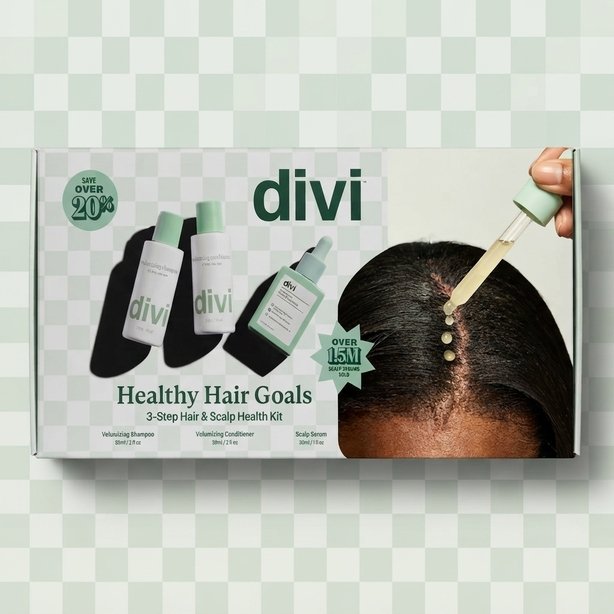
Divi Healthy Hair Goals Kit brings together three complementary products for people interested in lightweight volume, scalp care, and fuller-looking hair rather than heavy repair or intensive moisture. The set contains a 2.0 oz Volumizing Shampoo, 2.0 oz Volumizing Conditioner, and 1.0 oz Scalp Serum, creating a compact routine that moves from scalp cleansing to lightweight conditioning and then to leave-on scalp care.
The kit is especially relevant to fine, thin, flat, or thinning-looking hair because the shampoo and conditioner are designed to avoid the heavy residue that can collapse volume, while the serum focuses on the appearance of fullness and scalp condition. Divi currently markets the set as paraben-, SLS-, and SLES-free, and the products are made in the United States with globally sourced ingredients.
For shoppers comparing different approaches to volume and scalp care, HotScope’s Hair Care collection provides a broader selection, while the Shampoo & Conditioner category is useful when the leave-on scalp-serum step is not needed.
Healthy Hair Goals Kit Features
- Brand: Divi
- Product type: Three-piece scalp and volumizing hair-care kit
- Included shampoo: Volumizing Shampoo, 2.0 oz
- Included conditioner: Volumizing Conditioner, 2.0 oz
- Included scalp treatment: Scalp Serum, 1.0 oz
- Primary concerns: Flat hair, fine hair, visible thinning, scalp dryness, oil or product buildup, and lack of volume
- Volumizing Shampoo highlights: Hydrolyzed rice protein, green tea extract, microalgae, caffeine, biotin, peppermint oil, tea tree oil, and Lactobacillus ferment
- Volumizing Conditioner highlights: Rice protein, olive leaf extract, tea tree oil, rosemary leaf extract, panthenol, caffeine, biotin, and lightweight conditioning agents
- Scalp Serum highlights: Acetyl tetrapeptide-3, copper tripeptide-1, caffeine, hyaluronic acid, amino acids, tea tree oil, peppermint oil, rosemary extract, and green tea extract
- Parabens: Divi markets the kit as paraben-free
- SLS/SLES: Free from SLS and SLES according to the current product information
- Color-treated hair: The current Volumizing Conditioner is described as color-safe
- Dermatologist-tested: Claimed for the current conditioner
- Scalp Serum format: Lightweight leave-on liquid
- Retail item number: 2628876
The three products perform different jobs, which is one of the better aspects of the kit. The shampoo does most of the cleansing, the conditioner reduces friction and improves softness, and the serum remains on the scalp after washing rather than being rinsed away.
The Kit Is More About Volume Than Heavy Moisture
A person with very dry, coarse hair may look at a three-product kit and assume it is a complete moisturizing routine. That is not really what Divi has built here.
The Volumizing Shampoo and Conditioner are designed around fine, thin, or flat hair that needs body without excessive weight. Divi specifically describes the conditioner as providing lightweight hydration and helping hair remain soft without sacrificing bounce.
That makes the set quite different from a rich dry-hair routine. Someone whose main issue is dehydration rather than flatness may find HotScope’s Wellness Premium Hydration Conditioner more relevant as a heavier conditioning comparison.
The Healthy Hair Goals Kit makes more sense when the concern is a combination of scalp care, visible thinning, and lack of body.
The Volumizing Shampoo Uses Several Cleansers Instead Of SLS Or SLES
The shampoo does not contain sodium lauryl sulfate or sodium laureth sulfate, but that does not mean it contains no cleansing surfactants.
Its current ingredient list begins with cocamidopropyl betaine, sodium C14-16 olefin sulfonate, sodium cocoyl isethionate, and sodium cocoyl glutamate after water.
These ingredients provide the actual cleansing action that removes scalp oil, sweat, and styling residue.
This distinction is useful because “SLS/SLES-free” is sometimes interpreted as automatically meaning exceptionally mild. Sodium C14-16 olefin sulfonate can still provide substantial cleansing, so how the shampoo feels will depend on the complete surfactant blend, wash frequency, hair texture, and scalp condition.
The FDA’s information on hair-cleansing products also notes that shampoos and conditioners can occasionally be associated with reactions such as itching, rash, breakage, or other adverse effects, which is why tolerance matters more than a single free-from claim.
For a different volumizing shampoo format already available through HotScope, Bamboo and Hibiscus Volumizing Shampoo offers another route for people comparing body-focused cleansers.
Rice Protein Supports The Fuller-Hair Positioning
Hydrolyzed rice protein appears in both the shampoo and conditioner.
Hydrolyzed proteins are broken into smaller fragments so they can be incorporated into cosmetic formulas more easily. On hair, they can contribute to film formation, improve feel, and temporarily make strands behave as though they have more body.
That cosmetic effect is particularly relevant to fine hair because volume does not always require producing additional hairs. Making existing fibers feel slightly more substantial, reducing oily collapse, and improving separation can all influence how full the hairstyle appears.
This is why it is important to distinguish volumizing existing hair from medically treating hair loss.
A shampoo or conditioner can make hair look fuller without changing the number of active follicles on the scalp.
The Conditioner Uses Lightweight Conditioning Agents Instead Of Heavy Oils
The Volumizing Conditioner begins with cetearyl alcohol, propanediol, behentrimonium chloride, C13-15 alkane, polyquaternium-37, and cetrimonium chloride.
This is a recognizable conditioner architecture.
Cetearyl alcohol helps create cream structure and softness, while behentrimonium chloride and cetrimonium chloride are cationic conditioning ingredients that help improve slip and combability.
Divi also includes Silicone Quaternium-3, so the conditioner should not be described as silicone-free.
That is worth noting because volumizing conditioners are sometimes marketed as though all silicones necessarily flatten hair. Here, Divi uses a silicone conditioning ingredient inside a formula that the company still positions as lightweight.
The practical question is therefore not whether one ingredient category is universally good or bad, but whether the finished conditioner leaves a particular person’s hair soft without creating unwanted heaviness.
Olive Leaf, Rosemary And Tea Tree Play Supporting Roles
Divi highlights olive leaf extract, rosemary leaf extract, and tea tree oil in the conditioner.
Olive leaf is positioned primarily around softness and hydration, while rosemary contributes antioxidant-related botanical support. Tea tree oil appears in both the wash products and the scalp serum and is used in the line around scalp freshness and buildup.
These ingredients should not overshadow the main functional parts of the formula.
The conditioner still obtains much of its immediate detangling effect from fatty alcohols, quaternary conditioning agents, polymers, and silicone. The shampoo still relies on surfactants to cleanse. The serum still relies on a combination of humectants, peptides, caffeine, botanical oils, and amino acids.
That whole-formula perspective gives a more realistic picture than presenting one botanical extract as responsible for all of the results.
The Scalp Serum Is The Most Distinctive Product In The Set
The Volumizing Shampoo and Conditioner are fairly conventional hair-care products with a scalp-focused ingredient story. The Scalp Serum is what changes the kit from a normal wash duo into a more specialized routine.
Its current formula contains glycerin, acetyl tetrapeptide-3, copper tripeptide-1, caffeine, sodium PCA, sodium lactate, arginine, hyaluronic acid, multiple amino acids, tea tree oil, peppermint oil, eucalyptus oil, rosemary extract, green tea extract, copper gluconate, and vitamin C.
This creates a very different formula from a rinse-off conditioner.
The serum remains on the scalp, giving its humectants and conditioning ingredients much longer contact with the skin than a shampoo that is rinsed away shortly after application.
For shoppers primarily interested in a leave-on scalp treatment rather than a complete kit, HotScope’s Hair Tonic Revitalizing provides a useful category comparison.
Divi’s Clinical Claim Applies To The Serum, Not The Entire Kit
This distinction is important.
Divi describes its Scalp Serum as clinically tested and says it can improve the appearance of hair fullness and density in as little as six weeks. The company’s current study information reports that after 12 weeks of daily serum use, 90% of 31 participants reported improved-looking fullness, 87% reported greater-looking density, and 82% said their scalp felt less dry. These were results from a user self-assessment questionnaire in an independent 31-subject study.
Those details make the claim more informative, but they also show its limits.
The percentages describe participants’ assessments of how their hair and scalp looked or felt. They are not the same as a large independent medical trial demonstrating new follicle formation or establishing treatment for androgenetic alopecia.
The six-week and twelve-week claims also belong to the serum’s tested routine. They should not be attached automatically to the shampoo or conditioner individually.
Caffeine Has Some Research Behind It, But It Is Not The Same As A Hair-Loss Drug
Caffeine appears in all three products, although the leave-on serum gives it the most obvious role because of the longer scalp contact time.
Research into topical caffeine and hair is developing. A 2025 systematic review indexed by the National Library of Medicine found generally positive results across available topical-caffeine studies, but the authors also noted important limitations in the evidence base.
This does not make a caffeine serum interchangeable with approved medical treatments for hair loss.
The FDA distinguishes ordinary cosmetic claims from products intended to affect the structure or function of the body. FDA guidance on cosmetics versus drugs explains why claims such as cleansing or improving appearance are treated differently from claims to treat a medical condition or regrow hair.
For this kit, phrases such as fuller-looking, denser-looking, volumizing, scalp-conditioning, and reduced appearance of thinning are much more appropriate than claiming that it cures hair loss.
Copper Tripeptide-1 And Acetyl Tetrapeptide-3 Need Similar Restraint
The serum contains both Copper Tripeptide-1 and Acetyl Tetrapeptide-3, which help give it its peptide-focused identity.
Peptides are small chains of amino acids, but not all cosmetic peptides work in the same way or have the same clinical evidence.
Copper tripeptide-1 is used widely in cosmetic formulas for skin- and scalp-conditioning purposes. Acetyl tetrapeptide-3 also appears in commercial scalp treatments marketed for thinning-looking hair.
However, seeing the word peptide on an ingredient list is not proof that the finished product regenerates follicles.
The product-specific evidence matters more than assumptions made from individual ingredients, which is why Divi’s small independent consumer study is more relevant to this exact serum than broad statements about what peptides theoretically might do.
Hyaluronic Acid, Sodium PCA And Amino Acids Support The Scalp Barrier
The Scalp Serum contains a substantial hydration system that receives less attention than the peptides and caffeine.
Glycerin, sodium PCA, sodium lactate, hyaluronic acid, PCA and multiple amino acids all contribute to the conditioning and moisture-supporting side of the formula.
That matters because a scalp serum does not need to generate new hair to have a useful cosmetic function.
A scalp that feels less tight, dry, or flaky can simply be more comfortable to maintain. Divi’s own study found that 82% of participants reported a less-dry feeling scalp after 12 weeks.
A comfortable scalp environment can also make it easier to maintain regular cleansing without repeatedly scratching or disturbing the skin.
Peppermint, Tea Tree And Eucalyptus Give The Serum Its Tingle
The serum contains peppermint oil, tea tree oil, eucalyptus oil, and menthol.
These ingredients explain the cooling or tingling sensation Divi describes.
That sensation should not be mistaken for proof that hair follicles are being stimulated or that the product is “working harder.” Cooling receptors in the skin can create a very noticeable sensory response even without indicating a measurable change in hair growth.
The formula also contains fragrant botanical materials, so someone with a scalp that is highly reactive to essential oils should pay attention to tolerance.
Divi itself advises discontinuing use if irritation develops.
Persistent itching, burning, scaling, or unexplained shedding should not simply be treated with progressively more scalp serum. The American Academy of Dermatology’s hair-loss guidance recommends proper evaluation because different forms of thinning can have very different causes and treatments.
Putting The Three-Step Routine Together
The wash routine begins with the Volumizing Shampoo concentrated primarily around the scalp, where oil and product buildup accumulate.
The conditioner then belongs mainly through the mid-lengths and ends. Divi’s current instructions recommend leaving it on briefly before rinsing rather than applying a heavy layer over the roots.
The Scalp Serum is the leave-on stage. It is applied directly to the scalp rather than used like a traditional hair oil through the lengths. Divi’s current full-size serum directions specify once-daily application to wet or dry scalp and leaving it in rather than rinsing it away.
This separation is useful because the three products do not compete for the same job.
The shampoo cleans the scalp, the conditioner reduces friction through the hair, and the serum provides prolonged scalp contact.
Fine Hair Benefits From Conditioning Too
Fine hair is sometimes under-conditioned because people worry that any conditioner will destroy volume.
That can create a different problem. Hair that tangles easily can experience greater friction and breakage during combing.
The American Academy of Dermatology’s recommendations for managing hair loss advise using conditioner after shampoo because coating the strand can reduce breakage and split ends.
Divi’s conditioner is designed around that balance.
It contains enough conditioning material to improve slip and softness while avoiding the heavy oil-and-butter architecture common in rich masks for coarse hair.
For people whose hair actually needs heavier conditioning, Wellness Premium Hydration Conditioner provides a useful contrast with a more moisture-centered formula.
The Kit Can Improve The Appearance Of Volume In Several Different Ways
“Volume” in this kit does not come from one single mechanism.
The shampoo removes oil and residue that can pull fine strands together. Rice protein can influence the feel and body of the fibers. The conditioner helps the strands remain manageable without relying on a very rich formula. The serum then targets the scalp and the visible appearance of density over continued use.
This multi-step approach explains why the Healthy Hair Goals Kit can make more sense than simply choosing the strongest possible volumizing shampoo.
A harsh cleanser can temporarily make hair feel extremely light, but repeated over-cleansing can leave the hair rough and harder to manage.
The AAD’s guidance on hair-damaging habits recommends gentle scalp shampooing, regular conditioning, and reducing unnecessary mechanical stress, especially when thinning or breakage is already a concern.
Breakage And Hair Loss Should Not Be Confused
A strand breaking halfway along its length is different from a hair shedding from the follicle.
Conditioner, protein-containing products, gentler brushing, and reduced heat can help manage breakage by improving the physical behavior of existing hair.
True hair loss can involve genetics, hormonal changes, autoimmune disease, illness, medication, nutritional issues, traction, scalp disease, or other causes.
This distinction matters because someone seeing more scalp through the hair may assume they only need a volumizing kit when the real issue requires medical assessment.
The AAD recommends seeing a dermatologist when thinning or hair loss is a concern because earlier identification of the cause can improve treatment options.
Healthy Hair Goals Kit can support cosmetic fullness and scalp care, but it should not be positioned as a universal answer to unexplained hair loss.
Current Ingredient Profiles
The Volumizing Shampoo contains water, cocamidopropyl betaine, sodium C14-16 olefin sulfonate, sodium cocoyl isethionate, sodium cocoyl glutamate, peppermint oil, menthol, hydrolyzed rice protein, tea tree oil, Lactobacillus ferment, caffeine, glucosamine HCl, biotin, chlorella extract, green tea extract, lactic acid, limonene and linalool among its current ingredients.
The Volumizing Conditioner contains water, cetearyl alcohol, behentrimonium chloride, C13-15 alkane, peppermint oil, Polyquaternium-37, cetrimonium chloride, Silicone Quaternium-3, glycerin, olive leaf extract, panthenol, menthol, tea tree oil, rice bran extract, hydrolyzed rice protein, caffeine, biotin, rosemary extract, burdock root extract, ivy extract and several conditioning polymers.
The Scalp Serum contains water, glycerin, tea tree oil, acetyl tetrapeptide-3, copper tripeptide-1, caffeine, sodium PCA, sodium lactate, arginine, hyaluronic acid, multiple amino acids, peppermint oil, eucalyptus oil, menthol, vitamin E, rosemary extract, green tea extract, copper gluconate and ascorbic acid.
The formulas are therefore not fragrance-neutral minimalist products. Peppermint, tea tree, eucalyptus, menthol, limonene, and linalool are relevant for people with known scalp sensitivities.
What Makes Healthy Hair Goals Kit Different
The main advantage of Healthy Hair Goals Kit is the way it combines immediate cosmetic volume with longer-term scalp care.
The shampoo and conditioner can change how the hair looks and behaves from the first wash by removing buildup and improving softness without using an especially heavy conditioner. The serum works on a different timeline and is supported by Divi’s 12-week, 31-subject consumer study around visible fullness, density and scalp dryness.
The travel-size format also allows all three parts of the routine to be tested together before moving to larger bottles.
Someone who only wants a volumizing cleanser may be better served by a single shampoo such as HotScope’s Bamboo and Hibiscus Volumizing Shampoo. Someone interested primarily in leave-on scalp care could compare the concept with Hair Tonic Revitalizing. The Healthy Hair Goals Kit makes the most sense when both sides of the routine matter.
Final Note
Divi Healthy Hair Goals Kit is best understood as a three-stage volume and scalp-care system for fine, flat, or thinning-looking hair, not as a medical hair-regrowth treatment.
The 2 oz Volumizing Shampoo uses a sulfate-alternative surfactant blend with rice protein, caffeine, green tea, microalgae, peppermint and tea tree. The 2 oz conditioner follows with lightweight cationic conditioners, rice protein, olive leaf, rosemary and panthenol. The 1 oz leave-on Scalp Serum then adds peptides, caffeine, hyaluronic acid and amino acids for continued scalp conditioning.
Divi’s serum testing is useful but should be represented accurately. The current figures come from a 31-subject independent study with user self-assessment over 12 weeks, and the claims concern improved-looking fullness, density and scalp dryness rather than proof of new follicle growth.
For someone who wants a compact introduction to scalp-focused hair care while keeping wash-day products light enough for volume, the Healthy Hair Goals Kit brings those three functions together in a more coherent way than treating shampoo, conditioner and scalp serum as interchangeable treatments.

Reviews
There are no reviews yet.