

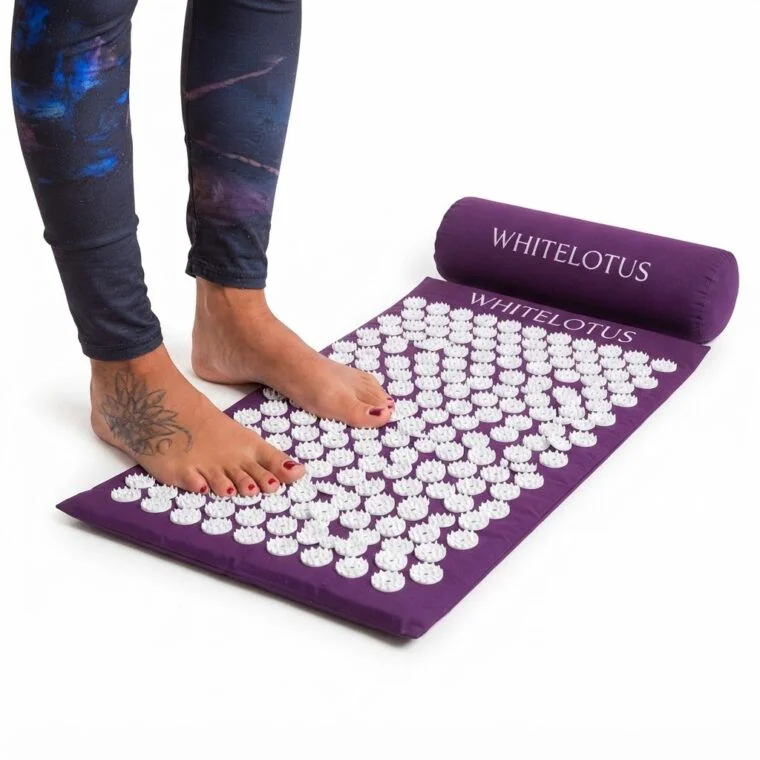
Premium Acupressure Mat & Pillow Set
White Lotus Beauty Premium Acupressure Mat & Pillow Set is a home wellness accessory built around controlled mechanical pressure rather than needles, heat, vibration, or electricity. The set combines a full-size memory-foam mat with a contoured acupressure pillow and storage bag, creating separate pressure surfaces for the back, shoulders, neck, and other supported areas.
Across the mat and pillow are 10,710 individual pressure points arranged across 255 rosettes. The mat itself contains 8,820 points across 210 rosettes, while the pillow adds another 1,890 points across 45 rosettes. White Lotus states that the system was designed by qualified acupuncturists and uses a cotton exterior, memory-foam filling, and glue-free pressure-point construction.
Within HotScope, this type of product belongs most naturally alongside the broader Beauty Wellness collection rather than skincare devices or massage cosmetics. It is a reusable physical wellness tool rather than a topical treatment.
Premium Acupressure Mat & Pillow Set Features
- Brand: White Lotus Beauty
- Product type: Acupressure mat and pillow wellness set
- Main mat dimensions: Approximately 72–73 cm long × 43 cm wide × 2 cm thick
- Pillow dimensions: Approximately 37 cm × 15 cm × 10 cm
- Total rosettes: 255
- Pressure points per rosette: 42
- Total pressure points: 10,710
- Mat pressure points: 8,820
- Pillow pressure points: 1,890
- Outer material: Cotton
- Internal support: Memory foam
- Pressure-point material: Food-grade plastic according to current product specifications
- Dye: Non-allergenic dye according to the manufacturer
- Construction: Rosettes attached without glue
- Included storage: Travel/storage bag
- Design: Developed by acupuncturists
- Suggested starting session: Approximately 10–15 minutes according to the current retailer directions
- Routine positioning: Relaxation, muscle-tension support, mindfulness, and recovery-focused self-care
- Ulta item number: 77001226
The manufacturer’s technical specifications account for all 10,710 pressure points rather than presenting that number as an approximate marketing figure.
The Mat And Pillow Create Two Different Pressure Zones
The set works differently from a single flat acupressure pad because the mat and pillow have different shapes.
The main mat provides a broad pressure surface that can make contact across a larger section of the back or body. At roughly 72–73 cm long and 43 cm wide, it is large enough to cover considerably more surface area than a small massage pad.
The pillow is smaller and raised. Its approximately 37 × 15 × 10 cm dimensions create a curved support that can sit beneath the neck or another area where a flat mat would not make equally consistent contact.
That division is useful because body contours are not flat. The neck, upper shoulders, and lumbar area can require different support from the middle of the back.
The memory-foam interior also changes the experience compared with laying plastic pressure points directly over a hard board. The foam compresses under body weight while allowing the rosettes to remain in contact with the surface.
10,710 Pressure Points Spread Force Across The Surface
An acupressure mat can look intimidating because of the large number of pointed projections, but these points are designed for surface pressure rather than skin penetration.
Each White Lotus rosette contains 42 individual pressure points. With 210 rosettes on the mat, that produces 8,820 contact points. The 45 pillow rosettes add 1,890 more, bringing the entire system to 10,710.
A high point count distributes body weight across many small areas rather than concentrating all force in only a handful of locations.
This is also what separates an acupressure mat from acupuncture. Acupuncture uses fine needles that penetrate the skin at selected points. A mechanical stimulation mat remains on the skin surface.
The National Center for Complementary and Integrative Health’s overview of acupuncture is useful for understanding that distinction. Acupuncture has a considerably larger clinical research base than consumer acupressure mats, so evidence about acupuncture should not automatically be transferred to a non-penetrating mat.
Mechanical Pressure Has Been Studied For Neck And Lower-Back Discomfort
There is some direct research on mechanical needle-stimulation pads that resemble modern acupressure mats.
A randomized pilot study involving people with chronic neck or lower-back pain evaluated a mechanical needle stimulation pad over a short treatment period. The researchers reported improvements in several pain-related measures, although the study was small and was explicitly described as a pilot investigation. The full research is available through the National Library of Medicine’s mechanical stimulation pad study.
That study is more relevant to a product like this than evidence involving inserted acupuncture needles because the intervention also relied on broad mechanical stimulation of the skin.
Even so, it did not test this exact White Lotus retail set.
A product page should therefore avoid statements such as “clinically proven to eliminate back pain.” A more accurate interpretation is that mechanical acupressure-style stimulation has shown promising results in small studies, while evidence for individual consumer mats remains limited.
Acupressure Research Is Broader Than Acupressure-Mat Research
The wider acupressure literature contains additional encouraging findings, especially around pain.
A systematic review of acupressure for chronic low-back pain found reductions in pain across the included studies, but the researchers also highlighted differences between interventions and the need for stronger evidence.
A separate review of acupressure for low-back pain similarly concluded that the intervention appeared beneficial while noting that the quality of evidence was downgraded because of limitations in the underlying trials.
This distinction matters for shoppers.
The fact that acupressure has been studied does not mean that every spike pattern, rosette shape, pressure level, mat material, or session length has been independently demonstrated to produce the same outcome.
White Lotus’s design can reasonably be described as inspired by acupressure principles and supported by a small body of relevant mechanical-pressure research, rather than presented as a replacement for medical treatment.
The Memory-Foam Core Changes The Feel Of The Pressure
The pressure points receive most of the attention, but the internal filling is just as important to the physical experience.
White Lotus uses a memory-foam core inside both the mat and pillow.
Memory foam compresses as body weight is applied. That allows the surface to conform more closely to body shape than a rigid base would.
The effect is especially relevant around the pillow, where the support needs to follow the curve beneath the neck rather than remaining completely flat.
It also means that the surface underneath the mat can change the intensity. Placing a pressure mat on a softer support will generally create a different sensation from using the same mat on a firm floor because the entire system can compress differently.
For beginners, the current retailer directions specifically suggest starting on a softer surface or wearing a thin layer of clothing when the pressure feels too intense.
Starting With Lighter Pressure Makes More Sense Than Forcing Tolerance
Acupressure mats are not supposed to be a test of how much discomfort someone can tolerate.
The current White Lotus retail directions recommend beginning with approximately 10–15 minutes while wearing a thin shirt, then gradually increasing direct skin contact and session duration as the sensation becomes more familiar.
That graduated approach is more sensible than immediately applying maximum pressure.
The first contact can feel sharp because body weight is being distributed over thousands of small points. As the body settles and weight becomes more evenly distributed, the sensation may feel different.
There is no advantage in continuing through significant pain, numbness, broken skin, or worsening irritation.
The product is intended as a wellness accessory, not as a device that needs to hurt in order to work.
The Pillow Gives Neck And Shoulder Areas More Focused Contact
A flat mat cannot naturally follow the hollow beneath the neck, which is why the separate pillow is one of the more useful parts of this set.
The pillow contains 45 rosettes and 1,890 individual pressure points, supported by memory foam.
Its curved construction allows contact around a smaller region without forcing someone to reposition the entire full-size mat.
The manufacturer markets this feature particularly around neck and shoulder tension.
That positioning is reasonable as a relaxation use, but persistent neck pain should not simply be self-treated indefinitely with pressure tools. Neck discomfort can originate from muscle tension, posture, joint conditions, injury, nerve irritation, or other causes.
The NCCIH chronic-pain evidence overview places complementary approaches within a broader pain-management context rather than presenting them as substitutes for diagnosis.
Relaxation Claims Need More Nuance Than “Releases Stress”
Acupressure mats are commonly marketed for relaxation, and there is some research examining that area.
A 2024 study investigated regular acupressure-mat use during a three-week relaxation program. Participants reported reductions in perceived stress, although the study did not find matching changes across all measured psychophysiological stress markers. The research can be reviewed through the PubMed study on acupressure mats and perceived stress.
That result is useful because it gives a more realistic interpretation of relaxation claims.
Someone may experience an acupressure session as calming without that automatically proving a specific hormonal, neurological, or circulatory mechanism.
For this product, phrases such as “designed to support relaxation” or “can be incorporated into a wind-down routine” are more defensible than claiming that the mat medically treats stress.
That also makes the set a natural fit within HotScope’s Beauty Wellness range, where the emphasis can remain on everyday wellness rather than disease treatment.
Sleep Research Is Promising But Not Specific To This Mat
White Lotus and current retailer descriptions also position the product around winding down and sleep support.
Acupressure has been studied in relation to sleep. A systematic review and meta-analysis on acupressure and sleep quality evaluated 13 studies involving 968 adults and found improvements in measured sleep-quality outcomes.
However, those studies involved multiple acupressure techniques and populations, not specifically this White Lotus mat.
For that reason, the product should not be described as an insomnia treatment.
A better interpretation is that the pressure mat may suit someone who likes incorporating quiet physical relaxation into an evening routine. Whether that translates into better sleep will vary from person to person.
Cotton, Memory Foam And Glue-Free Construction
White Lotus puts unusual emphasis on the materials used around the pressure points.
The technical specifications identify cotton fabric, memory-foam filling, non-allergenic dye, and food-grade plastic rosettes. The rosettes are attached without glue.
Glue-free construction is particularly practical for a product with hundreds of repeated plastic components because each rosette needs to remain securely attached during repeated body-weight loading.
The cotton surface also provides a fabric barrier between the memory-foam interior and the pressure-point components.
Current retailer information describes the set as free from latex, fragrance, and common allergen-focused materials. People with a known contact allergy should still check the latest manufacturer specifications rather than relying on the word “hypoallergenic” as a guarantee that no reaction can occur.
Skin Condition Matters Before Direct Contact
Direct skin contact creates stronger pressure than using the mat through clothing, so the condition of the skin matters.
The mat should not be treated like an exfoliating tool. Its points are designed to press against the skin, not scrape across it.
If the skin has cuts, active irritation, a rash, sunburn, or another area that is already painful, postponing direct pressure is more sensible than assuming increased stimulation will help.
For an everyday body-care routine, using a cleanser such as HotScope’s Body Shower Gel keeps cleansing separate from the acupressure session. The mat itself is not intended to replace body cleansing, massage oil, exfoliation, or moisturizer.
Similarly, a body product such as Pineapple Whipped Body Cream belongs to the moisture-care side of a routine rather than being necessary for the mechanical pressure effect.
Keeping these functions separate also helps prevent heavy creams or oils from accumulating unnecessarily on the cotton mat surface.
Temporary Pressure Marks Can Be Expected
Thousands of small pressure points pressing against the body can leave a visible pattern on the skin after a session.
A temporary rosette pattern is different from broken skin, significant bruising, or persistent irritation.
The amount of visible marking can vary with session length, clothing, pressure, skin sensitivity, surface firmness, and body position.
Someone who wants to reduce intensity can begin through a thin layer of clothing, as recommended in the current product directions, rather than assuming bare-skin contact is necessary from the first session.
If the skin remains sore or visibly irritated well beyond the session, additional pressure should not simply be added the next day.
Acupressure Is Not The Same As Massage Therapy
The phrases massage mat and acupressure mat are sometimes used almost interchangeably, but their mechanical action is different.
Traditional massage involves moving, compressing, kneading, or manipulating soft tissue. This mat remains relatively stationary while body weight creates pressure against many surface points.
There is no motor, rotating head, vibration system, or kneading mechanism inside the White Lotus set.
This matters when setting expectations. Someone wanting active mechanical massage will experience a very different sensation from someone lying quietly on a fixed acupressure surface.
The product is better described as a static mechanical pressure tool that can be integrated with meditation, stretching, recovery, or quiet relaxation routines.
Recovery Claims Should Remain Conservative
The current retailer page describes the mat in connection with circulation and post-workout recovery.
Those claims need context.
A small body of research suggests that pressure-based complementary therapies may influence perceived discomfort, but there is not strong evidence showing that this exact retail mat accelerates muscle-tissue repair after exercise.
“Recovery” is therefore more appropriately understood in the everyday wellness sense of relaxing after physical activity and addressing the subjective feeling of muscle tightness.
It should not be presented as a substitute for appropriate rest, gradual training, rehabilitation, or assessment of an injury.
Within HotScope, that makes the Beauty Wellness category a more appropriate internal destination than presenting the mat alongside medical treatment products.
Storage Helps Protect More Than Appearance
The included storage bag is a relatively simple accessory, but it has a practical purpose.
White Lotus specifically includes it to help keep the mat and pillow protected when stored or transported.
The exposed rosettes can otherwise collect dust, hair, and textile fibers, particularly if the mat is left uncovered on the floor.
Keeping it in the supplied bag also reduces unnecessary compression or contact with other objects while it is not being used.
Because the product contains memory foam and fixed plastic rosettes, cleaning methods that involve high heat, aggressive machine cycles, or chemical cleaners should not be assumed to be safe unless the current manufacturer instructions specifically allow them.
The most reliable care reference remains the instructions supplied with the set.
Who May Appreciate This Type Of Wellness Tool
Premium Acupressure Mat & Pillow Set is most relevant to someone who prefers non-electronic, reusable wellness accessories and does not mind the distinctive sensation created by many concentrated pressure points.
It may appeal to people building a quiet evening routine, practicing meditation, relaxing after everyday activity, or experimenting with a noninvasive mechanical pressure tool for occasional muscular tightness.
It will be less suitable for someone expecting a powered massage machine or an immediate medical treatment for unexplained pain.
For users who already maintain a wider body-care routine, HotScope’s Moisturisers collection covers the separate skin-hydration side of self-care, while the acupressure mat remains focused on mechanical pressure and relaxation.
What Makes Premium Acupressure Mat & Pillow Set Different
The strongest distinction is the amount of engineering packed into an otherwise simple, non-electronic product.
The mat and pillow together provide 255 rosettes, 10,710 pressure points, cotton outer material, memory-foam support, glue-free construction, and two different surface shapes for broad and targeted contact.
The main mat handles larger areas, while the separate contoured pillow provides a more practical shape for the neck and shoulders. The included travel bag keeps both pieces together between sessions.
There is also some relevant scientific context. Mechanical stimulation pads have been studied in small randomized trials for chronic neck and lower-back discomfort, broader acupressure research has reported promising pain outcomes, and newer work has examined acupressure mats specifically in relation to perceived stress.
None of that justifies presenting this particular mat as a cure.
Its more realistic strength is that it provides a repeatable, adjustable, noninvasive pressure experience at home without electricity, moving parts, disposable components, or topical formulas.
Final Note
White Lotus Beauty Premium Acupressure Mat & Pillow Set is best viewed as a thoughtfully constructed home relaxation and mechanical acupressure system rather than a medical pain-treatment device.
Its 10,710 pressure points, two-piece pressure design, memory-foam support, cotton covering, glue-free rosettes, and storage bag give it a more substantial construction than a basic flat pressure pad. Starting with shorter sessions and lighter contact also makes more sense than immediately trying to tolerate maximum pressure.
The evidence around acupressure and mechanical stimulation is encouraging in some areas, but it remains important to separate general research from claims about one exact retail product. Used with that expectation, the set can fit naturally into an everyday wellness routine alongside HotScope’s Beauty Wellness products, body cleansing, and separate skin-moisturizing care.
:::

Reviews
There are no reviews yet.