

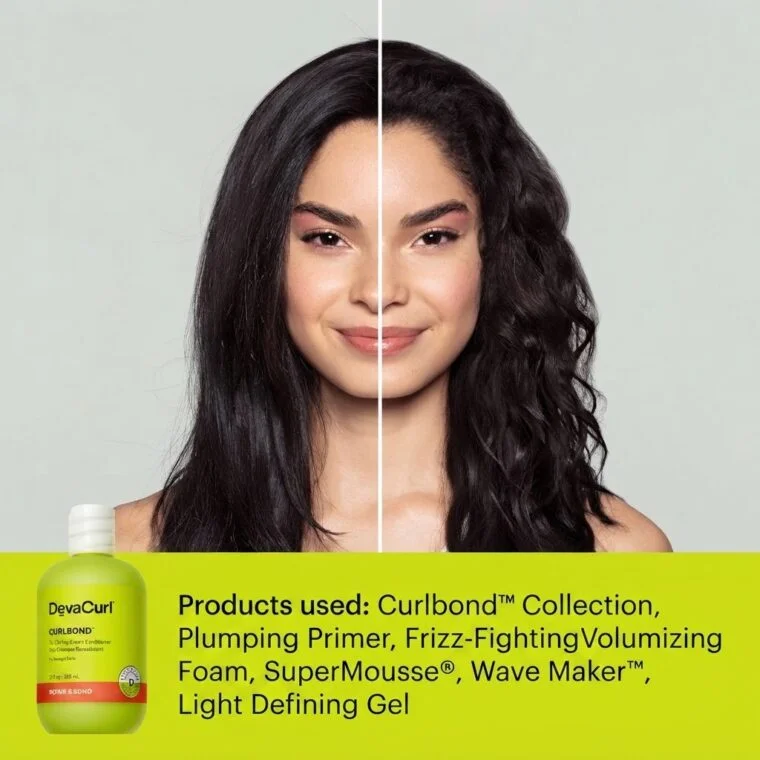
CURLBOND Re-Coiling Cream Conditioner
DevaCurl CURLBOND Re-Coiling Cream Conditioner is a rich rinse-out conditioner created for waves, curls, and coils that have become less defined, rougher, or more fragile after heat styling, coloring, relaxing, brushing, friction, or other forms of mechanical and chemical stress. Its formula combines traditional conditioning agents with DevaCurl’s CurlBond Complex, built around succinic acid, arginine, lysine, and naturally derived guar, to support softer-feeling, more manageable curls while reducing the appearance and feel of damage.
The current Ulta format contains 12.0 oz, and the conditioner is formulated without silicones, parabens, or SLS/SLES sulfates. DevaCurl also positions the formula as safe for color-treated curls and suitable across waves, curls, and coils rather than restricting it to one curl pattern.
Within HotScope, it belongs naturally in the Hair Care collection and the more focused Shampoo & Conditioner category, where it can be compared with moisturizing, anti-frizz, volumizing, and color-care formulas according to what the hair actually needs.
CURLBOND Re-Coiling Cream Conditioner Features
- Brand: DevaCurl
- Product type: Rinse-out repair and conditioning cream
- Current retail size: 12.0 oz
- Hair patterns: Waves, curls, and coils
- Best suited to: Hair showing cosmetic damage from heat, color, relaxing, brushing, protective styling, or friction
- CurlBond Complex: Succinic acid, arginine, lysine, and naturally derived guar
- Conditioning base: Cetearyl alcohol, behentrimonium chloride, stearamidopropyl dimethylamine, stearyl alcohol, cetrimonium chloride, and conditioning polymers
- Supporting ingredients: Glycerin, panthenol, caprylic/capric triglyceride, tocopheryl acetate, and amino acids
- Silicone-free: Yes
- Paraben-free: Yes
- SLS/SLES sulfate-free: Yes
- Fragrance: Cozy Getaway, with tropical and warm fragrance notes
- Color-treated hair: DevaCurl positions it as color-safe
- Packaging: Bottle made with 50% recycled ocean-bound plastic according to DevaCurl
- Ulta item number: 2581858
DevaCurl currently claims that the CurlBond conditioner can improve strength, soften and define curls, reduce frizz, support elasticity, temporarily improve the appearance of split ends, and help protect damaged hair from additional cosmetic stress. Those claims should be read as performance claims for the finished DevaCurl formula rather than universal properties of every product containing amino acids or succinic acid.
Designed Around Damaged Curls Rather Than Moisture Alone
A useful way to understand CURLBOND is to separate conditioning from repair positioning. A normal conditioner mainly reduces friction, improves slip, softens the fiber, and makes detangling easier, while CURLBOND adds an amino-acid and succinic-acid system intended specifically for hair that has already been stressed.
Curly and coily hair can particularly benefit from good conditioning because bends and twists make natural oils less likely to spread evenly along the strand. The American Academy of Dermatology notes that curly hair tends to be more prone to dryness and breakage and recommends conditioning the full length rather than concentrating only on the ends. AAD guidance for curly and coily hair provides useful context for why a creamy conditioner can be an important part of a curl routine.
Someone whose main concern is simply dryness may want to compare CURLBOND with HotScope’s Wellness Premium Hydration Conditioner. CURLBOND is more strongly positioned around damaged curl structure and definition, while a hydration-first conditioner places greater emphasis on softness and moisture.
What CurlBond Complex Is Trying To Do
DevaCurl identifies succinic acid, arginine, lysine, and naturally derived guar as the ingredients central to CurlBond Complex. The company describes the system as working on damaged areas of curly hair and helping improve the feel and strength of strands that have been affected by chemical or mechanical stress.
Arginine and lysine are amino acids, which are building blocks of proteins. Hair fibers themselves are largely made from keratin protein, so amino-acid-containing hair products are often formulated around the idea of interacting with damaged regions of the fiber and improving surface properties.
That does not mean a rinse-out conditioner biologically regenerates hair. Once hair has grown beyond the scalp, cosmetic products primarily work by coating, lubricating, filling irregularities, reducing friction, and temporarily improving the physical behavior of the strand. A detailed NIH review of hair-care physicochemistry explains that conditioners can deposit materials onto damaged cuticle regions and improve smoothness and manageability without turning damaged hair into newly grown hair.
Succinic Acid Is Part Of The Bond-Repair Story
Succinic acid appears relatively high in the ingredient list, following the main fatty alcohols, conditioning agents, and glycerin. DevaCurl specifically includes it in the CurlBond Complex rather than treating it as a minor supporting ingredient.
The brand describes CurlBond as a bond-building system. That language should still be interpreted carefully because different commercial bond-repair products use different chemistries, and simply containing an acid does not establish that two products repair hair through the same mechanism.
What can be said more confidently is that chemical processes such as bleaching, coloring, perming, and relaxing can alter the structure and physical properties of the hair fiber. The NIH overview of hair cosmetics discusses how chemical and mechanical treatments can damage the cuticle and cortex and how conditioning products may reduce friction and subsequent breakage.
For shoppers whose damage is closely tied to artificial hair color, HotScope’s Elvive Color Vibrancy Protecting represents a different route focused more heavily on color maintenance. CURLBOND places the emphasis on curl condition and damage management rather than shampoo cleansing.
A Strong Conditioning Base Does Much Of The Everyday Work
The CurlBond Complex may be the headline technology, but the everyday softness and detangling are also explained by the conventional conditioning ingredients surrounding it.
Cetearyl alcohol and stearyl alcohol are fatty alcohols that give the cream body while contributing softness and slip. They should not be confused with lightweight volatile alcohols simply because they share the word alcohol in their names.
Behentrimonium chloride, cetrimonium chloride, stearamidopropyl dimethylamine, Quaternium-87, Quaternium-91, and Polyquaternium-7 are conditioning ingredients that help reduce friction and improve combability. Damaged hair surfaces tend to interact particularly well with cationic conditioning materials, which is one reason these ingredients appear so frequently in formulas made for rough or processed hair.
The NIH review of shampoos and conditioners describes conditioners as products that can decrease friction, improve manageability, reduce static, and temporarily improve the feel of damaged areas. Those functions are especially relevant to curls because excessive tugging during detangling can create additional mechanical damage.
Glycerin And Panthenol Add Moisture Support
Although DevaCurl describes CURLBOND primarily as a repair-focused conditioner rather than its deepest moisturizing treatment, the formula still contains several ingredients associated with hydration and softness.
Glycerin appears near the beginning of the formula and acts as a humectant. Glycereth-26 and propylene glycol provide additional water-binding and formulation support, while panthenol contributes conditioning and moisture-related benefits.
Caprylic/capric triglyceride adds emollient character, helping explain why the conditioner feels creamier than a lightweight detangling spray. Tocopheryl acetate, a vitamin E derivative, is also present as a supporting conditioning ingredient.
DevaCurl itself notes that CURLBOND is designed primarily around repair and conditioning and recommends richer masks when considerably more moisture is needed. That makes the product useful for damaged curls without automatically making it the richest option for extremely dry hair.
Detangling While The Conditioner Is In The Hair
DevaCurl directs users to distribute the conditioner through wet curls, gently detangle with the fingers, work the cream through the ends, and then rinse. That sequence makes practical sense because the conditioning agents are present on the fiber while tangles are being separated.
The American Academy of Dermatology similarly recommends gentle detangling for textured hair and notes that thick curly hair can be combed in the shower before the conditioner is rinsed away. AAD healthy-hair guidance emphasizes using a wide-tooth comb and working carefully rather than pulling through knots.
This is especially important for already damaged curls. A bond-focused conditioner cannot compensate for repeatedly tearing through knots with excessive force, so the mechanical part of the routine still matters.
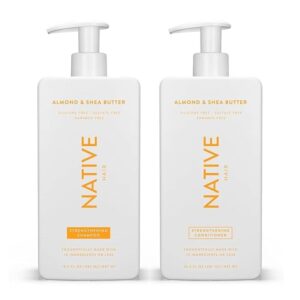
For people comparing a simpler cleansing-and-conditioning combination, HotScope’s Native Shampoo offers a different shampoo-focused approach. CURLBOND is better positioned when the concern extends beyond basic cleansing into visible damage, softness, and curl recovery.
What “Re-Coiling” Means In Cosmetic Terms
The phrase Re-Coiling can sound as if the conditioner permanently changes someone’s natural curl pattern, but that is not the most useful interpretation.
Heat, chemical processing, dryness, breakage, and friction can make existing waves, curls, and coils look stretched, fuzzy, or less uniform. Improving slip, conditioning damaged regions, reducing roughness, and supporting elasticity can allow the existing pattern to sit more cohesively again.
DevaCurl describes CURLBOND as enhancing definition and elasticity while helping damaged curls recover a healthier-looking shape. This is a cosmetic restoration of the appearance and behavior of existing curls, not the creation of an entirely new genetic hair pattern.
Hair that has been permanently altered by severe chemical or thermal damage may still require gradual trimming as new hair grows. No rinse-out conditioner can make extensively destroyed fiber biologically regenerate.
Split-End “Sealing” Is Temporary
The current product description includes a split-end sealing claim. It is useful to understand what that means before interpreting the phrase as permanent repair.
Split ends occur when the hair fiber separates at the tip or along a damaged section. Conditioners and film-forming materials can temporarily coat those separated surfaces, helping the end look smoother and reducing friction, but they do not permanently fuse the hair back into virgin fiber.
The NIH review of conditioners discusses how protein-derived and conditioning materials can temporarily improve the appearance of split ends. When splitting is extensive, trimming remains the only way to physically remove the damaged end.
This distinction does not make the product’s conditioning benefit unimportant. Smoother, better-lubricated ends may tangle less and experience less repeated friction, which can help protect the remaining length.
Frizz Control Comes From Smoother, Better-Conditioned Fibers
Ulta currently attributes up to 48 hours of frizz reduction to the product’s tested performance claims. That should be read as a DevaCurl finished-formula claim rather than as a guarantee that every curl type will stay equally smooth for exactly two days.
Humidity, porosity, existing damage, styling products, weather, drying method, and how frequently the hair is touched can all influence visible frizz.
Conditioning still helps because rough cuticle surfaces create more friction between strands. Smoother fibers tend to separate and move more predictably, which can improve definition and reduce the fuzzy appearance associated with damaged curls.
People whose main concern is frizz rather than repair can compare the broader options in HotScope’s Shampoo & Conditioner category before choosing whether a bond-oriented conditioner is necessary.
Color-Treated Curls Are One Of The More Relevant Use Cases
Chemical coloring can affect hair beyond changing pigment. Depending on the process, repeated coloring and bleaching can alter cuticle condition, increase porosity, and make the fiber more vulnerable to breakage.
DevaCurl specifically identifies color services as one type of chemical damage for which CURLBOND was developed. The current Ulta description also carries a color-preservation claim of up to 20 washes for the CurlBond Complex.
That does not mean the conditioner can prevent all fading. Wash frequency, water temperature, dye type, UV exposure, porosity, and cleansing products all affect color longevity.
For shoppers prioritizing pigment retention above curl repair, Elvive Color Vibrancy Protecting provides a relevant HotScope comparison. Someone with both color damage and a compromised curl pattern may care about both goals.
Silicone-Free Does Not Mean Conditioning-Free
CURLBOND contains no silicones according to DevaCurl’s current formulation positioning, but the formula still contains a substantial conditioning system.
This is worth highlighting because silicone-free conditioners are sometimes incorrectly assumed to offer little slip. Here, cationic conditioning agents, fatty alcohols, guar derivatives, polyquaterniums, emollients, glycerin, and panthenol provide the detangling and softening structure instead.
Whether silicone-free is personally preferable depends on the rest of the routine. Silicones themselves are widely used cosmetic conditioning materials, and their absence should not automatically be interpreted as proof that one conditioner is healthier than another.
The more useful question is whether the finished formula gives the hair enough slip, softness, and manageability without creating an unwanted coated feel.
Fragrance Is Part Of The Formula
CURLBOND is not fragrance-free. DevaCurl describes its Cozy Getaway fragrance as a warm tropical scent built around coconut water, melon, floral, citrus, amber, and vanilla-style notes, and the ingredient list includes parfum and linalool.
That may simply be part of the sensory experience for many users, but someone who already knows that fragranced scalp or hair products trigger irritation should consider the full ingredient panel.
The conditioner is usually concentrated through the lengths and ends rather than deliberately massaged over the scalp, which can reduce unnecessary scalp exposure while still allowing the product to condition the hair.
Full Ingredient Profile
The current ingredient declaration is Aqua/Water/Eau, Cetearyl Alcohol, Behentrimonium Chloride, PPG-3 Benzyl Ether Myristate, Glycerin, Stearamidopropyl Dimethylamine, Stearyl Alcohol, Succinic Acid, Arginine, Caprylic/Capric Triglyceride, Cetrimonium Chloride, Citric Acid, Glycereth-26, Guar Hydroxypropyltrimonium Chloride, Hydroxypropyl Guar Hydroxypropyltrimonium Chloride, Isopropyl Alcohol, Lysine HCl, Panthenol, Pentaerythrityl Tetra-di-t-butyl Hydroxyhydrocinnamate, Polyquaternium-7, Propylene Glycol, Quaternium-87, Quaternium-91, Sodium Hydroxide, Tetrasodium Glutamate Diacetate, Tocopheryl Acetate, Potassium Sorbate, Sodium Benzoate, Parfum/Fragrance, and Linalool.
DevaCurl notes that preservative systems, fragrance, or other formulation details can change over time, so the ingredient panel printed on the bottle being purchased should remain the final reference for allergies or known sensitivities.
CURLBOND Versus A Standard Moisturizing Conditioner
CURLBOND makes the most sense when the hair concern includes damage plus curl definition, not simply when the ends feel a little dry.
A straightforward moisturizer such as HotScope’s Wellness Premium Hydration Conditioner is oriented more heavily toward softness, hydration, and manageability. CURLBOND adds the brand’s succinic-acid and amino-acid repair technology to that traditional conditioning function.
Someone with healthy curls that mainly need moisture may not require a bond-focused formula every time. Someone whose curls have become weaker or less defined after repeated coloring, heat, friction, or mechanical styling is closer to the audience DevaCurl identifies for this conditioner.
The broader Hair Care collection can therefore be useful for building the rest of the routine around cleansing, conditioning, styling, and scalp care rather than expecting one repair conditioner to perform every hair-care job.
What Makes CURLBOND Re-Coiling Cream Conditioner Different
The main difference is the way DevaCurl combines a traditional creamy conditioning base with its CurlBond Complex. Succinic acid, arginine, lysine, and guar derivatives sit alongside fatty alcohols, cationic conditioners, glycerin, panthenol, emollients, and conditioning polymers, creating a formula intended to address both immediate manageability and the cosmetic signs of damaged curls.
It is silicone-free and paraben-free, carries color-care and frizz-control claims, and is designed for waves, curls, and coils rather than being restricted to one texture. Its strongest use case is hair that needs more than simple softness: curls that have become rougher, weaker, less elastic, tangled, or less defined after repeated styling and chemical processing.
The most realistic expectation is not permanent biological reconstruction of damaged hair. It is better-conditioned, easier-to-detangle, smoother-feeling hair with improved curl definition and reduced mechanical stress, supported by a formula specifically developed around damaged curl fibers.
Final Note
DevaCurl CURLBOND Re-Coiling Cream Conditioner is best viewed as a damage-focused rinse-out conditioner for waves, curls, and coils. Its CurlBond Complex adds succinic acid, lysine, arginine, and guar-based conditioning technology to a rich base of fatty alcohols, cationic conditioners, humectants, panthenol, and emollients.
For curls affected by coloring, heat, friction, brushing, or repeated styling, that combination provides a more targeted approach than using a basic conditioner solely for softness. Gentle detangling and lower-damage styling habits still matter just as much, which is why the American Academy of Dermatology’s hair-damage guidance recommends regular conditioning, gentle combing, and reducing excessive heat and pulling alongside any cosmetic treatment.
:::


Reviews
There are no reviews yet.