

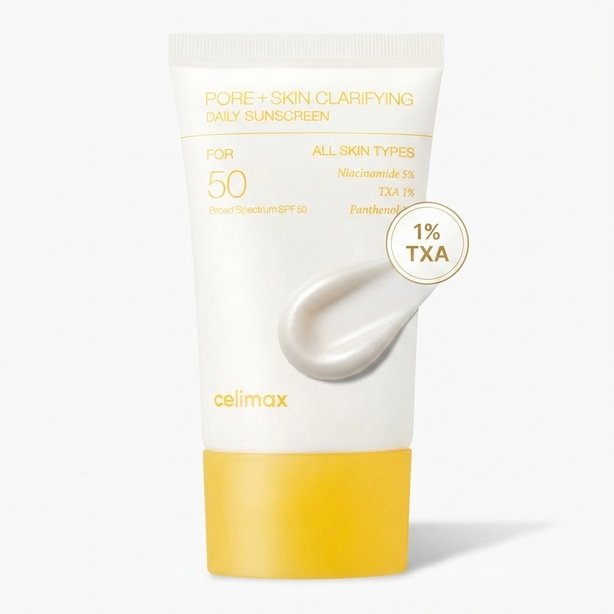
Pore + Skin Clarifying Daily Sunscreen
celimax Pore + Skin Clarifying Daily Sunscreen combines Broad Spectrum SPF 50 protection with 5% niacinamide, 1% tranexamic acid, and 1% panthenol, giving it a more treatment-oriented profile than a basic everyday sunscreen. The current U.S. formula is designed to protect against ultraviolet exposure while supporting a more even-looking complexion, helping address the appearance of UV-related dark spots and keeping the finish lightweight enough for daily facial wear.
The current tube contains 1.69 oz / 50 ml. For shoppers comparing other daily SPF textures, HotScope’s Madagascar Centella Hyalu Cica Water Fit Sun Serum takes a more hydration-centered sunscreen-serum approach, while this celimax formula places considerably more emphasis on niacinamide, tranexamic acid, visible pores, and uneven tone.
Pore + Skin Clarifying Daily Sunscreen Features
- Brand: celimax
- Product type: Daily facial sunscreen with brightening skincare ingredients
- Size: 1.69 oz / 50 ml
- Protection: Broad Spectrum SPF 50
- Sunscreen filters: Avobenzone 2.7%, Homosalate 13.6%, Octisalate 4.5%, Octocrylene 9%
- Niacinamide: 5%
- Tranexamic Acid: 1%
- Panthenol: 1%
- Texture: Lightweight, transparent, skincare-like cream
- Primary skincare concerns: Uneven-looking tone, UV-related dark spots, visible pores, and daily sun protection
- Supporting ingredients: Silica, tocopherol, biosaccharide gum-1, loquat leaf extract, spearmint extract, and quercetin
- Mineral UV filters: None listed
- Water resistance: No 40- or 80-minute water-resistance claim appears on the current U.S. Drug Facts label
- U.S. classification: OTC sunscreen drug
- NDC: 87226-150
- Ulta item number: 2657154
The current U.S. Drug Facts record confirms the four sunscreen-filter percentages, while Ulta identifies the 5% niacinamide, 1% tranexamic acid, and 1% panthenol concentrations.
SPF 50 Remains The Most Important Part Of The Formula
The niacinamide and tranexamic acid give this sunscreen an interesting skincare profile, but the primary purpose remains ultraviolet protection.
The current U.S. formula uses four organic sunscreen filters. Avobenzone contributes important UVA protection, while homosalate, octisalate, and octocrylene contribute to the overall UV-filter system. DailyMed lists the finished product as an OTC sunscreen and states that, when used as directed with other sun-protection measures, broad-spectrum sunscreen helps reduce the risks associated with sun exposure.
The FDA’s current sunscreen guidance recommends broad-spectrum sunscreen and emphasizes that SPF products still need appropriate application and reapplication rather than being treated as all-day protection from one morning layer.
That point is particularly important with a sunscreen carrying several fashionable skincare ingredients. A product does not become a serum first and an SPF second simply because the ingredient list includes niacinamide and tranexamic acid.
5% Niacinamide Gives The Formula A Serious Skincare Component
Niacinamide appears unusually high in the formula and is present at a disclosed 5% concentration.
Niacinamide is the amide form of vitamin B3 and has been studied extensively in topical skincare. Research indexed by PubMed has found that topical niacinamide can influence visible hyperpigmentation and skin tone, with one controlled study reporting reduced hyperpigmentation after repeated use. Research on topical niacinamide and pigmentation provides useful background for why it appears in brightening formulations.
That does not mean sunscreen containing 5% niacinamide will erase every post-acne mark or dark spot. Pigmentation can have multiple causes, and results depend on continued UV protection, skin biology, other products in the routine, and time.
The more useful interpretation is that celimax has combined a meaningful amount of a familiar tone-supporting ingredient with SPF rather than adding a trace amount simply for label appeal.
For nighttime routines that also use niacinamide, HotScope’s CeraVe Skin Renewing Face Night Cream provides a different barrier-focused format containing niacinamide alongside ceramides and hyaluronic acid.
Pore Care Does Not Mean Permanently Shrinking Pores
The word Pore in the product name needs realistic interpretation.
Pores are normal anatomical openings associated with hair follicles and sebaceous glands. A sunscreen cannot permanently remove them or physically close them.
What cosmetic products can influence is how noticeable pores appear. Surface oil, uneven texture, dehydration, surrounding pigmentation, and the way light reflects from the skin can all change their visibility.
This formula contains several ingredients that may contribute to that visual effect. Niacinamide supports the overall skin-conditioning profile, while silica and polymethylsilsesquioxane can influence the immediate surface finish. Silicone elastomer and film-forming ingredients also help create a smoother-feeling layer.
That makes “pore clarifying” more accurately understood as improving the cosmetic appearance of texture and pores, not changing the permanent structure of the follicle.
Someone using separate exfoliating products for clogged or rough-looking skin can compare the role with HotScope’s Instant Reveal Facial Peel. An exfoliating peel and a daily sunscreen perform entirely different jobs and should not be treated as substitutes.
1% Tranexamic Acid Targets The Uneven-Tone Side Of The Formula
celimax includes 1% tranexamic acid, commonly abbreviated TXA.
Tranexamic acid has attracted significant interest in dermatology because topical formulations have been studied for hyperpigmentation conditions including melasma. For example, clinical research has evaluated topical 5% tranexamic acid for facial pigmentation. PubMed’s topical tranexamic-acid study illustrates that research background.
There is an important concentration difference, however.
The celimax sunscreen contains 1% TXA, while several clinical studies have tested different concentrations and formulations. It would therefore be inaccurate to take results from a 5% medical-study formula and promise the same outcome from this sunscreen.
Its 1% tranexamic acid is better viewed as a supporting brightening ingredient working alongside niacinamide and, importantly, daily UV protection.
Sunscreen Is Especially Relevant When Dark Spots Are The Concern
Using brightening ingredients without managing UV exposure can work against the same cosmetic goal.
Ultraviolet exposure can contribute to visible pigmentation and uneven tone, which is why broad-spectrum sunscreen is particularly relevant in routines centered around post-acne marks, sun-related spots, or melasma-prone pigmentation.
The American Academy of Dermatology’s sunscreen guidance recommends broad-spectrum SPF 30 or higher for exposed skin and explains that UVA contributes to premature aging and age spots while UVB is strongly associated with sunburn.
This gives the product’s combination of SPF plus tone-focused ingredients some practical logic. The sunscreen addresses ongoing UV exposure while the niacinamide and tranexamic acid address the cosmetic appearance of uneven tone through different mechanisms.
Panthenol Helps Balance The Treatment-Oriented Formula
The third disclosed skincare concentration is 1% panthenol.
Panthenol, also known as provitamin B5, is commonly used as a humectant and skin-conditioning ingredient. In this formula it helps shift the product away from feeling like nothing more than sunscreen filters plus pigmentation ingredients.
The inactive formula also contains propanediol, pentylene glycol, butylene glycol, biosaccharide gum-1, caprylic/capric triglyceride, and tocopherol.
Together, these ingredients support spreadability, moisture retention, emollience, and the overall sensory profile.
Someone whose skin still needs more moisture underneath SPF can browse HotScope’s Moisturisers collection rather than expecting this sunscreen to replace every moisturizer for every skin type.
The Lightweight Finish Comes From More Than The UV Filters
The ingredient list contains several texture-engineering ingredients that help explain the transparent, skincare-like finish described by Ulta.
Polymethylsilsesquioxane and silica can contribute to a smoother, less greasy surface feel. Methyl trimethicone is a lightweight silicone, while dimethicone/vinyl dimethicone crosspolymer creates a soft elastomeric texture.
Film-forming materials including VP/Eicosene Copolymer, Polyacrylate Crosspolymer-6, and Ammonium Acryloyldimethyltaurate/VP Copolymer further influence how the sunscreen spreads and settles.
This matters for pore-conscious or combination skin because a sunscreen that remains extremely oily can make texture appear more noticeable even when the UV protection itself is good.
The lightweight formulation is therefore part of the product’s cosmetic strategy rather than simply a sensory bonus.
It Is An Organic-Filter Sunscreen, Not A Mineral Formula
The current active ingredients are avobenzone, homosalate, octisalate, and octocrylene. There is no zinc oxide or titanium dioxide in the active Drug Facts panel.
That makes this an organic-filter sunscreen under the usual cosmetic classification rather than a mineral sunscreen.
The AAD explains that products containing zinc oxide or titanium dioxide are generally called physical or mineral sunscreens, while products using other approved UV filters are commonly described as chemical or organic-filter sunscreens. Both categories can provide effective broad-spectrum protection when appropriately formulated and used.
For shoppers comparing the sensory differences between sunscreen formats, HotScope’s Madagascar Centella Hyalu Cica Water Fit Sun Serum offers another lightweight serum-style SPF concept, although its supporting skincare ingredients and product positioning are different.
Water Resistance Should Not Be Assumed
The current U.S. Drug Facts label does not state that Pore + Skin Clarifying Daily Sunscreen is water resistant for either 40 or 80 minutes.
Instead, its official directions specifically say to use a water-resistant sunscreen if swimming or sweating.
That wording is meaningful. FDA sunscreen labeling guidance requires sunscreens that have passed the required water-resistance testing to state whether they remain effective for 40 or 80 minutes. Products without that qualification carry directions telling consumers to use a water-resistant sunscreen for swimming or sweating.
This makes celimax Pore + Skin Clarifying Daily Sunscreen better suited to routine everyday facial protection than automatically presenting it as a beach, swimming, or intensive-sport sunscreen.
Morning Layering And Reapplication
This sunscreen is intended as the final skincare layer before makeup.
The current Drug Facts label directs application 15 minutes before sun exposure and reapplication at least every two hours. Ulta similarly positions it as the last step of the morning skincare routine.
When moisturizer is needed, it can be allowed to settle first before sunscreen is spread evenly across exposed facial and neck skin. Makeup can then follow after the sunscreen film has had time to settle.
The FDA sunscreen recommendations reinforce the importance of applying sunscreen before exposure and reapplying at least every two hours.
The key point is that adding niacinamide and tranexamic acid does not change the basic application requirements of SPF. Using too little product may reduce the level of protection actually achieved.
Reapplication Still Matters With SPF 50
SPF 50 is a high level of labeled UVB protection, but it does not mean the sunscreen lasts indefinitely.
The AAD notes that higher SPF numbers do not allow someone to remain outdoors proportionally longer without reapplication. Sunscreen still needs to be renewed approximately every two hours outdoors and according to the product’s directions.
This is particularly relevant with makeup because people often apply a proper morning sunscreen layer and then forget about it for the rest of the day.
A separate reapplication method may therefore be useful when extended outdoor exposure is expected, but any sunscreen used for top-ups still needs to provide sufficient, even coverage rather than being treated as a token mist.
Spearmint Extract Is Worth Noticing On Sensitive Skin
The current inactive ingredient list includes Mentha Viridis, or spearmint extract, along with loquat leaf extract and quercetin.
These botanical ingredients appear relatively low in the formula and should not overshadow the sunscreen filters, niacinamide, tranexamic acid, or panthenol.
Spearmint is still worth noting for people whose skin is particularly reactive to aromatic botanical ingredients. The product should not automatically be described as universally suitable for highly sensitive skin merely because it contains panthenol.
The official Drug Facts label instructs users not to apply the sunscreen over damaged or broken skin, to avoid the eyes, and to discontinue use and seek medical advice if a rash occurs.
Pore + Skin Clarifying Daily Sunscreen Versus A Hydrating Sun Serum
Both celimax Pore + Skin Clarifying Daily Sunscreen and HotScope’s Madagascar Centella Hyalu Cica Water Fit Sun Serum sit within the lightweight facial-SPF category, but their skincare identities are different.
The Madagascar Centella formula is positioned primarily around Centella and hydration, while celimax makes 5% niacinamide, 1% tranexamic acid, 1% panthenol, uneven tone, and visible pores central to its formulation story.
Someone primarily concerned with dry-feeling skin may prefer a moisture-centered sunscreen texture. Someone concerned about post-acne marks, uneven tone, and a heavier-looking pore texture may find celimax’s supporting ingredient profile more relevant.
The better sunscreen is still ultimately the one that can be applied generously and consistently without making the rest of the routine difficult.
Current Ingredient Profile
The current U.S. sunscreen actives are Avobenzone 2.7%, Homosalate 13.6%, Octisalate 4.5%, and Octocrylene 9%.
The current inactive formula includes Water, Niacinamide, Butyloctyl Salicylate, Propanediol, Polymethylsilsesquioxane, C20-22 Alkyl Phosphate, C20-22 Alcohols, 1,2-Hexanediol, Pentylene Glycol, Panthenol, Methyl Trimethicone, Tranexamic Acid, Dimethicone/Vinyl Dimethicone Crosspolymer, Glyceryl Stearate, VP/Eicosene Copolymer, Tromethamine, Polyacrylate Crosspolymer-6, Ammonium Acryloyldimethyltaurate/VP Copolymer, Silica, Butylene Glycol, Ethylhexylglycerin, Methylpropanediol, Polyether-1, Tocopherol, Polyglyceryl-4 Isostearate, Caprylic/Capric Triglyceride, Disteardimonium Hectorite, Biosaccharide Gum-1, Eriobotrya Japonica Leaf Extract, Mentha Viridis Extract, and Quercetin.
Because sunscreen labeling can vary by market, the U.S. Drug Facts panel on the tube being purchased should remain the final reference for the exact active-filter concentrations.
What Makes Pore + Skin Clarifying Daily Sunscreen Different
The strongest feature of celimax Pore + Skin Clarifying Daily Sunscreen is that its skincare claims are supported by disclosed ingredient concentrations rather than only a list of fashionable extracts.
Five percent niacinamide forms a substantial part of the supporting formula. One percent tranexamic acid gives it a targeted uneven-tone component, while 1% panthenol adds moisture and conditioning support. The four-filter Broad Spectrum SPF 50 system remains responsible for actual UV protection.
The product also avoids making the formula excessively treatment-heavy. Silica, lightweight silicones, texture modifiers, and film-forming ingredients help maintain the transparent, skincare-like finish that a daily sunscreen needs if it is going to sit comfortably beneath makeup.
For a broader routine, HotScope’s Skincare collection can cover evening treatments and hydration, while a product such as CeraVe Skin Renewing Face Night Cream can keep richer barrier care in the nighttime routine instead of overloading the daytime SPF layer.
Final Note
celimax Pore + Skin Clarifying Daily Sunscreen is best understood as a Broad Spectrum SPF 50 facial sunscreen with unusually prominent tone- and texture-focused skincare ingredients.
Its strongest technical points are the combination of avobenzone, homosalate, octisalate, and octocrylene for UV protection, alongside 5% niacinamide, 1% tranexamic acid, and 1% panthenol.
The pore claim should remain realistic: sunscreen cannot permanently shrink follicles, but a smoother, less greasy surface and a well-designed skincare routine can make pores look less obvious. Likewise, tranexamic acid and niacinamide can support a more even-looking complexion, but they do not remove the need for consistent sun protection.
The biggest practical limitation is water resistance. Because the current U.S. label specifically advises switching to a water-resistant sunscreen for swimming or sweating, this formula is most naturally positioned for daily facial wear, commuting, work, and ordinary outdoor exposure rather than intensive water or sport use.
:::

Reviews
There are no reviews yet.