Color Last Shampoo for Color-Treated Hair
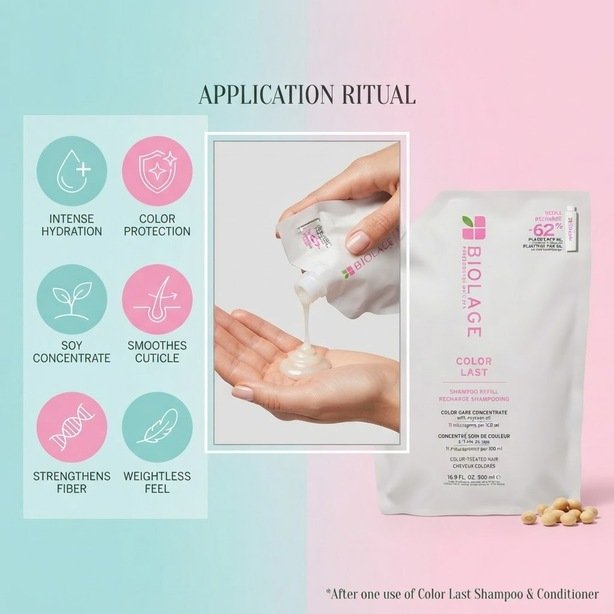
Biolage Color Last Shampoo for Color-Treated Hair is a low-pH cleansing shampoo developed specifically for dyed, highlighted, and pre-lightened hair. Its current U.S. formula uses sodium laureth sulfate and coco-betaine for cleansing, with dimethicone, cationic guar, soybean oil, and a low-pH formulation approach intended to leave color-treated hair smoother, shinier, and less stripped after washing. Biolage currently says the Color Last Shampoo and Conditioner system helps prevent color fade for up to four weeks. (Biolage)
Biolage also reports 35% more shine, 13 times smoother hair, and twice the hair strength after one use when the Shampoo and Conditioner are used together compared with a non-conditioning shampoo. Those figures apply to the two-product Color Last system, not to shampoo used by itself.
The shampoo is currently available through Ulta in 1.7 oz, 13.5 oz, 16.9 oz refill, and 33.8 oz jumbo formats, making it possible to choose anything from a small trial size to a salon-style bottle.
For shoppers comparing color-care products on Erothots, it belongs naturally within the Hair Care collection and Shampoo & Conditioner range. A closely related alternative is Elvive Color Vibrancy Protecting, which is also specifically positioned around color-treated hair.
About Color Last Shampoo for Color-Treated Hair
Color Last is not a color-depositing shampoo. It does not add violet, blue, red, brown, or other direct pigments to change the hair’s tone.
Its purpose is simpler: clean the scalp and hair while helping an existing salon or at-home color remain visually vibrant.
That makes it different from toning or color-depositing formulas. Biolage sells a separate Color Last Purple Shampoo when neutralizing yellow or brassy tones is the goal, while ordinary Color Last Shampoo is colorant-free and intended for routine cleansing.
The formula is also suitable for pre-lightened hair according to Biolage, so the color-treated positioning includes bleached hair rather than only permanent brunette, red, or fashion-color services.
Color Last Shampoo for Color-Treated Hair Features
- Brand: Biolage
- Collection: Color Last
- Product type: Shampoo for color-treated and pre-lightened hair
- Current sizes: 1.7 oz, 13.5 oz, 16.9 oz refill, and 33.8 oz jumbo
- Formula approach: Low-pH cleansing shampoo
- Main surfactants: Sodium Laureth Sulfate and Coco-Betaine
- Highlighted botanical ingredient: Soybean Oil
- Conditioning ingredients: Dimethicone and Guar Hydroxypropyltrimonium Chloride
- Additional formula ingredients: Glycol Distearate, Salicylic Acid, Citric Acid, Fumaric Acid, and Ethylhexyl Salicylate
- Fragrance: Yes
- Sulfate-free: No
- Silicone-free: No
- Paraben-free: Yes, according to Biolage
- Mineral-oil-free: Yes, according to Biolage
- Added colorants: None according to Biolage
- Vegan: Yes, according to Biolage
- Cruelty-free: Biolage is approved under Cruelty Free International’s Leaping Bunny Programme
- Color-fade claim: Up to four weeks when used with Color Last Conditioner
- Performance claim: 35% more shine, 13x smoother hair, and 2x stronger hair after one use of the Shampoo and Conditioner system versus non-conditioning shampoo
Biolage’s current U.S. page identifies the formula as vegan and free from parabens, mineral oil, and colorants.
The Low-pH Formula Is One Of The Most Relevant Color-Care Details
Biolage repeatedly describes Color Last as a low-pH shampoo.
That is more technically meaningful for processed hair than vague language about “locking in” color.
Hair fibers respond to pH. A review indexed by the National Library of Medicine found that more alkaline shampoo conditions can increase negative electrical charge and friction on hair fibers, potentially contributing to cuticle damage and frizz. The paper supports the broader value of keeping hair-cleansing products toward the mildly acidic range, although it did not specifically test Biolage Color Last.
Color-treated hair is especially relevant because permanent coloring and bleaching can already alter the condition of the cuticle and cortex.
A lower-pH cleanser cannot reverse all chemical processing, but it can be designed to avoid adding unnecessary alkaline swelling during routine washing.
Biolage does not currently publish the exact numerical pH of Color Last Shampoo on the product page, so it is better to call it low pH, as the manufacturer does, rather than inventing a value.
It Does Contain Sodium Laureth Sulfate
One specification deserves to be especially clear: Color Last Shampoo is not sulfate-free.
Sodium Laureth Sulfate is the second ingredient in Biolage’s current U.S. ingredient declaration, immediately after water. Coco-Betaine follows as the second major cleansing surfactant.
That may initially seem surprising for a shampoo marketed for dyed hair because sulfate-free products have become strongly associated with color care.
Sulfate presence by itself, however, does not describe the performance of an entire finished shampoo. Surfactant concentration, secondary surfactants, conditioning agents, pH, wash frequency, hair condition, and the conditioner used afterward all influence how the hair feels and how rapidly color changes.
Biolage has chosen to keep SLES in the formula while formulating the shampoo at a low pH and testing it as part of a dedicated color-care system. The brand’s four-week fade-prevention claim applies to the Shampoo and Conditioner used together.
Someone who specifically wants a sulfate-free cleanser may prefer a different formula. Erothots’ Native Shampoo provides a useful comparison because it follows a different cleansing and formulation approach while also being positioned as suitable for color-treated hair.
Sodium Laureth Sulfate And Coco-Betaine Handle Most Of The Cleansing
The surfactant system begins with Sodium Laureth Sulfate and Coco-Betaine.
SLES is an anionic surfactant that provides strong cleansing and lather. Coco-betaine is a milder amphoteric surfactant that can modify the overall cleansing character and foam of the formula.
This combination is common because a shampoo needs to remove more than visible dirt.
Scalp sebum, sweat, styling creams, dry shampoo, hairspray, silicones, pollution, and other residue can accumulate around the roots. If that buildup is never removed, color may technically remain present while the hair itself looks flat or dull.
The goal of Color Last is therefore not to avoid cleansing. It is to clean effectively without unnecessarily roughening already processed hair.
The American Academy of Dermatology recommends concentrating shampoo mainly on the scalp rather than aggressively rubbing cleanser through the full lengths, particularly when the hair is dry or fragile. Its healthy hair guidance explains that this approach removes scalp buildup while limiting unnecessary drying of the lengths.
Soybean Oil Is Present, But In A Small Supporting Role
Biolage currently highlights Glycine Soja Oil, or soybean oil, as the key ingredient in Color Last Shampoo.
The brand describes it as helping condition, smooth, and seal moisture into dehydrated color-treated hair. Soybean oil appears near the lower end of the current INCI rather than forming the shampoo’s base.
That placement is important.
This is not an oil shampoo where soybean oil replaces surfactants. The immediate physical performance is still dominated by the cleansing system, dimethicone, conditioning polymer, pH modifiers, and the complete formula.
Soybean oil contributes lipids to the conditioning story, but it should not be treated as if most of the bottle consists of soybean oil.
This is also why ingredient position is useful when comparing Color Last with a richer product such as Erothots’ Wellness Premium Hydration Conditioner, where oils and conditioning materials have a different purpose because the product does not need to cleanse the scalp.
The Stearic Acid Marketing And Current Ingredient List Do Not Fully Match
Biolage’s current marketing repeatedly says Color Last is micro-dosed with soybean oil and stearic acid.
There is an interesting technical detail, however.
The current complete ingredient declaration visible on Biolage’s U.S. Color Last Shampoo page lists soybean oil but does not separately list stearic acid. The current INCI ends with Ethylhexyl Salicylate, Linalool, Amyl Cinnamal, and Fumaric Acid.
That means it is reasonable to mention stearic acid as part of Biolage’s current Color Last technology description, but not to state that it is separately declared in the current shampoo INCI when the manufacturer’s own ingredient panel does not show it.
For ingredient allergies or strict ingredient avoidance, the bottle being purchased should remain the final reference.
Dimethicone Helps Explain The Smoothness And Shine Claims
Dimethicone is the sixth ingredient in the current manufacturer formula.
This means Color Last Shampoo is not silicone-free.
Dimethicone can deposit a smooth lubricating film along the hair fiber. That can reduce friction, improve combability, and change the way light reflects from a rough or chemically treated surface.
This provides a practical explanation for at least part of the shampoo-and-conditioner system’s reported improvements in smoothness and shine.
A modern review of hair-care physicochemistry describes the cuticle as the protective outer barrier of hair and explains how surface condition and friction strongly affect hair feel, manageability, and damage.
A smoother-looking strand does not mean chemical coloring damage has biologically healed. Hair above the scalp is a non-living fiber. Cosmetic conditioning works primarily by modifying that existing fiber’s surface and mechanical behavior.
Guar Hydroxypropyltrimonium Chloride Adds Conditioning During Washing
Another useful ingredient is Guar Hydroxypropyltrimonium Chloride.
This is a cationic derivative of guar used in shampoos to improve conditioning, slip, and manageability. It is particularly valuable in formulas containing stronger anionic cleansers because it can help offset the rough feel that completely unconditioned washing may leave behind.
Color-treated hair benefits from good slip because chemically processed fibers can become more vulnerable to mechanical damage.
Conditioning during shampooing does not replace rinse-out conditioner, but it can make the cleansing stage less harsh on the lengths.
That fits Biolage’s decision to base its performance testing on Color Last Shampoo plus Color Last Conditioner rather than suggesting shampoo alone is responsible for all of the measured smoothness and strength changes.
Why Conditioner Matters So Much After Coloring
Biolage’s best performance numbers come from the Color Last shampoo-and-conditioner system for a reason.
Conditioner reduces friction between strands, makes detangling easier, and leaves the cuticle surface feeling smoother.
The American Academy of Dermatology specifically recommends using conditioner after each shampoo for color-treated, permed, or otherwise chemically processed hair.
That advice also helps explain why evaluating a color shampoo without considering what follows it can be misleading.
A cleansing shampoo may remove oil successfully, but rough detangling afterward can still damage processed hair.
For additional conditioning on Erothots, Wellness Premium Hydration Conditioner is currently positioned as suitable for color-treated and chemically processed hair, although it belongs to a different brand and is not part of Biolage’s Color Last performance testing.
The Four-Week Color Claim Needs The Asterisk
Biolage says Color Last Shampoo helps prevent color fade for up to four weeks.
The important detail is the test condition.
The manufacturer’s page states that the claim comes from a consumer test after application of Color Last Shampoo and Conditioner. It is therefore not evidence that one wash with shampoo preserves every type of dye for four weeks.
Hair-color longevity varies substantially.
Permanent oxidative color, demi-permanent color, direct fashion pigments, toner, highlights, and bleached hair do not all fade through identical mechanisms. Wash frequency, water temperature, ultraviolet exposure, heat styling, porosity, and starting hair condition can also influence how the result changes.
The safest product description is therefore that the Color Last Shampoo and Conditioner system is manufacturer-tested to help prevent fading for up to four weeks, rather than promising four weeks of unchanged color for everyone.
The Shine, Smoothness And Strength Numbers Also Apply To The Duo
Biolage currently reports three additional performance figures: 35% more shine, 13x smoother hair, and 2x stronger hair after one use.
These figures are also based on the Shampoo and Conditioner system compared with non-conditioning shampoo.
That distinction prevents an easy ecommerce mistake.
Writing “this shampoo makes hair 13 times smoother” would remove the condition attached to the study and make the individual bottle sound more strongly tested than it was.
The more accurate version is that Biolage reports these changes after using Color Last Shampoo and Conditioner together.
Color Last Is For Preserving Color, Not Correcting Brass
Color protection and tone correction are different jobs.
Standard Color Last Shampoo contains no added colorant according to Biolage.
Someone with blonde, silver, highlighted, or lightened hair that has become visibly yellow or brassy may need pigment rather than simply a low-pH cleansing formula.
Biolage makes Color Last Purple Shampoo specifically for that purpose, using violet pigment to neutralize warmer tones.
The standard Color Last formula is better suited to someone who likes their current shade and wants to maintain its appearance rather than deliberately shift its tone.
It Will Not Replace Hair Dye
Color Last Shampoo should also not be confused with a product such as a color-depositing cleansing conditioner.
It does not restore lost red, brunette, copper, pink, or blue pigment by depositing replacement dyes.
As salon color gradually fades, Color Last can help reduce conditions associated with premature fading, but it cannot recreate pigment that is no longer present.
This makes it fundamentally different from temporary direct-dye products that intentionally stain the hair surface.
The FDA’s hair-dye information provides broader background on the different types of coloring products and the precautions associated with hair dye itself. Color Last is a maintenance shampoo, not a new coloring process.
UV Exposure Can Also Affect Dyed Hair
Shampoo choice is only one part of keeping color looking fresh.
Research has shown that artificial hair color can fade when exposed to radiation, and photofilter studies have investigated methods of reducing that process. A study indexed by PubMed specifically examined fading of artificial hair color under simulated environmental exposure.
Other research has shown that UV and visible light exposure can alter hair lipids and contribute to photochemical damage.
Color Last Shampoo therefore should not be expected to override every other source of fading.
For prolonged outdoor exposure, physical protection such as a hat can still be useful. The AAD also recommends protecting chemically treated hair from sun exposure as part of reducing accumulated hair damage.
Hot Water Can Work Against A Color-Care Routine
Very hot water is not required for shampoo to clean the scalp.
Color-treated hair is already a processed fiber, so unnecessarily aggressive washing can make the lengths feel rougher even when the shampoo itself is designed for color care.
The practical goal is to thoroughly wet the scalp and hair, cleanse gently, and rinse well rather than trying to scrub pigment out of the lengths.
The AAD recommends concentrating shampoo on the scalp and treating wet hair gently because wet strands are easier to damage through pulling and rough manipulation.
This approach is useful with Color Last because it allows the cleanser to do its actual job at the roots while the lather rinses through the lengths.
Washing Color-Treated Hair With Color Last
Biolage’s current directions are simple: apply the shampoo to wet hair, lather gently, and rinse thoroughly. The brand recommends using it as part of the Color Last routine with the matching conditioner.
There is usually no reason to aggressively scrub the entire length of colored hair.
Concentrating most of the massage around the scalp removes oil and buildup from the area that actually produces sebum. The foam moving through the lengths during rinsing supplies additional cleansing with less friction.
Someone who uses significant dry shampoo, heavy styling products, or scalp oils may sometimes need a more thorough wash than someone whose hair accumulates very little residue.
Wash frequency can also be adjusted according to scalp type rather than following one universal color-care schedule. The AAD advises shampooing according to how quickly the scalp becomes dirty or oily.
Color Last Can Be Used On Bleached Hair
Biolage currently confirms that standard Color Last Shampoo can be used on pre-lightened hair.
That makes sense because bleaching frequently leaves the hair with greater conditioning needs than untreated hair.
The shampoo does not restore melanin or reverse bleach chemistry, but its conditioning system and low-pH positioning can fit a routine designed to reduce additional roughness.
Someone whose bleached hair is mainly dry rather than fading may want to compare color maintenance with a more hydration-centered approach. Erothots’ Hair Care collection includes both color-focused and moisture-focused formulas, so the main concern can determine which type of shampoo makes the most sense.
The Formula Contains Salicylic Acid, But It Is Not An Anti-Dandruff Shampoo
Salicylic Acid appears in the current ingredient list.
Its presence should not lead to the conclusion that Color Last is a medicated dandruff treatment.
The shampoo is marketed as a cosmetic color-care cleanser, and salicylic acid can serve different formulation roles depending on concentration and the finished product.
Biolage does not label this shampoo with an anti-dandruff drug active or make dandruff-treatment claims on the current product page.
Someone dealing with persistent dandruff, significant scaling, or an itchy scalp would therefore be looking at a different product category rather than relying on the ingredient name alone.
Fragrance Is Part Of The Formula
Color Last Shampoo contains Parfum/Fragrance together with individually declared aromatic components including limonene, hexyl cinnamal, coumarin, linalool, and amyl cinnamal.
It should not be described as fragrance-free.
For most users that simply affects scent preference. For someone with a known fragrance allergy or a scalp that reacts easily to fragranced products, it is more relevant.
The current manufacturer list should be checked against the bottle when sensitivity is a concern because hair-care formulas and fragrance declarations can change over time.
The Current Manufacturer And Retail Ingredient Lists Are Different
There is an important listing inconsistency between the current Biolage and Ulta pages.
Biolage’s current manufacturer INCI includes Glycine Soja/Soybean Oil, Ethylhexyl Salicylate, and Fumaric Acid and does not show several ingredients present in the retailer list.
Ulta’s current page is still displaying a different ingredient declaration containing ingredients such as Benzophenone-4, Orchis Mascula Extract, and other components while not displaying soybean oil in the ingredient panel, even though the same Ulta page highlights soybean oil as a key ingredient.
This suggests different formula or packaging data may still be circulating in retail inventory.
For general product description, the current Biolage manufacturer formula is the better reference. For a specific allergy or ingredient restriction, the printed ingredient list on the bottle actually being purchased should take priority.
Current Biolage Ingredient Profile
The current U.S. manufacturer declaration is:
Aqua / Water / Eau, Sodium Laureth Sulfate, Coco-Betaine, Sodium Chloride, Glycol Distearate, Dimethicone, Citric Acid, Parfum / Fragrance, Sodium Benzoate, Sodium Hydroxide, Hexylene Glycol, Cocamide MIPA, Salicylic Acid, Carbomer, Guar Hydroxypropyltrimonium Chloride, Limonene, Hexyl Cinnamal, Coumarin, Benzyl Alcohol, Glycine Soja Oil / Soybean Oil, Ethylhexyl Salicylate, Linalool, Amyl Cinnamal, and Fumaric Acid.
The ingredient list answers several common purchasing questions immediately.
It contains sulfate, silicone, soybean oil, fragrance, and several fragrance allergens. Biolage identifies it as vegan and free from parabens, mineral oil, and added colorants.
Color Last Shampoo Versus Elvive Color Vibrancy Protecting
Erothots’ Elvive Color Vibrancy Protecting is the closest internal comparison because both products are intended for dyed hair.
Color Last’s current Biolage positioning concentrates on its low-pH formula, soybean oil, conditioning technology, and Shampoo-plus-Conditioner performance testing.
The Elvive listing on Erothots centers more strongly on an antioxidant and UV-filter color-protection concept.
Someone comparing them should therefore look beyond the words “color protecting” and consider the actual formula, surfactants, conditioning preferences, fragrance tolerance, and whether the rest of the matching system will be used.
Color Last Shampoo Versus A General Color-Safe Shampoo
A shampoo can be suitable for colored hair without being designed primarily around color retention.
Erothots’ Native Shampoo is one example currently described as suitable for color-treated hair, but its positioning is broader and its formulation philosophy differs from Biolage Color Last.
Color Last makes more sense when maintaining salon color is one of the main purchasing priorities.
A general color-safe cleanser makes more sense when the user simply wants a normal shampoo that will not conflict with dyed hair.
That distinction helps prevent the term “color safe” from making every shampoo sound identical.
Who Is Color Last Shampoo Best Suited To?
The clearest match is hair that has been permanently colored, demi-permanently colored, highlighted, toned, or pre-lightened and needs a regular cleansing shampoo designed around color maintenance.
It may also suit someone who dislikes very stripped-feeling color shampoos but still wants noticeable lather and conventional cleansing.
It is less suitable for someone specifically requiring sulfate-free, silicone-free, or fragrance-free hair care because the current formula contains all three ingredient categories.
Someone seeking actual pigment deposition or brass neutralization will also need a different product.
Within Erothots, the wider Shampoo & Conditioner collection makes it easier to compare color care with hydration, volume, anti-frizz, and repair-focused formulas rather than assuming one shampoo category works best for every processed hair type.
What Makes Color Last Shampoo for Color-Treated Hair Different
The most useful characteristic is not a trendy free-from claim.
Color Last deliberately combines a traditional SLES-based cleansing system with a low-pH formula and significant conditioning support.
Sodium Laureth Sulfate and Coco-Betaine do the cleansing. Dimethicone and cationic guar help smooth the fiber. Soybean oil provides a smaller emollient component. Citric acid and other pH-adjusting ingredients support the acidic formulation approach.
Biolage then tests the shampoo as part of a system rather than pretending shampoo works in isolation. The company’s four-week fade claim and one-use shine, smoothness, and strength measurements all involve Color Last Shampoo plus Conditioner.
That makes the product best understood as a professional-style color-maintenance cleanser rather than a sulfate-free trend shampoo.
Final Note
Biolage Color Last Shampoo for Color-Treated Hair is a low-pH, sulfate-containing, silicone-containing shampoo made specifically for maintaining dyed and pre-lightened hair.
The current U.S. formula uses Sodium Laureth Sulfate and Coco-Betaine for cleansing, with Dimethicone, Guar Hydroxypropyltrimonium Chloride, and Soybean Oil providing conditioning support. Biolage identifies it as vegan, paraben-free, mineral-oil-free, and colorant-free.
Its strongest performance claims belong to the complete Color Last Shampoo and Conditioner system: Biolage reports help preventing color fade for up to four weeks, plus 35% more shine, 13x smoother hair, and twice the strength after one use under the company’s stated comparison conditions.
The formula is not the right choice for someone who automatically equates color care with sulfate-free shampoo. It is better suited to a shopper who wants effective cleansing, low-pH color maintenance, smoothness, and shine and is comfortable with SLES, silicone, and fragrance.
For related options on Erothots, shoppers can compare the Hair Care collection, browse Shampoo & Conditioner, look at the dedicated color-care positioning of Elvive Color Vibrancy Protecting, or add extra conditioning through Wellness Premium Hydration Conditioner.
:::

Reviews
There are no reviews yet.