

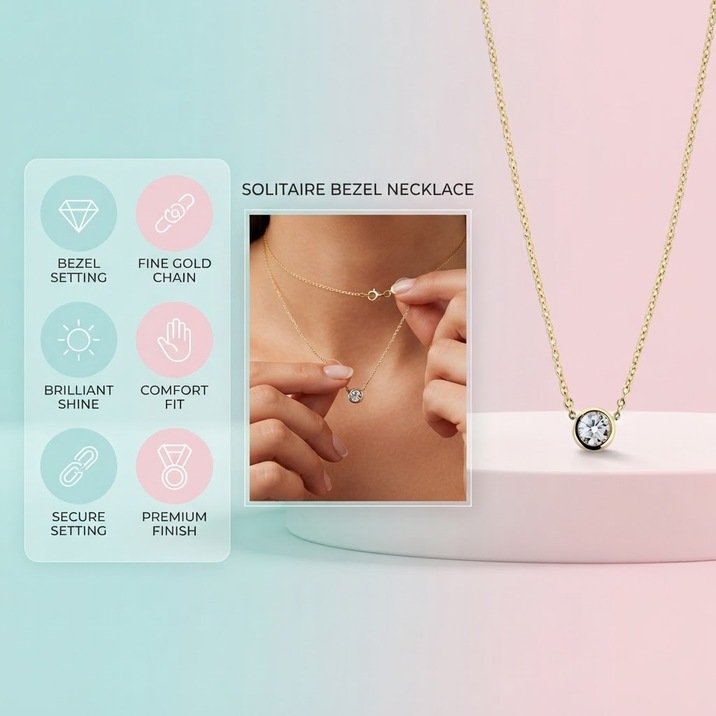
Bezel Lab Grown Diamond Necklace 0.5 ct
The Bezel Lab Grown Diamond Necklace 0.5 ct gives the classic solitaire necklace a clean, modern structure by surrounding a single round diamond with a smooth metal rim. Instead of using prominent prongs, the bezel follows the diamond’s perimeter, creating a compact circular pendant that sits neatly against the neckline.
The current necklace features a minimum 0.5 ct lab-grown diamond measuring approximately 5 mm, with GH color and VS clarity. The complete bezel pendant measures approximately 6.7 mm in diameter and hangs from an adjustable 16–18 inch 14k solid-gold necklace. Current listings include both yellow-gold and white-gold versions.
About Bezel Lab Grown Diamond Necklace 0.5 ct
This necklace keeps the design centered around one diamond rather than spreading the stated carat weight across several smaller stones. That gives the 0.5 ct specification a very different visual effect from a pavé or tennis necklace where total diamond weight is distributed along a chain.
The bezel adds approximately 1.7 mm to the overall diameter, taking the 5 mm diamond to a finished pendant diameter of about 6.7 mm. This creates a visible gold border without turning the setting into a large decorative frame.
For shoppers comparing different necklace formats, the broader Necklace collection brings together gemstone pendants, pearls, chains, and layered styles, while the main Jewellery collection provides a wider look at rings, earrings, bracelets, and other fine-jewelry structures.
Bezel Lab Grown Diamond Necklace 0.5 ct Features
- Jewelry type: Solitaire diamond necklace
- Diamond origin: Lab grown
- Minimum diamond weight: 0.5 ct
- Diamond size: Approximately 5 mm
- Diamond color: GH
- Diamond clarity: VS
- Setting: Full bezel-style setting
- Pendant diameter: Approximately 6.7 mm
- Metal: 14k solid gold
- Current metal colors: Yellow gold and white gold
- Necklace length: Adjustable 16–18 inches
- Gold sourcing claim: 90% recycled 14k gold
- White-gold finish: Rhodium plated
- Overall design: Compact round solitaire pendant with a smooth metal border.
The Bezel Setting Changes The Character Of The Diamond
A bezel setting surrounds the outside edge of a gemstone with metal instead of holding it primarily with individual prongs.
Visually, that produces a more continuous outline. The diamond remains the central feature, but the gold creates a distinct circular border around it.
For a necklace designed for frequent rotation, this also produces a clean surface transition between diamond and setting. There are fewer visually prominent prongs breaking up the perimeter, and the finished pendant reads almost as one small polished disc with a diamond at its center.
The style is especially useful for someone who likes solitaire jewelry but prefers a smoother, more architectural setting than a traditional prong-set pendant.
A True 0.5 ct Single-Stone Look
Carat measures diamond weight rather than diameter. In this necklace, the manufacturer specifies a minimum diamond weight of 0.5 ct and an approximate stone diameter of 5 mm.
That distinction matters when comparing it with multi-stone jewelry.
A necklace labeled 0.5 ct total weight could theoretically distribute that weight among several diamonds. Here, the specification refers to the single bezel-set diamond forming the pendant’s focal point.
The physical dimensions are therefore especially useful when judging the piece online. A 5 mm stone inside a 6.7 mm setting gives a much clearer idea of real-world scale than carat terminology alone.
GIA’s diamond education explains how carat weight works alongside cut, color, and clarity when assessing diamond jewelry.
Lab Grown Diamond Rather Than A Diamond Simulant
The stone is specifically identified as lab grown, and that wording is important.
Laboratory-grown diamonds are not the same category as cubic zirconia, glass, or other materials designed merely to imitate diamond. GIA explains in its lab-grown diamond guide that laboratory-grown diamonds have essentially the same chemical, physical, and optical properties as natural diamonds, although their growth history is different.
The FTC likewise requires clear terminology around laboratory-created diamonds so consumers are not led to believe a lab-grown stone was mined. Its Jewelry Guides cover accurate descriptions for natural, laboratory-created, and imitation gemstones.
For this necklace, lab grown describes the diamond’s origin, not a diamond-like substitute.
Understanding GH Diamond Color
The diamond is specified in the GH color range.
GIA’s internationally used diamond color scale begins at D and continues through Z. D sits at the colorless end, with progressively increasing traces of yellow, brown, or gray appearing farther down the scale.
Grades G and H fall within the near-colorless range.
In a necklace this size, the surrounding metal also influences the overall visual impression. Yellow gold adds warmth around the stone, while white gold creates a cooler frame with less color contrast between the setting and diamond.
That makes metal choice an aesthetic decision as well as a material one.
What VS Clarity Tells You
The listed diamond clarity is VS, meaning Very Slightly Included.
The GIA clarity scale evaluates inclusions and blemishes under 10× magnification. In the VS range, inclusions are considered minor and can range from difficult to somewhat easier for a skilled grader to identify under that magnification.
Clarity should not be confused with color or carat. Each describes a separate characteristic.
For a pendant worn at normal viewing distance, overall appearance is influenced by all of these factors together, including the diamond’s cutting, cleanliness, lighting, and setting.
14k Solid Gold Construction
The necklace is crafted in 14k solid gold rather than gold vermeil or conventional gold plating. The manufacturer currently states that its 14k pieces use 90% recycled gold.
Solid karat gold means the gold alloy forms the jewelry itself rather than serving only as a decorative coating over an unrelated base metal.
That distinction becomes useful when comparing this diamond necklace with fashion pieces such as the Pearl Multi Row Chain Necklace, which takes a more decorative layered approach and uses different materials.
A fine-jewelry solitaire and a layered fashion necklace may both fill the same area around the neckline, but their construction and styling purpose are quite different.
Yellow Gold And White Gold Create Different Frames
Current lab-grown diamond necklace listings show the 0.5 ct design in both 14k yellow gold and 14k white gold.
Yellow gold creates visible warmth around the diamond. Because a bezel surrounds most of the stone’s perimeter, the metal color becomes more visually noticeable than it might be in a very fine four-prong setting.
White gold produces a more tonally continuous effect between diamond and setting.
The manufacturer states that its 14k white-gold jewelry receives a rhodium-plated finish, which contributes to its bright white appearance and surface shine.
The diamond specifications remain the main technical focus, but the metal color noticeably changes the final appearance of the same bezel architecture.
The 6.7 mm Pendant Is Compact But Visible
The complete pendant measures approximately 6.7 mm in diameter.
That places it firmly within a refined solitaire scale rather than oversized pendant territory.
It has enough diameter to create a clearly visible point at the neckline while remaining small enough for layering. The circular bezel also gives the pendant slightly more visual area than the 5 mm diamond would occupy by itself.
For comparison, the site’s Jewellery Page 2 includes additional grown-diamond and stone-led designs, allowing shoppers to compare how diamonds behave when used in rings and other jewelry rather than a single necklace pendant.
Adjustable 16 To 18 Inch Length
The necklace adjusts between 16 and 18 inches.
That two-inch range is useful because a relatively small change in necklace length can noticeably alter where a solitaire sits.
At approximately 16 inches, the pendant stays higher around the neckline. Moving toward 18 inches gives it more drop and can create additional room for a shorter necklace above it.
Actual placement varies according to neck circumference and individual proportions, so the stated measurements are more useful than relying on labels such as short or medium length.
The adjustable construction also makes the necklace easier to reposition for different necklines.
Wearing The Diamond Necklace By Itself
A 0.5 ct solitaire already provides a distinct focal point, so the necklace does not need another pendant beside it.
With an open shirt, scoop neck, square neckline, or simple dress, the small circular setting can occupy the center of the exposed neckline without introducing additional color.
The lack of colored gemstones is one reason it can move easily between different clothing palettes.
It can also work when other jewelry is more decorative. A sculptural ring or detailed earrings can carry additional texture while the necklace remains the clean diamond element.
Layering Without Hiding The Bezel
When layering this necklace, spacing matters.
A second necklace that finishes almost exactly where the bezel sits can visually compete with the diamond or cause the chains to overlap. A clearer length difference leaves the 6.7 mm pendant visible.
The Necklace collection provides several useful contrasts, including pearl and chain-led designs. Pairing a small diamond solitaire with a necklace of noticeably different texture can make each layer easier to distinguish.
The Pearl Multi Row Chain Necklace, for example, creates its visual effect through multiple strands and pearl accents. A bezel solitaire takes the opposite approach, concentrating almost all attention into one small central point.
0.5 ct Versus Smaller Solitaire Necklaces
The manufacturer currently also offers a 0.25 ct version of the same general bezel concept.
The 0.5 ct version is therefore the more substantial single-stone option within that specific bezel family.
This does not mean twice the carat weight translates into a diamond that looks exactly twice as wide. Carat measures weight in three dimensions rather than face-up diameter alone.
The important buying comparison is therefore a combination of carat and actual stone dimensions. Here, the 0.5 ct necklace specifies a 5 mm diamond and 6.7 mm finished pendant, giving a concrete reference for its visible scale.
The Recycled Gold Claim In Context
The current specification states that the 14k gold contains 90% recycled gold.
A recycled-content statement refers to the source of the gold entering the alloy. It does not create a separate karat grade, nor should it automatically be treated as proof of every possible sustainability claim.
The Responsible Jewellery Council’s Chain of Custody standard provides broader industry context for tracing responsibly sourced gold, silver, and platinum-group metals through jewelry supply chains.
Keeping these terms separate makes the product description more useful: the necklace is 14k gold, and the manufacturer states that 90% of the gold used is recycled.
Keeping The Diamond And Bezel Clean
Diamonds attract oils easily, and even a high-quality stone can appear less bright when skin products or other residue collect on its surface.
GIA’s diamond care guidance identifies lint-free cloths, suitable jewelry-cleaning solutions, and mild household detergents as appropriate methods for diamond care.
A bezel deserves attention around the boundary where the stone meets the metal because residue can settle near the setting.
Avoid abrasive household cleaners and toothpaste. GIA cautions that abrasive products can scratch gold and that some harsh chemicals can damage metals used in diamond settings.
After cleaning, rinse appropriately and dry the necklace thoroughly with a soft, lint-free cloth.
Store The Fine Necklace Separately
The diamond is highly resistant to scratching, but the surrounding gold chain and bezel can still develop marks through repeated contact with harder jewelry.
Keep the necklace in an individual soft compartment rather than allowing it to become tangled with chains, rings, or earrings.
Fastening the clasp before storage can also reduce the chance of the chain feeding through itself and forming knots.
Extra care is useful when the jewelry box contains other diamonds. Diamond can scratch many other materials, so separating individual pieces helps protect both the gold setting and neighboring jewelry.
What Sets Bezel Lab Grown Diamond Necklace 0.5 ct Apart
The strongest feature of this necklace is the balance between a meaningful solitaire size and a very controlled setting.
A minimum 0.5 ct lab-grown diamond with GH color and VS clarity forms the centerpiece. Its approximately 5 mm diameter expands to a 6.7 mm finished pendant once surrounded by the smooth bezel. The adjustable 16–18 inch solid-gold necklace gives enough flexibility for solo wear or layering.
It is also clearly differentiated from both simulated-diamond jewelry and mined-diamond pieces. The stone is a laboratory-grown diamond, while the setting is 14k solid gold with current yellow- and white-gold options.
For further comparisons, the Necklace collection, broader Jewellery selection, diamond-focused Jewellery selection, and Pearl Multi Row Chain Necklace provide useful internal paths for comparing solitaire, layered, gemstone, pearl, and other jewelry constructions.


Reviews
There are no reviews yet.