

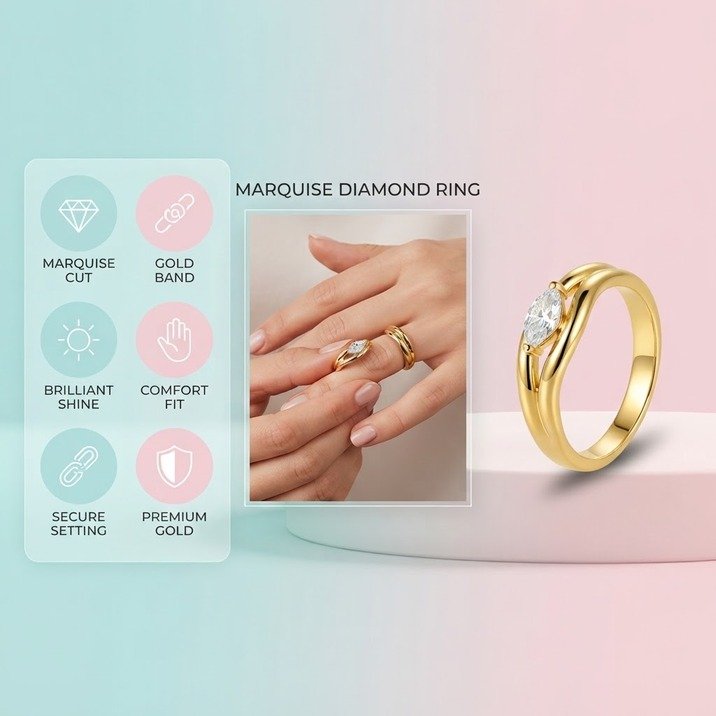
Dôme Figure Balance Ring
The Dôme Figure Balance Ring takes the rounded, fluid character of a classic Dôme band and interrupts it with a pear-cut gemstone that appears to hover above the curve. The result is intentionally asymmetrical. Instead of placing a stone directly in the center of a conventional setting, the design uses open space and an offset gemstone to make the ring feel sculptural from several angles.
The current specification gives the gemstone a 6 × 4 mm profile, with an approximately 3.40 mm top width and 2.30 mm shank width. Sizes currently run from 4 through 10. The main product page shows an 18k gold vermeil and garnet version, while current Dôme listings also include lab-grown white sapphire options in gold vermeil and sterling silver.
About Dôme Figure Balance Ring
The key feature here is not simply the pear-shaped gemstone. It is the way that stone interacts with the ring.
A standard gemstone ring commonly places its stone directly above the center of the band. Dôme Figure Balance Ring shifts that relationship. The curved metal approaches the gemstone without visually enclosing it in a heavy, symmetrical setting, creating the impression that the stone is suspended above the band. Mejuri describes the design as a pear-cut gemstone floating above the ring.
That open construction gives the piece a different character from a conventional center-stone ring such as the Topaz Ring in Sterling Silver, where the gemstone sits within a more traditional decorative setting.
Dôme Figure Balance Ring Features
- Jewelry type: Sculptural gemstone ring
- Collection style: Dôme Figure
- Design: Curved open form with an offset pear-cut gemstone
- Current featured material: 18k gold vermeil over sterling silver
- Featured gemstone: Garnet
- Other current stone option: Lab-grown white sapphire
- Sterling-silver option: Available with lab-grown white sapphire in current collection listings
- Stone dimensions: Approximately 6 × 4 mm
- Top width: Approximately 3.40 mm
- Shank width: Approximately 2.30 mm
- Current size range: 4–10
- Gold-vermeil base: Sterling silver
- Recycled silver claim: 91% recycled sterling-silver base on the current vermeil version
- Manufacturer positioning: Hypoallergenic
- Best visual characteristic: Offset stone, curved metal, and deliberate negative space.
The Pear Cut Is Central To The Balance Effect
A pear cut combines a rounded end with a tapered point. That directional shape makes it especially effective in an asymmetrical design because the stone has an obvious orientation.
A round gemstone can look visually similar from almost every direction. A pear-shaped stone changes depending on where its pointed end faces. In Dôme Figure Balance Ring, that directional character works with the curved band to create movement across the top of the finger.
The gemstone is approximately 6 mm long and 4 mm wide, making it large enough to remain clearly recognizable without turning the ring into a tall solitaire.
This proportion also provides a useful contrast with other rings in the Jewellery collection, where stone size, band width, and setting architecture vary considerably between designs.
Garnet Gives The Gold Vermeil Version A Deeper Contrast
The current main product listing presents the ring in 18k gold vermeil with garnet. The combination creates a strong distinction between the warm metal surface and the deeper gemstone color.
Garnet is actually a group of related minerals rather than one single mineral variety. Its colors can vary, although rich red tones are among the best-known appearances in jewelry. GIA’s garnet buying information provides additional gemological context for the material.
Because natural gemstones can vary, small differences in tone or internal appearance should not automatically be treated as faults. The exact stone in a finished ring may not look completely identical to another natural garnet photographed under different lighting.
Here, color becomes especially noticeable because there is relatively little metal immediately surrounding the 6 × 4 mm stone.
Lab Grown White Sapphire Creates A Clearer Alternative
Current Dôme collection listings also show the Balance Ring with lab-grown white sapphire, including both 18k gold-vermeil and sterling-silver versions.
White sapphire changes the visual direction significantly. Instead of using strong gemstone color as the focal point, it creates a clearer, more neutral point of light above the curved band.
Laboratory-grown sapphire should not be confused with glass or another gemstone simulant. GIA explains that synthetic counterparts of gemstones can have essentially the same chemical, physical, and optical properties as their natural equivalents while being grown in a laboratory.
GIA also identifies colorless corundum as white sapphire within the sapphire family. Its sapphire quality information provides useful background on sapphire as a gem material.
The important buying distinction is therefore origin. A lab-grown white sapphire is sapphire produced in a controlled environment rather than a naturally formed sapphire mined from the earth.
18k Gold Vermeil Over Sterling Silver
The gold-toned version is described as 18k gold vermeil, not solid 18k gold.
Vermeil uses a precious-metal structure with gold applied over sterling silver. The FTC’s gold and silver jewelry guidance specifically identifies vermeil as gold-plated jewelry with sterling silver underneath.
That makes the construction materially different from both solid-gold jewelry and ordinary gold-colored base-metal pieces.
The current manufacturer specification states that its vermeil uses a thick layer of 18k gold over a 91% recycled sterling-silver base. This percentage refers to recycled content within the sterling-silver material used by the manufacturer. It should not be interpreted as meaning that 91% of every component in the complete ring is recycled.
The Responsible Jewellery Council’s Chain of Custody standard provides wider context for how gold and silver can be traced through responsible precious-metal supply chains.
3.40 mm Top And 2.30 mm Shank Create A Leaner Dôme Shape
The measurements help explain why this ring feels different from a broad traditional Dôme band.
Its upper metal section measures approximately 3.40 mm wide, while the shank is about 2.30 mm. The difference is modest enough to maintain visual continuity around the finger but still gives the upper curve more presence.
The related Dôme Figure Ring provides useful context. Its current specification has a top width of approximately 5.8 mm, a 3.5 mm top height, and a 2 mm shank thickness.
The Balance Ring therefore uses a narrower metal profile and lets the gemstone occupy more of the visual attention. This is an inference from the two sets of dimensions, rather than a separate manufacturer claim.
For another internal comparison based around band structure rather than a pear stone, the third Jewellery selection includes sculptural and pinky-ring directions that can help shoppers compare how width and surface form affect a ring’s overall character.
Negative Space Is Part Of The Design
The empty area around the gemstone is not simply unused space.
It prevents the ring from becoming a conventional closed, symmetrical setting and allows the eye to separate three elements: the gemstone, the curved upper band, and the finger visible between them.
That is why the ring can look substantial without relying on a particularly wide band.
Negative space also affects stacking. When another ring is placed beside an open or asymmetrical piece, the neighboring band can become visible through parts of the design. The stack therefore changes the appearance of the Balance Ring more noticeably than it would change a completely closed band.
Ring Sizing Deserves Attention With An Offset Stone
The current size range is US 4 through 10.
With an asymmetrical ring, fit matters for more than comfort. A ring that is too loose may rotate, changing the intended orientation of the pear-cut stone. A secure but comfortable fit helps keep the sculptural top positioned where it was designed to sit.
Finger size can vary during the day and with temperature. It is better to base the choice on an actual ring measurement or accurate finger measurement rather than assuming that every ring from every brand fits identically.
The 2.30 mm shank is not an especially wide full band, but the offset gemstone adds visual and physical presence to the upper surface.
Wearing Dôme Figure Balance Ring On Its Own
This ring has enough visual information to work without an accompanying stack.
There is gemstone color or clarity, a directional pear shape, a curved band, and visible open space. Leaving the neighboring fingers relatively simple gives those details room to register.
The garnet version is particularly suited to this approach because the darker colored stone naturally becomes a focal point against gold vermeil. The white-sapphire versions read more neutrally and can coordinate easily with clear-stone or plain-metal jewelry. Current listings confirm both gemstone directions within the collection.
A simple ring worn elsewhere on the hand can repeat the metal color without duplicating the same shape.
Building A Dôme-Inspired Ring Stack
The manufacturer specifically positions the Balance Ring as compatible with other Dôme Figure rings. That makes sense structurally because the surrounding collection uses related rounded curves rather than unrelated geometric forms.
The important consideration is spacing.
A perfectly straight band may sit differently against the asymmetrical top than another curved or nesting ring. Before building a tight stack, look at where the neighboring ring touches the Balance Ring rather than assuming two rings in the same nominal size will sit completely flush.
The second Jewellery collection page is also useful when comparing gemstone and diamond-led ring styles before deciding whether the Balance Ring should be the main stone piece or one part of a larger hand stack.
If the goal is contrast rather than matching, the Topaz Ring in Sterling Silver shows how a more traditional gemstone presentation can sit at the opposite end of the design spectrum.
Coordinating The Ring With Other Jewelry
Because the ring already combines shape and gemstone detail, other jewelry does not need to reproduce the same motif.
With the garnet version, small plain gold-toned earrings or a restrained chain can keep the hand as the primary point of color. With white sapphire, a clear-stone stud or fine necklace can repeat the bright gemstone effect without creating an exact matching set.
Mixed-metal styling can also work with the sterling-silver version. Repeating the silver tone in one additional piece is enough to make the combination feel intentional.
For broader coordination across earrings, bracelets, chains, and rings, the main Jewellery category provides the strongest internal route because it keeps those related accessories together.
Care Depends On The Gemstone And Metal Version
The safest care method should account for both the stone and the surrounding metal.
For garnet, GIA states that warm soapy water is a safe cleaning method and advises against steam cleaning. Its garnet care guide also notes that ultrasonic cleaning may not be suitable when fractures are present.
For sapphire, GIA likewise identifies warm soapy water as a safe method. Its sapphire care guidance explains that treatment status can affect whether stronger cleaning methods are appropriate.
With gold vermeil, gentle cleaning is preferable because the gold is a surface layer over sterling silver. Abrasive polishing can gradually affect plated surfaces. A soft cloth and mild cleaning approach are therefore more appropriate than aggressive metal-polishing compounds.
The ring should also be stored separately from harder-edged pieces where possible. The offset gemstone and open structure make it sensible to avoid situations where chains, prongs, or other rings can catch against it.
What Makes Dôme Figure Balance Ring Different
Dôme Figure Balance Ring is best understood as a sculptural gemstone ring, rather than simply another pear-cut stone setting.
The 6 × 4 mm gemstone is deliberately separated from the conventional centered-ring format. Its relationship with the curved 3.40 mm top and 2.30 mm shank creates the visual tension behind the Balance name.
Material choice changes that design noticeably. Garnet with 18k gold vermeil creates stronger color contrast, while current lab-grown white sapphire versions offer a clearer stone against either warm vermeil or cooler sterling silver.
For someone comparing ring architecture rather than looking only at gemstone size, this is where the design becomes interesting. It uses a relatively small set of elements, one pear-shaped stone, one flowing band, and carefully placed open space, but arranges them in a way that looks noticeably different from a standard solitaire or straight gemstone band.


Reviews
There are no reviews yet.