

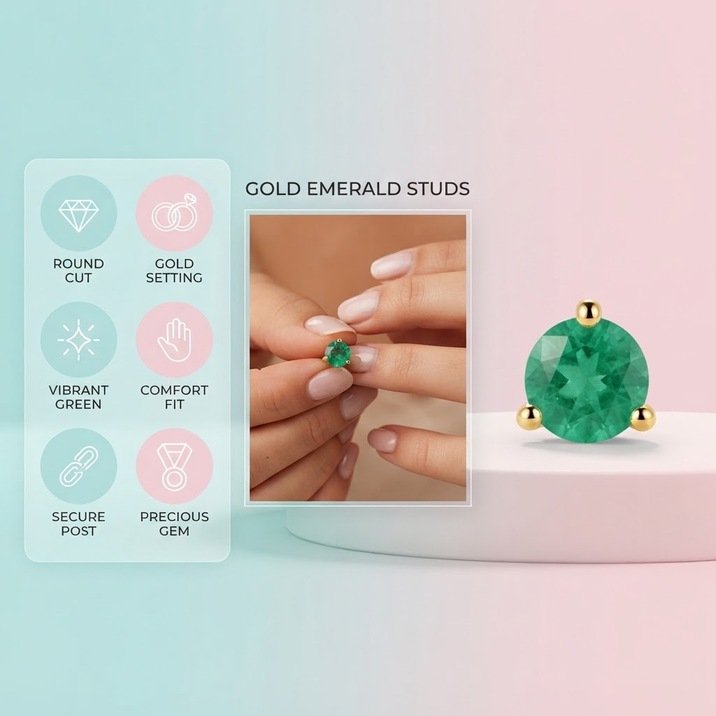
Gemstone Mini Studs
Gemstone Mini Studs turn a very small earring format into a full color wardrobe. Each pair uses 10k solid yellow gold with approximately 3 mm stones, keeping the setting compact while letting the selected gemstone provide most of the visual identity. The current range spans twelve month-based stone options, from deep garnet and amethyst through emerald, ruby, opal, pearl, and Swiss blue topaz.
Because every stone sits within the same restrained stud format, changing the gemstone can alter the mood of the earrings without changing their basic proportions. That makes the design particularly useful for mixing different colors across an ear stack or choosing one small pair as an uncomplicated everyday accent.
About Gemstone Mini Studs
Gemstone Mini Studs are built around one straightforward idea: a small round stone framed by warm yellow gold. There are no chains, oversized settings, or elaborate drop elements competing with the gemstone, so color remains the defining feature.
The approximately 3 mm stone size keeps the earrings noticeably smaller than many conventional gemstone studs. That scale also gives them a very different role from the larger earrings found in Hotscope’s Jewellery collection, where shoppers can compare studs against chandeliers, necklaces, bracelets, rings, and other jewelry forms.
Gemstone Mini Studs Features
- Jewelry type: Mini gemstone stud earrings
- Metal: 10k solid yellow gold
- Gold sourcing claim: 90% recycled 10k gold
- Stone size: Approximately 3 mm
- January: Garnet
- February: Amethyst
- March: Aquamarine
- April: Lab-grown white sapphire
- May: Emerald
- June: Pearl
- July: Ruby
- August: Peridot
- September: Blue sapphire
- October: Opal
- November: Citrine
- December: Swiss blue topaz
- Manufacturer positioning: Water resistant and hypoallergenic
- Design profile: Small gold setting with a single colored or light-toned stone.
One Stud Shape With Twelve Different Color Directions
The value of this design comes from consistency.
Every variation maintains the same approximately 3 mm scale, so the earrings can be mixed without one month’s option becoming dramatically larger than another. The main change is color and gemstone character.
Garnet creates a deeper red direction, while amethyst introduces purple. Aquamarine and Swiss blue topaz move toward cooler blue tones, emerald and peridot bring two noticeably different greens, and ruby adds a stronger red. Blue sapphire offers a darker blue option, while citrine shifts toward warmer yellow and golden tones.
Pearl, opal, and lab-grown white sapphire behave differently from strongly colored transparent gemstones. Pearl contributes soft luster, opal can display a more complex play of color, and white sapphire creates a clearer, more neutral look.
Readers who want a technical introduction to these materials can refer to the Gemological Institute of America’s gem encyclopedia, which covers the mineralogical characteristics and quality factors of many of the stones represented in the collection.
The Month Labels Are A Jewelry Palette, Not A Universal Birthstone Standard
The month-based organization is useful for gifting, but it is important not to confuse a retailer’s selected stone palette with one universal birthstone system.
For example, this collection assigns lab-grown white sapphire to April and Swiss blue topaz to December. GIA’s established birthstone guide identifies diamond as April’s traditional modern birthstone and lists tanzanite, turquoise, and zircon among December’s recognized birthstones.
That does not make the earring choices incorrect. It simply means these month-to-stone combinations should be understood as the collection’s selected interpretation rather than presented as the only accepted birthstone chart.
This distinction is particularly useful for shoppers choosing a birthday gift. Someone may prefer the color associated with the product’s month option even if it differs from another traditional or modern birthstone list.
10k Solid Yellow Gold Construction
All currently listed Gemstone Mini Studs use 10k solid yellow gold, and the manufacturer states that the alloy contains 90% recycled gold.
Solid karat gold differs from gold-plated jewelry because the gold alloy forms the body of the setting rather than serving only as a thin outer coating. The Federal Trade Commission’s precious-metal guidance explains how karat descriptions relate to gold content and why terms such as solid gold, plated gold, and vermeil should not be treated as interchangeable.
The yellow-gold setting also acts as a visual constant across the twelve stone choices. Even when the stone moves from purple to green or red to blue, the warm metal keeps the collection visually connected.
For a very different use of colored stone and metal, Hotscope’s Topaz Ring in Sterling Silver places a blue topaz-style center stone within a cooler silver-toned ring format. The comparison shows how strongly metal color can affect the presentation of a gemstone.
Natural Gemstones Will Not Always Match Perfectly
The current product specification notes that natural gemstone colors may vary slightly. This matters for options such as garnet, amethyst, aquamarine, emerald, ruby, peridot, sapphire, citrine, and topaz.
Natural gem material can show differences in saturation, tone, inclusions, and internal structure. Two 3 mm stones belonging to the same gem variety therefore do not have to look microscopically identical.
That variation should be distinguished from the explicitly lab-grown white sapphire April option. Laboratory-grown material has a different origin and should be labeled clearly rather than being presented as natural mined sapphire.
FTC jewelry rules emphasize the importance of accurately distinguishing laboratory-created gemstones from mined counterparts when they are marketed to consumers.
Pearl Is Different From The Mineral Gemstones In The Set
The June option uses pearl, making it materially different from most of the other choices. Pearls are organic gems formed within mollusks rather than crystals extracted from mineral deposits.
They also require different care.
GIA’s June birthstone guidance advises gentle treatment of pearls and recommends wiping them with a soft, damp cloth after wear. This matters because a cleaning method suitable for a durable sapphire may not be appropriate for a pearl.
The pearl option can therefore provide a softer visual alternative within the same mini-stud proportions, but it should not be treated as though its material properties are identical to ruby, sapphire, or aquamarine.
Opal Needs Its Own Care Considerations Too
October’s opal variant is another option that deserves more careful handling.
GIA notes that opal can be vulnerable to scratching, impact, high heat, and abrupt temperature changes. Its opal care information identifies warm soapy water as a safe cleaning approach while cautioning against harsher methods.
This is a good example of why owning several Gemstone Mini Stud colors does not necessarily mean every pair should receive exactly the same cleaning treatment.
The shared 10k gold setting may be consistent, but the stones themselves have different hardness, toughness, stability, and treatment considerations.
Ruby And Sapphire Offer Greater Gemstone Durability
Ruby and blue sapphire both belong to the corundum family.
GIA rates corundum at 9 on the Mohs hardness scale and describes it as a highly durable gemstone material for jewelry. That gives the July ruby and September sapphire versions a different durability profile from softer or more delicate options such as pearl and opal.
Hardness is not the only factor that matters, however. GIA’s broader explanation of gem durability notes that gemologists also consider toughness and stability rather than judging jewelry solely from a Mohs number.
That is useful context when comparing twelve different stones within one earring design. A gemstone can be relatively hard but still require care because of cleavage, treatments, heat sensitivity, or other structural characteristics.
Emerald, Peridot And Topaz Benefit From Gentler Cleaning
The collection includes several stones where conservative care is particularly sensible.
GIA recommends warm soapy water and gentle cleaning for emeralds because many natural emeralds contain surface-reaching fractures or filling materials that make steam and ultrasonic cleaning risky. Peridot is also best cleaned with warm soapy water, while rapid heat changes and aggressive cleaning methods are discouraged.
Topaz presents another consideration. GIA notes that some treated topaz can have surface coatings that may be affected by abrasive cleaning.
For a collection containing so many different gem materials, the safest general rule is therefore not to assume that one powerful jewelry-cleaning machine is appropriate for every pair.
GIA’s broader jewelry care guidance specifically cautions that ultrasonic cleaners are unsuitable for several gem types and treatments.
A 3 mm Stud Works Particularly Well In An Ear Stack
At approximately 3 mm, Gemstone Mini Studs take up relatively little space on the ear. That makes them especially useful when several earrings need to share one ear without every piece having equal visual weight.
A mini gemstone can occupy a second or third lobe position while a larger earring anchors the first piercing. Alternatively, two or three different Gemstone Mini Stud colors can create a deliberately mixed arrangement.
The Jewellery collection currently includes Chain Studs, which provide a useful contrast because their chain construction introduces movement and length where these mini gemstone studs remain close to the ear.
Hotscope’s second Jewellery page also includes Micro Chatelaine Stud Earrings, giving shoppers another stud-based direction to compare against the single-stone mini format.
Mini Studs Versus Statement Earrings
The small format also becomes easier to understand when placed beside a deliberately dramatic earring.
Hotscope’s Cherryparty Chandelier Earring uses a long, decorative silhouette with glass accents and visible movement. Gemstone Mini Studs take almost the opposite approach: one small stone, compact placement, and no suspended elements.
That difference gives the two styles distinct roles in a jewelry wardrobe.
A chandelier earring can become one of the first details noticed in an outfit. A 3 mm gemstone stud is more likely to function as a controlled accent, adding color without occupying much visual space.
Choosing A Color For Everyday Wear
The month label does not have to dictate the choice.
Someone drawn to cool colors may prefer aquamarine, blue sapphire, or Swiss blue topaz regardless of birth month. Green jewelry can move from the richer appearance of emerald to the brighter yellow-green character generally associated with peridot, while amethyst provides a clearly different purple direction.
More neutral-looking options such as pearl and lab-grown white sapphire are easier to combine with many other jewelry colors because they do not introduce as strong a hue.
The small 3 mm scale also makes stronger colors relatively easy to wear. A rich ruby or garnet in this format adds only a small point of red rather than turning the earrings into large colored-stone statements.
Mixing Gemstone Colors Without Making The Ear Look Busy
When several piercings are involved, repetition can make mixed colors feel intentional.
One approach is to use two Gemstone Mini Studs in different colors but keep the shared yellow-gold metal visible throughout the ear. The matching metal becomes the connection between otherwise different stones.
Another approach is to use one colored gemstone stud beside a plain gold stud or chain-based piece. This gives the gemstone a clearer role as the color accent rather than creating several competing colors.
Because all twelve current Gemstone Mini Stud options use the same 10k yellow-gold foundation, they are particularly well suited to this kind of controlled mixing.
Recycled Gold And Responsible Sourcing Context
The manufacturer currently states that its 10k solid gold contains 90% recycled gold. That is a specific recycled-content claim and should not be automatically expanded into claims that every component of every stud has a particular certification.
For broader context, the Responsible Jewellery Council’s Chain of Custody standard sets out systems for tracing responsibly sourced gold, silver, and platinum-group metals through jewelry supply chains.
This distinction keeps the product description accurate. Recycled content explains something about the source of the metal input, while certification and full supply-chain traceability are separate questions that require their own evidence.
Caring For A Mixed Gemstone Collection
The biggest care mistake with Gemstone Mini Studs would be assuming that all twelve pairs can be treated identically.
The solid-gold setting is only one component. Pearl, opal, emerald, peridot, topaz, sapphire, ruby, aquamarine, and the other stones each have their own durability characteristics.
For routine storage, keep the earrings in separate soft compartments so harder gemstones are not repeatedly rubbing against softer materials. GIA also recommends protecting jewelry from scratching and impact during storage and travel.
Cosmetics, fragrance, hairspray, chlorine, and household chemicals should also be considered. GIA notes that delicate porous gem materials such as pearls can be affected by perfume, makeup, and chlorine.
When cleaning a specific pair, follow guidance appropriate to that exact gemstone instead of choosing the strongest cleaning method available.
What Makes Gemstone Mini Studs Useful In A Jewelry Collection
Gemstone Mini Studs are less about one dramatic jewelry statement and more about giving the same small format several personalities.
The constant elements are 10k solid yellow gold and an approximately 3 mm stone size. The variables are color, gemstone origin, optical character, durability, and care requirements.
That consistency makes them easy to compare. Garnet, amethyst, aquamarine, lab-grown white sapphire, emerald, pearl, ruby, peridot, blue sapphire, opal, citrine, and Swiss blue topaz can all occupy essentially the same amount of space on the ear while producing noticeably different results.
For shoppers comparing that compact gemstone format with other jewelry constructions, Hotscope’s main Jewellery selection, the stud-focused options on Jewellery Page 2, the statement-scale Cherryparty Chandelier Earring, and the colored-stone Topaz Ring in Sterling Silver provide useful internal comparisons across size, movement, metal, and gemstone presentation.
:::



Reviews
There are no reviews yet.