

Lab Grown Sapphire Tennis Necklace
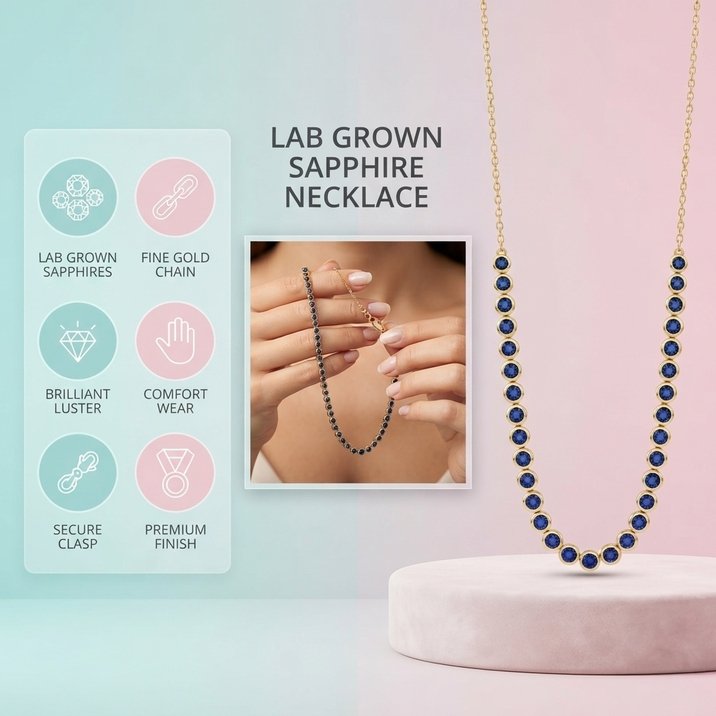
The Lab Grown Sapphire Tennis Necklace brings the clean, continuous-stone look of classic tennis jewelry into a more accessible gemstone format. A closely set line of lab-grown sapphires creates consistent shine around the neckline, while the choice of 15.5-inch or 17.5-inch lengths lets the necklace sit either closer to the collarbone or slightly lower.
With 3 mm stones and a slim 3.6 mm overall width, the design has enough presence to work as a standalone necklace without becoming bulky. It is also easy to combine with simpler chains from the necklace collection when a layered jewelry look is preferred.
About Lab Grown Sapphire Tennis Necklace
This necklace is built around a traditional tennis-jewelry arrangement, meaning individually set gemstones continue along the strand to create an uninterrupted line of color and reflected light.
The current gold-tone version uses 18k gold vermeil over sterling silver and is set with lab-grown sapphires. The manufacturer describes its sterling-silver base as containing 91% recycled material and lists the necklace as hypoallergenic. Individual metal sensitivities can still vary, so “hypoallergenic” should not be understood as a guarantee that no wearer will ever experience sensitivity.
Shoppers comparing it with different jewelry constructions can also browse the wider Jewellery collection, where gemstone, pearl, sterling-silver and other jewelry styles can be considered alongside it.
Lab Grown Sapphire Tennis Necklace Features
- Stone: Lab-grown sapphire
- Stone size: 3 mm
- Necklace width: 3.6 mm
- Setting height: 4 mm
- Available lengths: 15.5 inches and 17.5 inches
- Gold-tone material: 18k gold vermeil over sterling silver
- Base-metal detail: Sterling silver made with 91% recycled content
- Closure: Tongue-style clasp with two additional safety arms
- Manufacturer positioning: Hypoallergenic
- Style: Continuous tennis necklace
- Finish: Polished gemstone and precious-metal appearance
Lab-Grown Sapphire Explained
A lab-grown sapphire is not simply blue glass made to resemble sapphire. Laboratory-created sapphire is synthetic corundum produced under controlled conditions.
The Gemological Institute of America explains that synthetic counterparts of gemstones can have essentially the same chemical, physical and optical properties as their natural equivalents. The important difference is their origin: natural sapphire forms geologically, while laboratory-grown sapphire is produced by people under controlled conditions.
GIA’s broader information about synthetic gem materials also documents several established methods for producing synthetic sapphire, including flame-fusion, flux-growth and other laboratory processes.
That distinction makes accurate naming important. “Lab grown sapphire” describes the stone’s origin and should not be presented as natural mined sapphire.
Sapphire Size And Necklace Proportions
Each sapphire measures approximately 3 mm, while the finished necklace measures approximately 3.6 mm across and 4 mm high. Those measurements create a relatively narrow continuous gemstone line rather than the oversized appearance of chunky statement jewelry.
The 15.5-inch option is designed to sit comparatively high around the neckline. The 17.5-inch version provides another two inches of length, giving more room between the necklace and neck.
Exact placement will still depend on neck circumference, clothing neckline and individual proportions.
For someone who prefers a softer layered effect instead of a single uninterrupted gemstone strand, the Pearl Multi Row Chain Necklace provides a useful contrast between tennis-style symmetry and mixed-chain, pearl-based styling.
18k Gold Vermeil And Sterling Silver Construction
The term gold vermeil has a specific meaning and should not be treated as another name for ordinary gold-tone jewelry.
The U.S. Federal Trade Commission’s consumer information on gold and silver jewelry explains that vermeil is a form of gold-plated jewelry that uses sterling silver as the underlying metal. The Lab Grown Sapphire Tennis Necklace uses an 18k gold vermeil finish over its sterling-silver foundation.
It is also worth distinguishing two numbers that can easily be misunderstood. The manufacturer’s 91% recycled sterling silver statement refers to the recycled content used in the base metal. It does not mean the necklace contains only 91% silver. The FTC separately explains the standards associated with terminology such as sterling silver in its Jewelry Guides.
Secure Tennis Necklace Clasp
A gemstone strand needs a closure that can support the necklace without distracting from the continuous line of stones.
This design uses an inner tongue that slides into the clasp until secured. Two horizontal safety arms then close around the sides of the clasp, providing secondary security. To release the necklace, those safety arms are opened before the vertical release mechanism is pressed.
This multi-part construction is particularly useful on a tennis necklace because the clasp remains relatively compact while adding more security than a simple single-action closure.
Sapphire Durability
Sapphire is one of the harder gemstones commonly used in jewelry. GIA gives corundum, the mineral family that includes sapphire, a hardness of 9 on the Mohs scale and describes it as having excellent toughness.
That makes sapphire suitable for jewelry intended for regular wear, but hardness should not be confused with being indestructible. Hard surfaces can still damage settings, and another sapphire or diamond can scratch the polished surface.
The setting, clasp and vermeil finish also require consideration separately from the durability of the stones themselves.
If gemstone jewelry is a central part of a collection, a piece such as the Topaz Ring Sterling Silver Women Rings can create a coordinated colored-stone look without requiring every piece to use the same gemstone.
Styling The Tennis Necklace
One advantage of this design is that its visual impact changes considerably depending on what surrounds it.
Against an open neckline, the uninterrupted sapphire strand becomes the central jewelry feature. With a crew-neck knit, shirt or simple dress, it can add a more defined polished edge without requiring a large pendant.
The shorter length works particularly well when the intention is to keep the stones visually close to the neckline. The longer option leaves additional room for layering.
When several necklaces are worn together, leaving a noticeable length difference between each strand generally gives every piece enough visual space. A plain chain below or above the sapphire necklace can also balance its continuous sparkle without competing with it.
Lab-Grown Sapphire Versus Diamond Tennis Jewelry
A sapphire tennis necklace and a diamond tennis necklace may share almost the same underlying silhouette, but the gemstones create a different visual character.
Diamond tennis necklaces are typically selected primarily for colorless brilliance. Sapphire brings the recognizable properties of corundum and, depending on the particular sapphire option, can introduce more obvious gemstone character or color.
Lab-grown sapphire also should not be described as a lab-grown diamond alternative in the technical sense. Sapphire is corundum, whereas diamond is crystalline carbon. They are different gemstones with different optical and physical characteristics.
The similarity here comes from the tennis setting and continuous-stone design, not from the stones being chemically alike.
Jewelry Care And Storage
Sapphire itself is relatively straightforward to maintain. GIA’s sapphire care guidance notes that warm soapy water is generally safe for sapphire.
A complete necklace needs slightly more care because the gemstones are only one part of the piece. Gold vermeil is a surface finish, so repeated rubbing, abrasive cleaners and unnecessary chemical exposure can gradually affect its appearance.
For routine care, gently wipe the necklace with a clean, soft cloth after wear. Keep perfume, hairspray, lotions and household cleaners from building up on the surface. Store it flat or carefully arranged rather than tightly folded, which can place unnecessary stress on the individual tennis links.
It is also sensible to store the necklace separately from harder jewelry. Sapphire is hard enough to scratch many other gemstones and metals, while diamonds and other sapphires can potentially scratch sapphire.
A Refined Choice For Everyday And Occasion Styling
The Lab Grown Sapphire Tennis Necklace works because the design does not depend on oversized details. The visual effect comes from repetition: individually set 3 mm stones form one narrow, consistent line around the neck.
The 18k gold-vermeil construction adds warmth, while the sterling-silver foundation gives the necklace a precious-metal base. Two available lengths make it easier to choose between a close neckline placement and a slightly lower position.
For shoppers building a jewelry wardrobe rather than purchasing a single isolated piece, the broader Necklace collection provides useful options for combining tennis jewelry with pendants, chains and other gemstone necklaces.


Reviews
There are no reviews yet.