

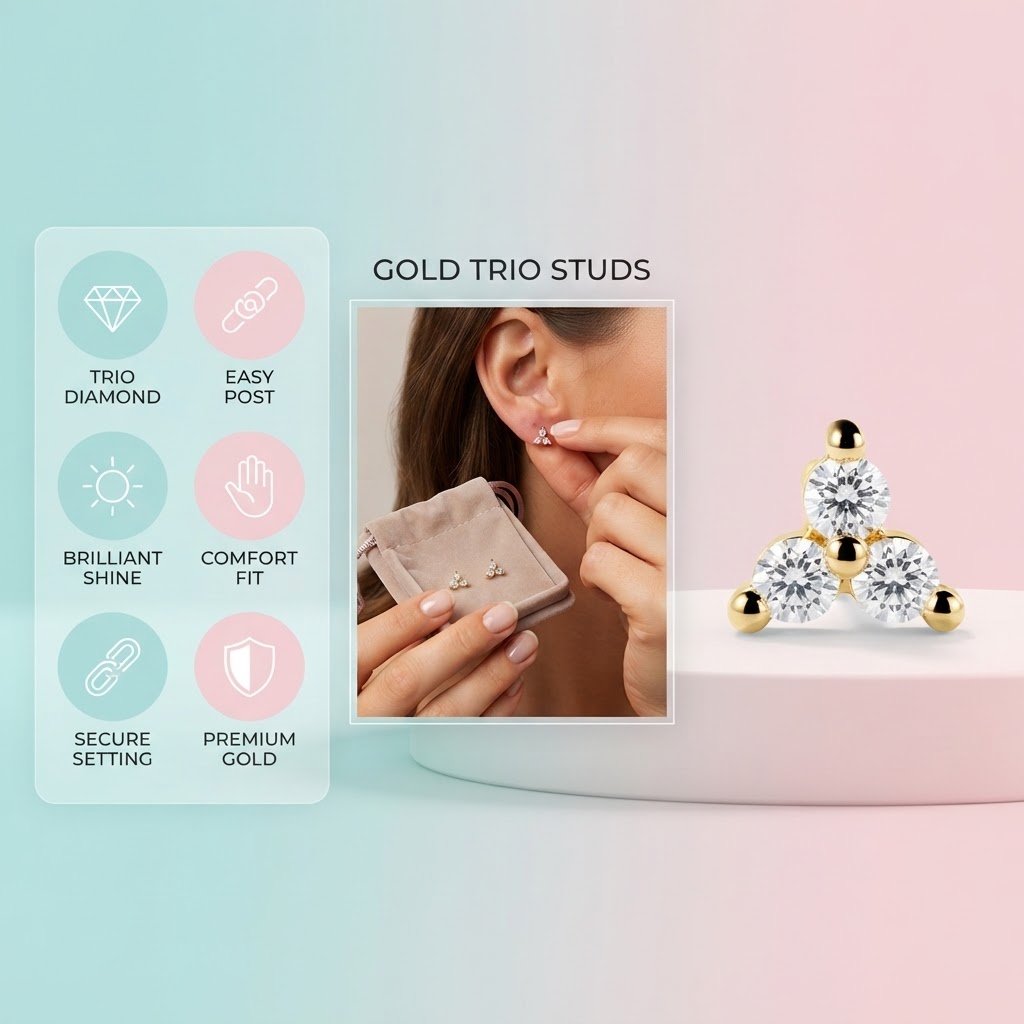
Mini Lotus Diamond Studs
Mini Lotus Diamond Studs bring natural diamonds into a compact floral-inspired arrangement rather than using the familiar single-stone stud format. Each earring uses a small cluster to create the suggestion of lotus petals, giving the pair more shape and texture while keeping the overall profile restrained enough for everyday jewelry styling.
The current specification lists 10k solid yellow gold, natural diamonds, a 0.09 ct average carat weight, GHI diamond color, SI–I clarity, 1.5 mm stones, and a 4.4 mm overall width. The manufacturer also states that the gold contains 90% recycled content and that 93% of its natural diamonds are traceable to a mine or region.
About Mini Lotus Diamond Studs
Instead of making one diamond the entire focal point, Mini Lotus Diamond Studs arrange several small stones into a compact lotus-like cluster. That changes how the earrings read on the ear. From farther away, the diamonds form one bright point; at closer range, the individual stones and petal-inspired arrangement become more apparent.
The design fits naturally within Hotscope’s broader Jewellery collection, where shoppers can compare stud earrings with necklaces, rings, bracelets, anklets, and larger statement earrings. The category currently includes both subtle and more decorative jewelry formats.
Mini Lotus Diamond Studs Features
- Jewelry type: Diamond stud earrings
- Design: Mini lotus-inspired diamond cluster
- Metal: 10k solid yellow gold
- Gold sourcing: 90% recycled gold according to the manufacturer
- Stone: Natural diamond
- Listed average carat weight: 0.09 ct
- Diamond color: GHI
- Diamond clarity: SI–I
- Individual stone size: Approximately 1.5 mm
- Overall width: Approximately 4.4 mm
- Wear profile: Small, close-to-ear stud
- Manufacturer positioning: Water resistant and hypoallergenic
- Natural-diamond traceability claim: 93% traceable to mine or region
The Lotus Cluster Changes The Look Of A Classic Stud
Traditional diamond studs generally place one round stone at the center of the design. Mini Lotus Diamond Studs use a cluster instead.
That arrangement creates several separate reflective surfaces in an area only about 4.4 mm wide. The effect is still delicate, but visually more detailed than a plain gold stud or one small solitaire.
The small scale also makes the lotus shape subtle. These are not oversized floral earrings. The botanical influence is present in the stone arrangement rather than through a large sculpted flower.
For comparison, Hotscope’s Cherryparty Chandelier Earring takes the opposite approach, using a longer statement silhouette and decorative movement. Mini Lotus Diamond Studs remain close to the ear and let proportion rather than size define the design.
Understanding The 0.09 Carat Specification
Carat describes diamond weight, not the physical diameter of an earring.
The Federal Trade Commission’s diamond buying guidance explains that carat is a measure of gemstone weight and may be expressed as either a decimal or fraction.
For these studs, the manufacturer lists an average carat weight of 0.09 ct and individual stone dimensions of approximately 1.5 mm. The 4.4 mm earring width is therefore a more useful specification when judging how large the completed lotus cluster will appear on the ear.
This is an important distinction when comparing clustered diamond jewelry with a single larger stone.
GHI Diamond Color
The natural diamonds are listed in the GHI color range.
GIA’s diamond color scale runs from D through Z. D represents the colorless end of the grading system, while progressively later grades indicate increasing visible body color.
G, H, and I therefore sit within the near-colorless area of the commonly used grading range. Because these particular diamonds are only about 1.5 mm each and grouped closely together, their visual effect also depends on the metal surrounding them, lighting conditions, setting style, and the way the cluster reflects light.
Color grade should consequently be considered alongside the other diamond characteristics rather than treated as a standalone quality score.
What SI–I Clarity Means Here
The listed diamonds have a clarity range of SI–I.
Diamond clarity describes internal inclusions and external blemishes. GIA’s diamond clarity information explains that grading considers factors including the size, position, nature, number, and visibility of clarity characteristics when examined under magnification.
With small accent diamonds such as the 1.5 mm stones used here, the practical buying question is not simply whether an inclusion exists. It is how the complete cluster looks at normal wearing distance.
The GIA 4Cs framework](https://4cs.gia.edu/en-us/4cs-of-diamond-quality/) is useful when interpreting specifications such as carat, color, and clarity because these measurements describe different aspects of diamond quality rather than interchangeable ratings.
10k Solid Gold Construction
The settings are made in 10k solid yellow gold, rather than gold-plated base metal. The manufacturer currently states that 90% of the gold used is recycled.
Solid karat gold is materially different from gold plating because the gold alloy forms the piece itself rather than being applied only as a thin decorative surface.
The FTC’s Jewelry Guides cover terminology used for gold, precious-metal alloys, diamonds, gemstones, and similar jewelry materials so that material descriptions can be represented accurately.
Within Hotscope, that makes these studs useful to compare against pieces made from other jewelry materials. The Topaz Ring in Sterling Silver, for example, combines a colored gemstone look with silver-toned metal rather than the warm 10k yellow-gold setting used here.
Diamond Sourcing And Traceability
The manufacturer states that the natural diamonds are responsibly sourced and that 93% are traceable to a mine or region.
Traceability is different from simply identifying a stone as natural. It concerns the information available about where material originated and how it moved through the supply chain.
The Responsible Jewellery Council maintains standards addressing responsible practices across jewelry supply chains, while its current diamond-traceability guidance discusses maintaining evidence about diamond origin through the chain of custody.
For shoppers comparing jewelry, this is more meaningful information than broad phrases such as “ethical diamonds” without an explanation of what sourcing or traceability claim is actually being made.
Scale And Ear Placement
At 4.4 mm wide, Mini Lotus Diamond Studs occupy relatively little physical space. That compact footprint is one of the strongest practical characteristics of the design.
As a main lobe earring, the pair creates a small diamond focal point without becoming the dominant accessory in an outfit. On an ear with multiple piercings, the same dimensions allow the lotus cluster to sit alongside smaller gold studs, huggies, or chain-based earrings.
Hotscope’s Jewellery category also includes Chain Studs, which provide a useful styling contrast because their elongated chain element introduces movement where the Mini Lotus design remains stationary and compact.
The strongest ear stacks usually vary either scale, texture, movement, or shape. Pairing several pieces of identical visual weight can make the arrangement feel crowded, whereas a small diamond cluster can work as the bright point beside simpler gold forms.
Pairing Diamonds With Other Jewelry
These earrings do not require matching diamond jewelry.
Yellow gold makes it easy to connect them visually with plain gold necklaces, bracelets, rings, and other earrings. Their small diamond area also means they can sit alongside another gemstone without creating a strong color conflict.
Someone building a gemstone-focused jewelry collection might contrast the clear diamond appearance with the blue-toned stone in Hotscope’s Topaz Ring. Someone who prefers a more decorative earring rotation could move between these compact studs and the larger Cherryparty Chandelier Earrings depending on the outfit.
For a broader mix of materials and jewelry silhouettes, the main Hotscope Jewellery section also includes necklaces, bracelets, rings, studs, chandelier earrings, and mixed-metal pieces.
Keeping Small Diamonds Bright
Diamond is durable, but jewelry still collects skin oils, cosmetics, soap residue, and everyday dirt, particularly around small settings.
GIA’s diamond jewelry care guidance recommends gentle cleaning with a mild degreasing solution and a soft brush, paying particular attention to areas around and behind the setting where residue can collect.
A soft cloth is useful for the gold surface after cleaning. Store the earrings separately from larger rings, chains, and harder-edged jewelry so the settings are not repeatedly rubbed or caught against other pieces.
Small diamond studs should also be inspected occasionally for any change in stone security. If a setting appears bent or a diamond moves, professional inspection is preferable to continuing to wear the earring.
A Closer Look Before Choosing Mini Lotus Diamond Studs
The appeal of these studs is not simply that they contain diamonds. Their character comes from combining small-scale proportions, clustered natural stones, and solid yellow gold.
The technical specifications make the design easier to understand: 1.5 mm natural diamonds form a lotus-inspired cluster only 4.4 mm wide, while the listed 0.09 ct average carat weight, GHI color, and SI–I clarity provide more useful context than general descriptions of brilliance.
For someone who prefers jewelry that stays visually close to the ear but has more detail than a plain metal stud, Mini Lotus Diamond Studs occupy a useful middle ground. They are decorative without becoming statement earrings, and the compact flower-like arrangement gives a familiar diamond stud a noticeably different identity.



Reviews
There are no reviews yet.