

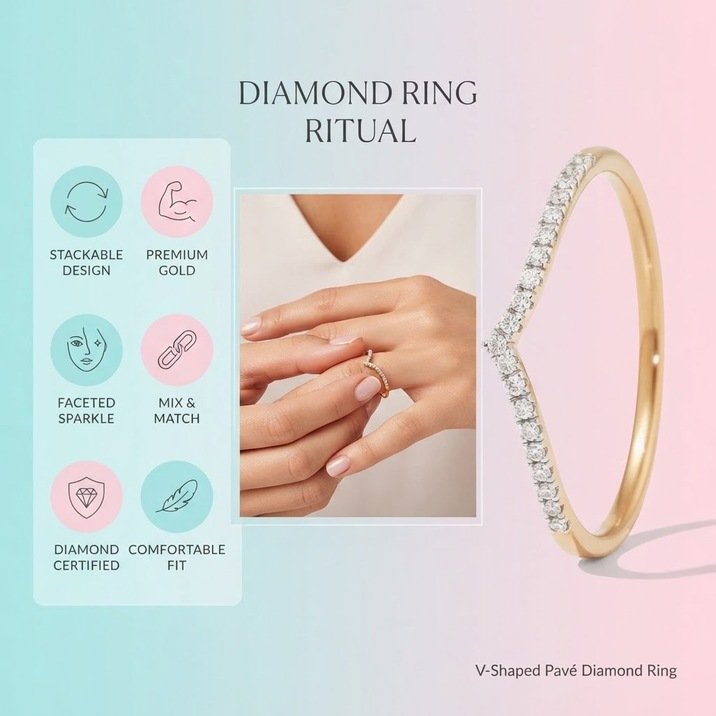
Pavé Diamond Wishbone Ring
Mejuri Pavé Diamond Wishbone Ring is a slim V-shaped fine-jewellery ring handcrafted in solid yellow gold and set with natural pavé diamonds. The current U.S. Mejuri listing offers the ring in 14k yellow gold with natural diamonds and sizes 4 through 10. Its diamond specifications include a minimum total carat weight of 0.092 ct, GHI colour, SI–I clarity, 0.9 mm stones and a 1 mm shank width.
The narrow wishbone shape makes the ring useful both as a standalone diamond accent and as a nesting or stacking ring. Rather than using one central stone, it spreads small diamonds across the V-shaped upper band, creating a continuous line of sparkle while keeping the overall profile fine and understated. Mejuri specifically positions the design as both a stacker and a statement piece.
For jewellery shoppers on Erothots, it fits naturally within the Jewellery collection. It can also be compared with the Topaz Ring Sterling Silver Women Rings when choosing between a slim diamond-set gold design and a larger coloured-stone ring.
About Pavé Diamond Wishbone Ring
The defining feature of the Pavé Diamond Wishbone Ring is its curved V-shaped silhouette.
Instead of forming a straight horizontal band across the finger, the upper section dips toward the centre. This type of design is often called a wishbone, chevron or V-shaped ring, depending on the exact proportions.
Mejuri uses the shape to create enough space for the ring to work naturally alongside other jewellery. A curved band can nest around certain solitaire, cluster or gemstone rings more easily than a completely straight band, while its 1 mm shank keeps the combination from becoming overly bulky.
The diamonds follow the wishbone line rather than gathering into one central setting. That makes the design visually different from a conventional engagement-style solitaire, even though both use natural diamonds.
It is ultimately a fine stacking ring first, with the pavé stones supplying the decorative detail.
Pavé Diamond Wishbone Ring Features
- Brand: Mejuri
- Product type: Pavé diamond wishbone stacking ring
- Current U.S. material: 14k solid yellow gold
- Stone: Natural diamonds
- Current U.S. sizes: 4, 5, 6, 7, 8, 9 and 10
- Minimum diamond weight: 0.092 ct
- Diamond colour: GHI
- Diamond clarity: SI–I
- Individual stone size: Approximately 0.9 mm
- Shank width: Approximately 1 mm
- Setting style: Pavé
- Silhouette: Curved V / wishbone
- Gold sourcing: Mejuri states its 14k collection uses 90% recycled gold
- Natural-diamond sourcing: Mejuri states 93% of its natural diamonds are traceable to mine or region
- Water resistance: Identified as water resistant by Mejuri
- Hypoallergenic: Identified as hypoallergenic by Mejuri
- Plated: No. The current U.S. version is solid 14k gold rather than gold vermeil or gold-plated silver
- Main styling use: Standalone wear or ring stacking
These specifications apply to the current U.S. 14k-yellow-gold listing. Some international Mejuri pages currently expose a 10k yellow-gold variant, so the material selected on the exact regional listing or physical product should be checked before publishing a final SKU-specific specification.
Pavé Diamond Wishbone Ring Fit And Silhouette
The ring is deliberately fine.
Its 1 mm shank gives the finger a narrow line of yellow gold rather than the broader presence of a chunky band or signet ring.
The V shape changes how that narrow band reads visually. Instead of disappearing into a simple horizontal line, the centre creates a distinct point that draws attention to the pavé section.
This can be especially useful in a stack because the pointed shape creates separation between neighbouring rings.
A straight diamond band placed beside another straight ring produces two parallel lines. A wishbone ring breaks that repetition by adding an angle.
That geometric difference is one of the main reasons this style works both as a practical stacker and as a ring that still looks intentional when worn alone.
Design Details
There is no large centre stone, coloured gemstone or heavily decorated shoulder.
The design concentrates almost entirely on three elements: solid yellow gold, a narrow wishbone profile and a line of small natural diamonds.
That simplicity allows the diamonds to create texture without making the ring look oversized.
The 0.9 mm individual stones are very small compared with the diamonds used as centre stones in traditional fine jewellery. Their visual impact comes from being arranged closely together.
This is exactly where pavé setting becomes useful.
What Pavé Diamond Setting Means
The word pavé comes from the French idea of a surface being paved.
The Gemological Institute of America describes pavé as a form of bead setting in which many small diamonds or other gems are placed closely together to create a surface covered with sparkle.
That description fits this ring particularly well.
Rather than asking one diamond to provide all the visual interest, the setting creates a sequence of tiny points of reflected light along the curve of the wishbone.
Small diamonds used in settings such as pavé are often described within the jewellery trade as melee diamonds. Their small individual size does not make them imitation stones. Mejuri specifies that the stones in this ring are natural diamonds.
The advantage is visual continuity.
A narrow 1 mm ring would have very little physical room for a large gemstone setting, but tiny pavé diamonds can follow the shape without requiring the band to become dramatically wider.
Natural Diamond Specifications
Mejuri gives unusually useful specifications for the diamonds rather than simply describing them as genuine.
The Pavé Diamond Wishbone Ring has a minimum diamond carat weight of 0.092 ct, with individual stones measuring approximately 0.9 mm. The listed colour range is GHI, while clarity is listed as SI–I.
Carat refers to diamond weight rather than physical diameter.
Because this ring uses several very small stones, the minimum carat figure refers to their combined weight rather than to one 0.092-carat central diamond.
The colour specification also deserves context. G, H and I sit within the near-colourless area commonly used in fine jewellery. Mejuri itself describes its natural diamonds broadly as falling within the GHI colour range.
Clarity in a pavé ring should also be interpreted differently from clarity in a large solitaire. These stones are less than a millimetre across, so the visual effect depends heavily on the overall setting and collective sparkle rather than examining one stone as a large standalone gem.
Natural Diamonds Rather Than Lab-Grown Diamonds
The current Pavé Diamond Wishbone Ring specifically uses natural diamonds.
That distinction matters because Mejuri also sells an expanding range of jewellery using lab-grown diamonds.
The company states that its natural diamonds come from partners following its sourcing requirements, while its lab-grown stones are sourced and tracked through a different system. Mejuri also states that natural and lab-grown diamonds share the same basic diamond material properties, even though their origins differ.
For this exact ring, the stone specification should therefore remain Natural Diamond, not simply “diamond” if the objective is a technically complete product page.
Solid 14k Gold Construction
The current U.S. ring is made from solid 14k yellow gold.
“Solid” is particularly important here.
It means the yellow-gold material forms the ring itself rather than being a thin gold coating placed over sterling silver or brass.
There is therefore no gold-vermeil layer that will eventually expose a different base metal through ordinary surface wear.
That does not mean solid gold is impossible to scratch or bend.
Mejuri’s own care guidance says gold is strong but not indestructible, and the company recommends appropriate storage and gentle cleaning to preserve its appearance.
The narrow 1 mm construction makes that advice especially relevant. Fine jewellery can be durable while still benefiting from sensible handling.
Mejuri Uses Recycled Gold In The 14k Collection
Mejuri currently states that every piece in its 14k gold collection contains 90% recycled gold and 10% newly mined gold.
The exact Pavé Diamond Wishbone Ring page also carries the 90% recycled 14k gold claim.
This is a material-sourcing specification rather than a different grade of gold.
Recycled 14k gold still has to meet the required jewellery alloy specification. The recycled designation describes where much of the raw gold input came from rather than implying that the finished gold is second-hand or physically worn.
Mejuri says the remaining newly mined portion supports its wider balance between recycled material and responsibly sourced primary gold.
Diamond Traceability And Sourcing
The current product page states that 93% of Mejuri’s natural diamonds are traceable to mine or region.
Mejuri’s broader materials information says it works with diamond suppliers through its Social & Environmental Accountability program and sets expectations around areas including labour conditions, human rights, environmental practices and business conduct.
The brand’s diamond-care information also says its natural diamonds are Kimberley Process compliant.
These are meaningful sourcing details, but wording should remain precise.
“93% traceable” does not mean every individual pavé stone in every ring can necessarily be traced directly by a customer to one named mine. It is Mejuri’s portfolio-level traceability claim.
The product can therefore accurately be described as using natural diamonds within Mejuri’s responsible-sourcing program without turning that into a stronger certification claim than the company itself makes.
Sizing And Fit Notes
The current U.S. listing offers whole sizes 4 through 10.
Because the band is only 1 mm wide, it occupies relatively little space on the finger compared with a broad band.
That generally makes slim rings easier to combine into a stack without requiring the same amount of room as several thick rings worn together.
Still, ring fit depends on the actual finger rather than the width alone.
Finger size can change slightly with temperature and time of day, so checking the manufacturer’s ring-size guide is more reliable than choosing solely from a ring that “usually” fits.
The wishbone point also changes the visual fit without changing the nominal ring size.
When stacked, it can sit around part of a neighbouring ring rather than forming a completely straight boundary.
Why Wishbone Rings Work Well For Stacking
A straight stacking ring adds another horizontal line.
A wishbone adds shape.
That is the main design advantage.
The centre dip can frame the lower edge of another ring, create space around a stone setting or simply break up several otherwise straight bands.
Mejuri reinforces this idea by selling a separate Wishbone Stacker Set that combines a pavé wishbone band with a solid-gold wishbone band designed to nest together.
This means stacking is not simply a styling idea added by retailers. It is part of Mejuri’s own design language for the ring.
The Erothots Topaz Ring Sterling Silver Women Rings offers an interesting internal contrast because it places emphasis on a larger centre gemstone rather than a narrow pavé line.
The exact way two rings sit together, however, depends on their setting height, width and diameter. No general product page should guarantee perfect nesting with every engagement or gemstone ring.
Wearing It As A Standalone Ring
The wishbone does not need another ring to make sense.
When worn alone, the V shape becomes more obvious because there is no neighbouring band filling the centre.
The combination of a 1 mm shank and 0.9 mm pavé diamonds gives the ring a fine appearance, but the angled silhouette prevents it from reading like a plain gold thread around the finger.
This is the better styling route when the objective is one small point of diamond detail rather than a full ring stack.
The yellow-gold background also gives the near-colourless stones a warmer surrounding tone than white gold or platinum would.
Comfort And Everyday Wear
Mejuri positions its 14k gold collection around everyday durability and identifies this exact ring as water resistant and hypoallergenic.
Those claims benefit from some context.
Water resistance is not the same as saying that every activity is ideal for diamond jewellery. Mejuri’s diamond-care guidance specifically recommends being careful with jewellery during physically demanding activity because even diamonds can be damaged and settings can experience impact.
The same principle applies to the narrow band.
Solid gold is much more suitable for repeated wear than a fragile decorative coating, but a fine 1 mm ring still deserves sensible treatment around heavy manual work.
The brand’s hypoallergenic claim also should not be converted into a guarantee that no individual can react to the alloy. Mejuri notes that 10k and 14k gold contain alloy metals added for strength.
Anyone with a confirmed metal allergy should consider their known sensitivity rather than relying solely on general hypoallergenic language.
Material And Care
Mejuri recommends storing its gold jewellery in a safe, dry place, preferably separately from other pieces when travelling to reduce unnecessary contact and scratching.
For cleaning 10k and 14k gold, the company recommends a soft-bristled brush or cloth with warm water and detergent-free soap. Abrasive cleaners should be avoided.
Its diamond guidance follows a similar approach: lightly clean the stones with a soft-bristled brush, warm water and detergent-free soap, then avoid abrasive products.
That simple cleaning method suits the Pavé Diamond Wishbone Ring particularly well because pavé settings contain numerous small areas around the diamonds where skin oils, lotion and everyday residue can collect.
Cleaning is about restoring surface brilliance, not changing diamond quality.
Pavé Settings Deserve A Little Extra Attention
Diamonds are extremely hard, but a jewellery piece consists of more than the stones.
The tiny metal elements holding pavé diamonds in position can still experience wear or impact.
GIA’s explanation of pavé shows that many small diamonds are secured closely together within the metal surface.
That means the ring should be treated as a complete setting rather than assuming diamond hardness makes the entire object indestructible.
If one part of the ring is hit sharply, the concern is not necessarily that a diamond itself will scratch. The small setting around it can also be affected.
That is why removing fine diamond jewellery for high-impact manual activities is a practical care decision even when the ring is marketed for frequent everyday wear.
Ways To Style It
The easiest approach is to let the wishbone shape determine the stack.
A straight polished band above it creates contrast between smooth metal and pavé texture.
A second V-shaped band can produce a nested, symmetrical effect.
A centre-stone ring can sit near the point when the setting shape allows enough clearance.
For mixed-metal styling, yellow gold can also be worn beside silver-toned pieces rather than requiring an entirely gold jewellery collection.
Erothots shoppers can browse the wider Jewellery collection for rings, necklaces, earrings and other pieces that can provide those contrasting metal and gemstone details.
If the ring is being worn alone, keeping the remaining hand jewellery relatively restrained gives the V silhouette more room to stand out.
Pairing The Ring With Other Jewellery
Because the ring contains diamonds but no coloured gemstone, it is relatively easy to coordinate with jewellery using other materials.
The Pearl Multi Row Chain Necklace introduces faux pearls and layered chain detail around the neckline without competing directly with the ring’s small diamonds.
For stronger earring detail, the Cherryparty Chandelier Earring takes an intentionally larger, decorative approach.
The advantage of the wishbone ring is that its sparkle remains concentrated on the hand, so earrings and necklaces can be simpler or more noticeable depending on the rest of the outfit.
Best Occasions For This Style
The ring does not rely on one event-specific design language.
Its small diamonds and solid-gold construction suit everyday jewellery, while the pavé sparkle gives it enough finish for dressier outfits.
It can work as a regular stacking ring, a fine standalone diamond ring or part of a more personal ring combination.
The wishbone shape also has a long association with ideas of luck and good fortune, which Mejuri references directly in its own product positioning.
That symbolism is cultural and decorative rather than something the jewellery literally provides.
It can nevertheless make the design meaningful for birthdays, milestones or gifting without needing to present the ring as a formal engagement or wedding ring.
A Regional Material Difference Is Worth Checking
There is currently an unusual regional detail in Mejuri’s listings.
The U.S. product page shows 14k Yellow Gold with Natural Diamond, while some international product pages currently expose a 10k Yellow Gold option for the same Pavé Diamond Wishbone Ring name.
Mejuri describes 10k gold as containing a lower proportion of pure gold and having a somewhat more muted colour, while its 14k collection is positioned as the higher-gold-content everyday option. Both use 90% recycled gold according to the brand.
This does not mean the U.S. specification is incorrect.
It means the exact regional SKU should be checked before a store imports specifications from another country’s product page.
For the current U.S. listing researched here, 14k yellow gold is the correct material.
What Makes Pavé Diamond Wishbone Ring Different
The strongest feature is how much design Mejuri gets from very small dimensions.
The band is only 1 mm wide, and the diamonds are approximately 0.9 mm each, yet the wishbone curve prevents the ring from looking like a conventional straight micro-band.
The pavé setting then follows that curve, creating a line of natural diamonds with a minimum combined weight of 0.092 ct.
Material quality is also straightforward. The current U.S. version is solid 14k yellow gold, not vermeil or gold-plated base metal. Mejuri says its 14k gold uses 90% recycled material, while the natural diamonds sit within its broader responsible-sourcing and traceability program.
Most importantly, the ring can change character depending on what surrounds it.
Alone, it is a narrow sculptural diamond band.
Beside a straight ring, it adds geometry.
Around a compatible centre-stone setting, the V can become a framing element.
Stacked with another wishbone, it can create a layered chevron pattern.
That flexibility is a stronger reason to choose the design than simply describing it as another diamond ring.
Final Note
Mejuri Pavé Diamond Wishbone Ring is a fine V-shaped stacking ring made in solid 14k yellow gold and set with natural pavé diamonds on the current U.S. listing. It is available in sizes 4 through 10, has a 1 mm shank and uses approximately 0.9 mm diamonds with a minimum combined weight of 0.092 ct. Mejuri lists the stones in the GHI colour and SI–I clarity ranges.
Its material construction is one of the clearest advantages. The ring is solid gold rather than plated, and Mejuri states that its 14k collection uses 90% recycled gold. The company also identifies 93% of its natural diamonds as traceable to mine or region and sources its natural stones through suppliers operating within its responsible-sourcing requirements.
The wishbone silhouette makes the ring particularly adaptable. It can stand alone as a small diamond accent or become part of a stack where its V shape creates spacing and visual structure that a straight band cannot.
For upkeep, Mejuri recommends gentle cleaning with warm water, detergent-free soap and a soft brush or cloth, avoiding abrasive cleaners and storing fine jewellery in a dry, protected place.
For related pieces on Erothots, shoppers can browse the Jewellery collection, compare the diamond wishbone with the gemstone-focused Topaz Ring Sterling Silver Women Rings, or coordinate it with the Pearl Multi Row Chain Necklace for a more layered jewellery look.
:::

Reviews
There are no reviews yet.