

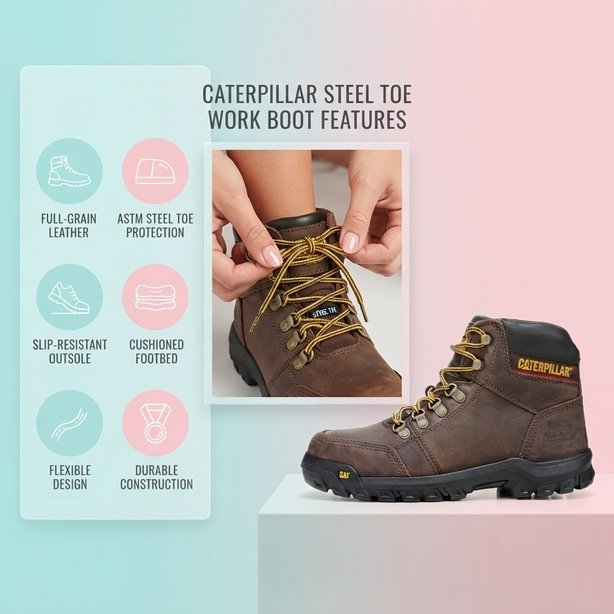
Men’s Outline Steel Toe Slip Resistant Work Boot
The Men’s Outline Steel Toe Slip Resistant Work Boot from CAT Footwear is built around practical workplace protection rather than decorative outdoor styling. A premium full-grain leather upper surrounds an ASTM F2413-rated steel safety toe, while electrical-hazard protection and a slip-resistant T1260 outsole address additional workplace risks. Inside, nylon mesh lining and a microfiber sock liner add a softer layer between the foot and the boot’s protective construction.
The Outline uses traditional lace-up construction and a roughly 6-inch work-boot profile. It is available in multiple leather colors and both medium and wide widths, making fit selection particularly important when the boot will be worn with work socks for long shifts.
About Men’s Outline Steel Toe Slip Resistant Work Boot
CAT Footwear positions the Outline as an accessible, straightforward safety boot combining three workplace-focused characteristics: steel-toe impact and compression protection, electrical-hazard protection, and slip resistance. The current manufacturer specification also confirms a full-grain leather upper, nylon mesh lining, microfiber sock liner, T1260 outsole and cemented construction.
This combination makes the Outline considerably different from an ordinary leather fashion boot. The steel toe and workplace certifications should be considered first, while appearance, color and casual styling remain secondary.
For customers comparing different types of footwear available through Hotscope, the broader Hotscope shop provides the most relevant internal browsing route without suggesting that an ordinary fashion boot offers the same level of workplace protection.
Men’s Outline Steel Toe Slip Resistant Work Boot Features
- Brand: CAT Footwear
- Model: Outline Steel Toe Work Boot
- Footwear Type: Men’s protective work boot
- Upper: Premium full-grain leather
- Toe Protection: Steel safety toe
- Safety Standard: ASTM F2413
- Protection: Impact and compression resistance
- Electrical Protection: Electrical Hazard rated
- Electrical-Hazard Limit: CAT states protection against open circuits up to 600 volts in dry conditions
- Outsole: T1260 slip-resistant outsole
- Lining: Nylon mesh
- Sock Liner: Microfiber
- Construction: Cement construction
- Closure: Lace-up
- Boot Height: Approximately 6-inch work-boot profile
- Widths: Medium and wide
- Current Colors: Honey Reset, Seal Brown, Black and Dark Gull Grey
- Current Manufacturer Size Range: Men’s US 7–15, depending on color and inventory
- Imported: Yes
CAT’s current Outline collection confirms the work boot is produced in medium and wide widths and across black, brown, gold/honey and grey color families.
ASTM F2413 Steel Toe Protection
The steel toe is the most important safety component in the Outline.
CAT Footwear identifies the boot as meeting ASTM F2413 requirements for impact and compression protection. ASTM F2413 is the performance specification used for protective safety-toe footwear, while its companion test standard, ASTM F2412, addresses the methods used to assess protective footwear.
The distinction matters because a reinforced-looking toe does not automatically make a boot certified protective footwear.
The ASTM footwear standards overview identifies F2413 specifically as the performance standard for protective safety-toe footwear.
OSHA likewise requires appropriate protective footwear when workers face hazards from falling or rolling objects, objects capable of piercing the sole, or certain electrical hazards.
For workers, that means the job’s hazard assessment should determine whether a steel-toe boot such as the Outline is appropriate rather than choosing protective footwear solely because it looks rugged.
What A Steel Toe Is Designed To Do
A steel safety toe creates a protective structure around the front of the foot. In the Outline, CAT specifically states that its ASTM F2413 steel toe is intended to protect against impact and compression.
Impact protection concerns a force striking the toe area, while compression protection concerns heavy pressure applied to that region.
Steel-toe protection does not mean the entire boot is resistant to every workplace hazard. Puncture hazards, chemicals, extreme heat, metatarsal hazards and other risks can require separate footwear specifications.
The OSHA foot-protection requirements are therefore more useful than treating “steel toe” as a universal safety label. Employers are expected to select protection according to the hazards actually present in a workplace.
Electrical Hazard Protection
CAT also identifies the Outline as Electrical Hazard protective footwear.
The manufacturer states that its EH design is intended to provide secondary protection against open electrical circuits of up to 600 volts under dry conditions.
The words secondary protection and dry conditions are important.
Electrical-hazard footwear should never be interpreted as permission to intentionally contact energized electrical equipment. It is one component of a wider workplace electrical-safety system and does not replace insulation procedures, de-energizing equipment, lockout practices, protective equipment or employer safety requirements.
OSHA includes electrical exposure among the hazards that can require protective footwear. Readers assessing work requirements can review the agency’s occupational foot-protection standard before deciding whether a particular certification matches their job.
Slip Resistant T1260 Outsole
The Outline uses CAT’s T1260 slip-resistant outsole.
Slip resistance is particularly relevant in workplaces where water, oil, grease, mud or other contaminants may reach walking surfaces. It should still be regarded as risk reduction rather than a guarantee against falling.
NIOSH explains that worn or unsuitable footwear can contribute to workplace slips and that outsole tread plays an important role in the friction developed between footwear and the floor.
The NIOSH guidance on workplace slips, trips and falls also explains why footwear works alongside housekeeping, floor design, lighting and contaminant control rather than replacing those measures.
In practical terms, even a slip-resistant Outline boot should be used carefully on contaminated, icy or unusually smooth surfaces.
Outsole Wear Deserves Regular Inspection
Work-boot tread should not be judged only when the upper begins to look old.
NIOSH-supported research has found that heavy outsole wear can reduce footwear traction, particularly when fluids become trapped between a worn sole and the walking surface.
This means a boot may still have an intact leather upper while its outsole has deteriorated enough to deserve replacement.
Inspect the T1260 sole periodically for flattened tread, uneven heel wear, cuts, separation or sections that have become noticeably smoother than the surrounding rubber.
This is particularly important when the boot was chosen specifically because workplace conditions require slip-resistant footwear.
Full Grain Leather Upper
CAT uses premium full-grain leather for the Outline upper.
Full-grain leather gives the boot the traditional appearance expected from industrial work footwear and provides a more substantial outer structure than textile-focused work sneakers.
The leather is available in several finishes, including Honey Reset, Seal Brown, Black and Dark Gull Grey on the current manufacturer page.
Color should not distract from material care. Leather exposed to dust, mud and workplace debris benefits from regular surface cleaning, particularly around flex points where accumulated dirt can contribute to premature wear.
For shoppers wanting to understand the terminology surrounding genuine and imitation leather, the FTC Leather Guides provide useful background on the way leather materials are represented in consumer products.
Nylon Mesh Lining And Microfiber Sock Liner
Protective work boots contain firm structural components, so the materials directly surrounding the foot matter.
The Outline uses a nylon mesh lining with a microfiber sock liner. The lining separates the foot from the interior surface of the leather upper, while the sock liner forms the immediate layer underneath the foot.
This does not make the Outline equivalent to a heavily padded athletic sneaker. Its primary purpose remains workplace protection.
When trying it on, pay attention to whether any part of the steel-toe area creates pressure against the toes. A protective toe cap itself will not meaningfully stretch, so a pair that is clearly too short or narrow should not be purchased on the assumption that the steel area will eventually loosen.
Cement Construction
CAT specifies cement construction for the Outline.
In footwear manufacturing, cement construction joins the upper to the sole using adhesive rather than the prominent stitched welt found on some traditional work boots.
That construction contributes to the Outline’s comparatively straightforward work-boot design.
It also means wear around the junction between upper and sole should be inspected periodically. Separation, cracking or significant damage can compromise the usefulness of work footwear even when the upper still appears wearable.
Boots used in safety-sensitive environments should be replaced when structural deterioration affects their integrity rather than being retained only because the leather still looks acceptable.
Six Inch Work Boot Profile
The Outline sits within CAT’s 6-inch work-boot collection.
That height provides greater ankle coverage than a low work sneaker while remaining lower and less enclosing than tall occupational boots.
The design can work naturally with work trousers and jeans because most of the shaft remains beneath the trouser leg.
A 6-inch profile should not automatically be interpreted as certified ankle protection, however. The actual safety characteristics documented for this product are its steel toe, electrical-hazard protection and slip-resistant construction.
The height is primarily part of the boot’s physical coverage and fit.
Lace Up Fit And Speed Hooks
The Outline uses conventional lace-up work-boot construction. Retail documentation for this model also references a speed-lacing arrangement toward the upper portion of the boot.
Lacing helps the wearer adjust tension through different parts of the upper.
Work boots should generally feel secure around the heel and instep without requiring extreme lace tension. If the laces must be pulled excessively tight to prevent the foot from moving, the basic size or width may not be appropriate.
The same applies to a boot that feels tight before a work shift begins. Feet can change slightly in volume over a long day, especially when standing for extended periods, so adequate space should be assessed while wearing the type of socks normally used at work.
Sizing And Width Options
CAT’s current Outline collection lists sizes from approximately men’s US 7 through 15, with both medium and wide widths represented across the range. Actual stock varies by color.
Width is particularly important in a steel-toe boot.
The rigid protective cap cannot adapt to an incorrectly fitted foot in the same way that a soft textile upper might. The toes should sit within the safety-toe area without persistent pressure against its sides or end.
CAT’s manufacturer size chart provides foot-length conversions in centimeters and inches, which can be useful when the buyer is between familiar sizes.
For Hotscope orders, fit should be checked indoors before workplace use because the Hotscope return policy currently requires eligible shoes to remain unworn and in their original box.
Medium Or Wide Width
Having both medium and wide versions gives the Outline an advantage over work boots offered in only one standard width.
A wide size is not simply a longer boot. Width affects the space around the ball of the foot and forefoot, which is particularly relevant when a rigid safety toe is present.
Choosing a longer medium-width boot solely to gain extra width can leave excessive room in front of the toes and allow unwanted movement.
The better approach is to match both length and width as closely as possible while wearing normal work socks.
The Outline Is Not Listed As Waterproof
One specification should not be added to this product without evidence: waterproofing.
CAT’s current Outline Steel Toe product page identifies steel-toe protection, electrical-hazard protection, slip resistance and full-grain leather, but it does not list waterproof construction among this model’s features.
That is an important difference between water-resistant-looking leather and a boot specifically engineered and tested as waterproof.
Someone working regularly in standing water, heavy rain or persistently wet outdoor conditions should therefore select footwear carrying the waterproof specification required for those conditions rather than assuming the Outline provides it.
Work Environments That May Suit The Outline
The combination of steel-toe, EH and slip-resistant features can make the Outline relevant to many industrial and trade settings where those specific protections are required.
Potential environments may include construction sites, workshops, warehouses, maintenance operations, manufacturing settings and other jobs involving impact or compression hazards around the feet.
Suitability still depends on the employer’s hazard assessment.
A workplace may additionally require puncture resistance, metatarsal guards, waterproofing, chemical resistance, insulation or another certification that this particular Outline specification does not claim.
The boot should therefore be matched to the job rather than assuming any ASTM steel-toe boot is automatically appropriate for every industrial environment.
Workwear Pairing
The Outline has a traditional work-boot appearance that pairs naturally with straight work trousers, carpenter pants, denim and other durable everyday clothing.
Honey and Seal Brown versions produce the most traditional leather-work-boot appearance, while Black and Dark Gull Grey offer a more understated option around dark uniforms and work trousers.
Unlike a fashion boot such as Hotscope’s Carleigh Jade Ankle Boot, the Outline should be selected primarily according to workplace hazards and certifications rather than styling. The comparison is useful because two boots may look similar at a distance while being designed for entirely different jobs.
The same distinction applies to the Notorious Ankle Boot, which is a casual fashion style and should not be treated as protective industrial footwear.
Leather And Work Boot Care
Regular cleaning helps make wear easier to identify.
Brush away dried mud and loose debris before wiping the leather with an appropriately damp cloth. If a leather treatment or conditioner is used, it should be suitable for the exact finish and should not make the outsole or workplace floor slippery.
Pay particular attention to the junction between the leather upper and cemented sole, the lacing hardware, outsole tread and toe area.
Allow damp boots to dry naturally in a ventilated place rather than placing them directly against intense heat.
The inside should also be allowed to dry between shifts where possible. Damp footwear can become uncomfortable and may deteriorate more quickly when repeatedly stored before fully drying.
Inspecting A Safety Boot Before Each Shift
Protective footwear deserves more attention than a casual sneaker because damage can affect why the boot was purchased in the first place.
Look for severe leather cuts, exposed or damaged safety-toe areas, separating soles, badly worn tread and damaged lacing hardware.
NIOSH research is especially relevant to the outsole: tread can lose effective slip resistance as wear increases.
If workplace policy specifies inspection or replacement intervals, those instructions should take priority over appearance-based judgments.
What To Check Before Choosing The Outline
Start with the workplace requirement.
Confirm that an ASTM F2413 steel toe is suitable and that the job does not call for a different toe technology or additional certification. Next, determine whether the electrical-hazard and slip-resistant features correspond to the conditions encountered at work.
Then assess fit using the socks normally worn during a shift. Make sure there is no persistent contact between the toes and rigid safety cap, and compare medium and wide versions instead of automatically increasing shoe length.
Also remember that the Outline is not currently documented as waterproof.
For online purchases, Hotscope shoppers can review the site’s shipping and delivery information alongside its return conditions before ordering, particularly when a work start date makes delivery timing important.
Men’s Outline Steel Toe Slip Resistant Work Boot Summary
The Men’s Outline Steel Toe Slip Resistant Work Boot is a traditional CAT work boot built around genuine workplace protection. Its premium full-grain leather upper houses an ASTM F2413 steel safety toe, while electrical-hazard protection, a slip-resistant T1260 outsole, nylon-mesh lining, microfiber sock liner and cement construction complete the design.
The strongest reasons to choose it are specific rather than cosmetic: steel-toe impact and compression protection, workplace slip resistance and EH protection in a familiar 6-inch leather boot.
The most important buying checks are equally specific. Confirm the required workplace standard, choose the correct length and width, do not assume the boot is waterproof, and inspect tread and structural condition regularly once the boot enters service.

Reviews
There are no reviews yet.