

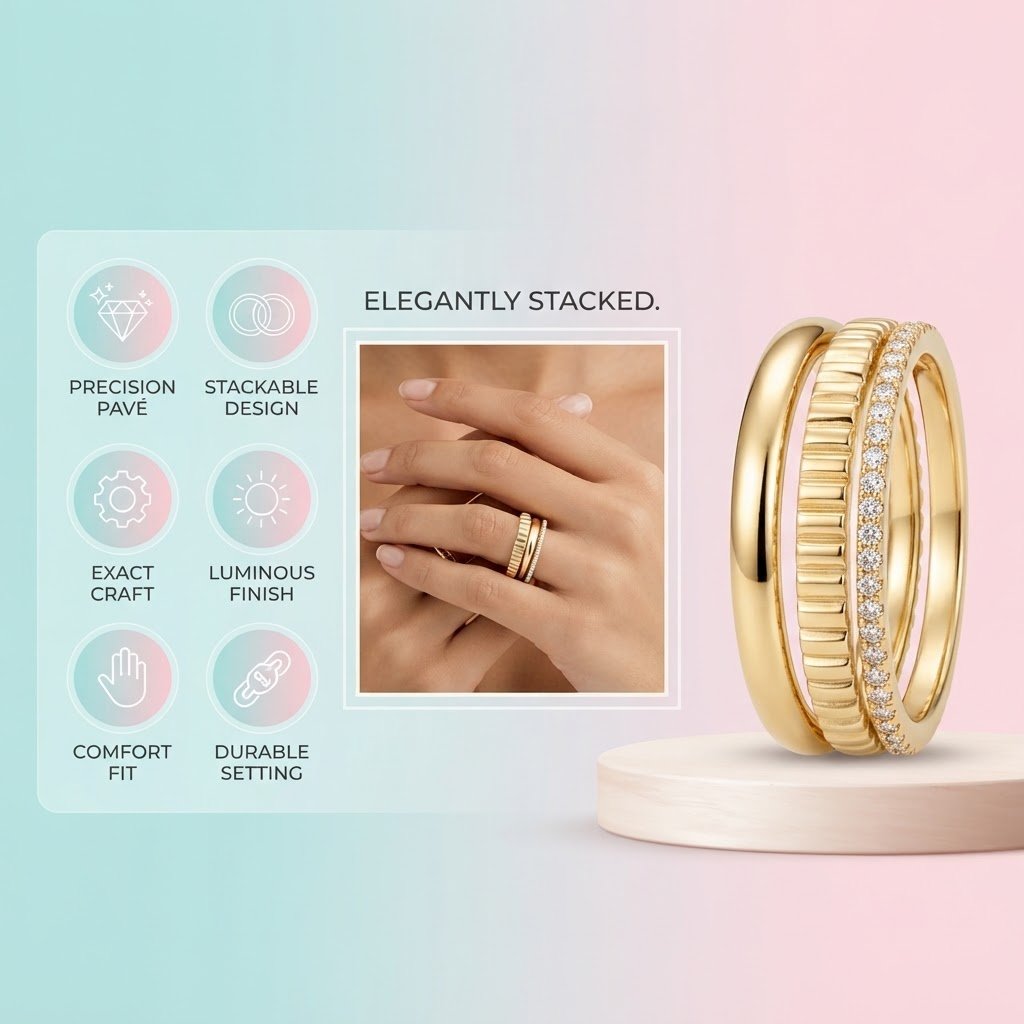
Pinky Rings
Mejuri Pinky Rings are a collection of small-scale rings designed to work especially well on the smallest finger, ranging from clean solid-gold signets to gemstone and pavé-diamond designs. Mejuri’s current U.S. Pinky Rings collection contains 23 products, including the Jude Pinky Signet Ring, Slim Signet Ring, Pavé Diamond Slim Signet, Pavé Diamond Signet Pinky Ring and other variations in sterling silver, 10k gold, 14k gold, natural gemstones and natural diamonds.
Unlike a single fixed product, Pinky Rings is a jewellery collection, so material, dimensions, stone type and sizing depend on the individual design. Current examples range from a fine 3.8 mm-wide engravable Slim Signet Ring in solid 10k yellow gold to an 8 mm-wide Pavé Diamond Signet Pinky Ring in solid 14k yellow gold with natural diamonds.
For Erothots, Pinky Rings belong naturally within the Jewellery category. They also provide a useful alternative to larger gemstone rings already in the collection, such as the sterling-silver Topaz Ring, because pinky-specific signets generally concentrate their visual detail into a smaller section of the hand.
About Pinky Rings
A pinky ring is simply a ring selected or designed to be worn on the smallest finger.
What makes Mejuri’s current collection interesting is that it does not limit the category to one traditional signet shape. The assortment includes polished signets, engraved rings, natural gemstone settings and pavé-diamond surfaces. Mejuri currently presents the collection for both women and men rather than defining pinky rings as a gender-specific jewellery format.
The most recognizable style remains the signet ring.
A signet typically provides a wider upper surface than the shank beneath it. That surface may be left polished, engraved or set with gemstones.
Mejuri uses all three approaches.
Its current Signet Pinky Ring offers an engravable polished top, the Jude Pinky Signet places a gemstone across the face, and the Pavé Diamond Signet Pinky Ring covers the upper surface with small natural diamonds.
Pinky Rings Features
- Brand: Mejuri
- Product category: Pinky and small-finger rings
- Current collection: 23 products on the U.S. Pinky Rings page
- Common styles: Signet, slim signet, pavé signet and gemstone signet rings
- Current metals: Sterling silver, solid 10k yellow gold and solid 14k yellow gold among available designs
- Gemstone options: Natural gemstones and lab-grown gemstone variations depending on the selected ring
- Diamond options: Natural diamond designs are currently available
- Typical pinky-focused sizing: Several dedicated styles run from US size 3 through 7
- Broader sizing: Some engravable signet designs currently extend through size 10
- Personalisation: Available on selected polished signet styles
- Current solid-gold sourcing: Mejuri states that its 10k and 14k gold pieces use 90% recycled gold
- Current sterling silver: 925 sterling silver; exact current Jude listing states 91% recycled silver
- Pavé Diamond Signet: 0.12 ct minimum natural diamond weight
- Jude Pinky Signet: 6 x 6 mm gemstone, 7 mm top width
- Slim Signet: 3.8 mm top width with optional engraving
- Care requirements: Vary according to metal and gemstone
Because Pinky Rings is a collection rather than a single SKU, one universal stone size, shank width or gold karat should not be assigned to every ring.
Pinky Rings Fit And Silhouette
Pinky rings usually occupy less finger circumference than rings made for the index, middle or ring finger, but that does not automatically make them visually tiny.
The top width is often what determines how substantial a signet looks.
Mejuri’s Slim Signet Ring has a 3.8 mm top width. The standard current Signet Pinky Ring increases that to 6 mm. Jude Pinky Signet reaches 7 mm, while Pavé Diamond Signet Pinky Ring uses an 8 mm top.
That progression shows why two rings made for the same small finger can look completely different.
A narrow polished signet creates a fine metal accent.
A 7 mm gemstone signet creates a much clearer focal point.
An 8 mm diamond-set top becomes closer to a compact statement ring even though it remains pinky sized.
The Jude Pinky Signet Ring Adds A Gemstone Centre
The current Jude Pinky Signet Ring is one of the clearest gemstone examples in Mejuri’s collection.
Its current sterling-silver version uses a 6 x 6 mm natural gemstone, a 7 mm top width and a 1.8 mm shank. Current stone selections include variations such as amethyst and champagne quartz in sterling silver, while Mejuri’s wider Pinky collection also lists 14k-gold Jude versions with stones including prasiolite and garnet.
The 6 mm stone occupies most of the 7 mm top width, so the gemstone is intended to be the dominant visual element.
That distinguishes Jude from a traditional signet where the polished metal surface itself is the central feature.
Mejuri also notes that natural gemstone colour can vary slightly. That is useful ecommerce information because two natural-stone rings should not be expected to display completely identical colour and internal characteristics.
Sterling Silver Gives Jude A Cooler Metal Option
The current sterling-silver Jude Pinky Signet uses 925 sterling silver.
Mejuri describes its sterling silver as containing 92.5% pure silver and identifies the current Jude product as made with 91% recycled sterling silver.
This is different from silver-coloured base-metal jewellery.
The material is sterling silver throughout the ring rather than a thin silver-coloured coating applied over an unidentified alloy.
For someone comparing it with an existing Erothots silver ring, the current Topaz Ring also uses a sterling-silver construction, although its larger gemstone-centred design is substantially different from the compact signet proportions of Jude.
Slim Signet Ring Keeps The Design Minimal
The Slim Signet Ring takes the signet concept in the opposite direction.
Its current 10k-yellow-gold version has a 3.8 mm top width and a 1.3 mm shank, creating a noticeably finer profile than Jude or the Pavé Diamond Signet.
There is no gemstone on the standard Slim Signet.
Instead, the polished top can be engraved with up to seven characters. Mejuri currently allows alphanumeric characters as well as selected symbols and spaces, with engraving placed on the outer top surface.
That gives it a different kind of personal detail.
Rather than making the ring noticeable through a stone or diamond surface, the wearer can add letters, numbers or another short inscription while retaining the clean solid-gold appearance.
Mejuri currently notes that engraved pieces are not eligible for return, so personalisation should be treated as a permanent ordering decision.
The Standard Signet Pinky Ring Sits Between Slim And Statement
Mejuri’s current Signet Pinky Ring has a 6 mm top width and 1 mm shank width.
That makes it wider at the face than the Slim Signet but still more restrained than the 7 mm Jude or 8 mm Pavé Diamond Signet.
The current product page offers complimentary optional engraving of one alphanumeric character on its polished top surface.
This is the classic signet approach within the group.
There is enough surface area to make the ring clearly read as a signet, but the lack of gemstones keeps the overall design focused on gold and shape.
Pavé Diamond Signet Pinky Ring Is The Fine-Jewellery Statement
The current Pavé Diamond Signet Pinky Ring uses solid 14k yellow gold with natural diamonds and is offered in sizes 3 through 7.
Mejuri publishes detailed stone specifications:
Minimum total diamond weight: 0.12 ct
Diamond colour: GHI
Diamond clarity: SI–I
Individual stone size: approximately 0.90–1 mm
Top width: 8 mm
Shank width: 1.5 mm.
The 0.12 ct figure refers to the combined diamond weight rather than one large 0.12-carat centre stone.
The design relies on many very small diamonds spread across the signet surface. That creates a different appearance from a solitaire ring where one gemstone occupies the centre.
Pavé Changes The Traditional Signet Surface
A classic signet offers a smooth face.
Pavé transforms that face into a stone-set surface.
On Mejuri’s Pavé Diamond Signet Pinky Ring, the diamonds measure only around 0.90–1 mm each, but their close arrangement creates a broader field of reflected light across the 8 mm top.
That makes the ring decorative from the front without adding a raised central gemstone.
The silhouette stays recognizably signet-like, while the surface treatment becomes considerably more detailed.
Solid 10k Gold Versus Solid 14k Gold
Mejuri currently uses both 10k and 14k solid gold within its pinky-ring assortment.
The Slim Signet and current standard Signet Pinky Ring pages list 10k yellow gold. The Pavé Diamond Signet Pinky Ring uses 14k yellow gold.
Both are solid-gold constructions rather than gold vermeil.
That means the gold alloy forms the body of the ring instead of existing only as an outer gold layer over sterling silver.
Mejuri describes 10k gold as an everyday-wear option with greater alloy content than 14k, while both current product types are made with 90% recycled gold according to the brand.
Solid Gold Is Different From Gold Vermeil
Mejuri sells many other jewellery products in Gold Vermeil, but the current solid-gold pinky signets discussed here belong to a different construction category.
Mejuri defines its Gold Vermeil as a 2.5-micron layer of 18k gold over sterling silver.
A solid 10k or 14k signet does not use that layered structure.
Scratching solid gold therefore does not expose a completely different silver-coloured base metal underneath, although the gold alloy itself can still collect scratches and signs of wear.
That distinction is particularly useful when comparing rings that may initially look similar in product photography.
Pinky Ring Sizing Needs Its Own Check
Dedicated pinky designs frequently start at smaller ring sizes.
The current Jude Pinky Signet and Pavé Diamond Signet Pinky Ring are both offered in sizes 3 through 7.
The current Signet Pinky Ring and Slim Signet Ring extend farther, with product pages currently listing sizes 3 through 10.
That broader range makes those designs useful beyond strictly pinky wear.
A ring labelled for pinky styling can still be worn on another finger if the correct size and proportions work for that hand.
Likewise, buying a smaller size simply because the product is called a pinky ring is not reliable. The wearer should use their actual smallest-finger measurement.
Width Can Affect How A Ring Feels
Ring size is not the only fit variable.
An 8 mm signet face occupies substantially more of the finger than a 3.8 mm Slim Signet top.
Shank width varies too.
The Slim Signet uses a 1.3 mm shank, Jude uses 1.8 mm, and Pavé Diamond Signet uses 1.5 mm.
These differences affect how much metal contacts the finger and how visually substantial the ring appears.
They are one reason an exact product specification is more useful than treating all pinky rings as one universal size.
Pinky Rings Can Be Worn Alone
A signet ring does not need a stack.
In fact, the pinky position naturally separates it from rings worn on the other fingers.
That spacing can give an 7 or 8 mm signet enough room to become the main hand-jewellery detail without adding additional rings beside it.
Jude is particularly suited to this approach because its 6 x 6 mm gemstone already creates a defined focal point.
The Pavé Diamond Signet works similarly, using its 8 mm diamond-covered top as the dominant element.
Pinky Rings Can Also Join A Ring Stack
Pinky placement can also extend an existing ring combination across the hand.
A narrow signet on the smallest finger can sit beside simple bands or gemstone rings worn elsewhere without requiring several rings on one finger.
Mejuri itself treats signets as compatible with broader ring styling and currently maintains extensive stacking and ring collections alongside its pinky assortment.
On Erothots, a sterling-silver Topaz Ring provides one possible contrast because its larger centre stone and silver finish create a completely different structure from a small yellow-gold signet.
Mixed-metal combinations can work intentionally rather than requiring every ring to use the same metal.
Engraving Changes The Character Of A Signet
Historically, signet-style jewellery has often been connected with emblems and personal markings. GIA has also discussed signet rings as a classic jewellery form suited to initials and personal symbols.
Mejuri keeps that idea simple.
The current Slim Signet allows up to seven characters, while the current Signet Pinky Ring allows a single alphanumeric character.
That creates two very different levels of personalisation.
One initial keeps the design close to the traditional monogrammed signet.
Seven characters provide enough room for a short name, date-like sequence or compact personal marking within Mejuri’s allowed character rules.
Gemstone Pinky Rings Need Stone-Specific Care
The Jude Pinky Signet should be cared for according to both its metal and gemstone.
Mejuri describes its jewellery as using several precious and semi-precious gemstone types, and the current Jude line contains multiple stone options.
That means a cleaning method suitable for one stone should not automatically be applied to every Jude variation.
The safest approach is to check the selected stone before using ultrasonic or steam cleaning.
For ordinary maintenance, gentle wiping and protected storage avoid unnecessary abrasion while keeping residue from building around the setting.
Caring For Sterling Silver Pinky Rings
Mejuri states that its sterling silver is 925 silver, made from 92.5% silver, and that the company adds an anti-tarnish treatment to its sterling-silver jewellery.
For cleaning, Mejuri recommends wiping sterling silver with a soft, dry cloth. A silver polishing cloth can be used gently when tarnish appears.
That makes the sterling-silver Jude easier to maintain than a piece requiring a delicate surface plating.
The natural gemstone should still be considered before applying any stronger cleaning process to the complete ring.
Caring For Solid-Gold Pinky Rings
Solid gold requires a different routine from Gold Vermeil.
Mejuri’s current care guidance for solid gold includes gentle cleaning appropriate to gold jewellery, while its broader jewellery-care service selects cleaning techniques based on material and stone construction.
The important point is not to assume that solid gold cannot scratch.
A fine 1 or 1.3 mm shank is still a relatively small jewellery component. Heavy pressure, impact and repeated contact with harder surfaces can alter the finish over time.
Those changes are ordinary physical wear rather than plating loss.
Diamond Pinky Rings Need Attention Around The Setting
Diamond hardness does not make the complete ring indestructible.
The Pavé Diamond Signet uses many tiny diamonds measuring only around 0.90–1 mm.
Those stones depend on the surrounding gold setting to remain positioned correctly.
A strong impact can affect small setting elements even if the diamond itself remains intact.
This is why pavé jewellery benefits from occasional inspection, especially if a ring is worn frequently.
The concern is the integrity of the whole setting rather than simply the hardness of the stones.
Pinky Rings Versus Standard Rings
The biggest distinction is usually scale and intended finger placement, not a completely different jewellery technology.
The same materials used in larger rings also appear here: sterling silver, solid gold, gemstones and diamonds.
What changes is proportion.
Smaller ring sizes and compact signet surfaces are better suited to the smallest finger.
A large cocktail ring can overwhelm that position, while a 3.8 to 8 mm signet top gives enough detail without requiring a very large setting.
Pinky Signet Versus Pavé Diamond Wishbone Ring
These two ring styles create almost opposite visual effects.
A pinky signet concentrates material at the top of the ring, often using a flat, gemstone-set or pavé-covered face.
A wishbone ring uses a fine V-shaped band, distributing its detail along a much narrower line.
Mejuri’s current Pavé Diamond Signet Pinky Ring has an 8 mm top and 1.5 mm shank. The Pavé Diamond Wishbone style belongs to a much slimmer stacking-ring category rather than the broad-faced signet family.
For a jewellery collection, that makes the two complementary rather than redundant.
The signet provides compact volume.
The wishbone provides fine geometry.
Ways To Style Pinky Rings
A polished gold signet can be the warm-metal anchor of a hand already wearing silver jewellery.
A sterling-silver gemstone signet can do the reverse, introducing a cooler metal beside yellow-gold rings.
A diamond signet works best when enough visual space is left around its pavé surface to prevent several detailed rings from competing with one another.
The Erothots Jewellery category currently includes sterling-silver and more decorative jewellery designs, so a pinky ring can be used to add a smaller hand-focused element rather than repeating the scale of a large necklace or chandelier earring.
Best Occasions For Pinky Rings
The category is flexible because the designs range from plain polished gold to diamonds.
A Slim Signet or simple Signet Pinky Ring can work as everyday jewellery because the surface is clean and the proportions are controlled.
The Jude adds visible gemstone colour and can become a stronger outfit detail.
The Pavé Diamond Signet provides considerably more reflected detail and uses solid 14k gold with natural diamonds, moving it toward a more decorative fine-jewellery finish while remaining compact enough for regular styling.
The occasion therefore depends more on the individual ring than on the fact that it is worn on the pinky.
Choosing The Right Pinky Ring
The easiest way to choose between Mejuri’s current styles is to compare surface width, material and decoration.
Choose the Slim Signet Ring when the preference is a fine solid-gold profile and room for a longer engraving. Its current top width is only 3.8 mm.
Choose the Signet Pinky Ring for a more traditional polished signet shape with a 6 mm top and optional single-character engraving.
Choose the Jude Pinky Signet Ring when a visible gemstone should become the focal point. Its stone measures 6 x 6 mm and the ring top is 7 mm wide.
Choose the Pavé Diamond Signet Pinky Ring when the priority is natural-diamond detail and a wider 8 mm solid-gold signet surface.
These differences are more useful than simply sorting the collection by price or colour.
What Makes Pinky Rings Different
The strongest part of Mejuri’s Pinky Rings collection is the amount of variation available within a very small section of the hand.
The current U.S. collection contains 23 products, yet the designs range from plain engravable gold to sterling-silver gemstones and solid-gold natural diamonds.
The proportions are equally varied.
Current examples span from a 3.8 mm Slim Signet top to an 8 mm Pavé Diamond Signet top, allowing the ring to look either subtle or substantial without abandoning the pinky format.
Material specifications are also clearly differentiated.
10k and 14k designs are solid gold, while sterling-silver versions use 925 silver. Current solid-gold product pages state that Mejuri uses 90% recycled gold, while the current Jude sterling-silver page states 91% recycled silver.
Most importantly, Pinky Rings should not be treated as one product with one specification. Exact width, size range, gemstone, gold purity, engraving option and care routine depend on the selected model.
Final Note
Mejuri Pinky Rings are a 23-product collection of compact rings designed around the smallest finger, with current choices spanning engravable signets, sterling-silver gemstone rings and natural-diamond signets in solid gold.
The current Slim Signet offers one of the finest profiles at 3.8 mm across the top, uses solid 10k yellow gold and accepts up to seven engraving characters. The current Jude Pinky Signet increases the top to 7 mm and adds a 6 x 6 mm gemstone. The Pavé Diamond Signet reaches 8 mm, using solid 14k gold and at least 0.12 ct of natural diamonds.
Sizing also varies rather than following one universal pinky standard. Dedicated Jude and Pavé Diamond Signet styles currently run from sizes 3 through 7, while some engravable signets extend through size 10.
For Erothots shoppers, Pinky Rings add a compact hand-jewellery option alongside the wider Jewellery assortment and offer a noticeably different scale from the larger sterling-silver Topaz Ring currently listed on the site.
The most useful buying decision is therefore not simply “gold or silver.” Start with the ring’s top width and fit, then choose between plain engraving, natural gemstone or pavé diamonds, and finally select the material that works best with the rest of the jewellery collection.

Reviews
There are no reviews yet.