

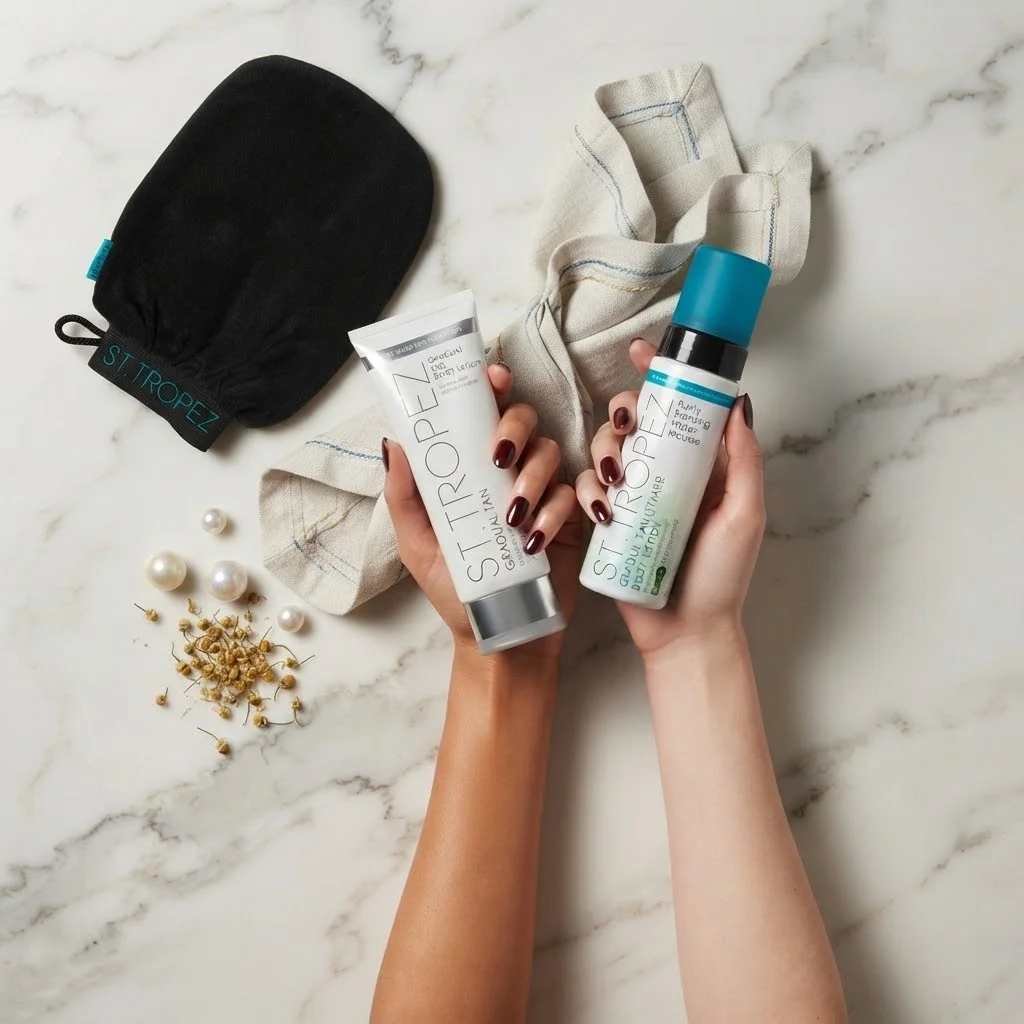
Tan Buildup Remover Buffing Mitt
St. Tropez Tan Buildup Remover Buffing Mitt is a reusable physical exfoliation mitt designed to lift away old self-tan residue while buffing dry surface skin. Rather than adding another liquid or scrub to a body-care routine, the mitt relies on its textured surface and gentle mechanical friction to help loosen uneven self-tan buildup before the next application. Ulta currently lists it as a single reusable mitt, with the main purposes of removing tan buildup, correcting uneven self-tan areas, buffing dry skin, and preparing the skin for another sunless tanning application.
It sits most naturally alongside cleansing, exfoliating, and moisturizing products. HotScope shoppers building a complete body-care routine can pair the mitt conceptually with a Body Shower Gel during cleansing and browse the broader Moisturisers collection for post-exfoliation hydration.
Tan Buildup Remover Buffing Mitt Features
- Brand: St. Tropez
- Product type: Reusable physical exfoliating mitt
- Quantity: 1 mitt
- Primary purpose: Removing old or uneven self-tan buildup
- Secondary purpose: Buffing away dry surface skin
- Suitable areas: Body areas where self-tan has accumulated unevenly
- Best-known trouble spots: Elbows, knees, ankles, feet, and hands
- Product format: No liquid formula or active ingredient system
- Reusable: Yes
- Cleaning: Rinse with warm water after use
- Drying: Leave to dry naturally
- Natural suntan removal: No; the brand states that it is intended to remove self-tan residue from the skin surface rather than a natural UV-generated tan
- Skin-prep role: Helps create a more even surface before applying fresh self-tanner
Ulta currently places the product within bath and body accessories rather than treating it as a chemical self-tan remover, which accurately reflects how the mitt works.
Physical Exfoliation Is What Does The Work
There are no acids, enzymes, solvents, or self-tan-dissolving ingredients inside the mitt. Its function comes from mechanical exfoliation.
The American Academy of Dermatology distinguishes between chemical exfoliation and mechanical exfoliation. Mechanical exfoliation uses a physical tool such as a sponge, brush, pad, or textured material to help remove cells and material from the outer skin surface.
That distinction is useful when comparing the mitt with a product such as HotScope’s Instant Reveal Facial Peel. A peel relies on chemical exfoliating ingredients, while the St. Tropez mitt works through physical contact. They are also intended for different areas of the body, so a facial peel should not be treated as a substitute body-tan-removal product.
With the mitt, technique matters more than an ingredient concentration. Excess pressure does not automatically remove self-tan more effectively and can instead leave the skin feeling uncomfortable.
Why Old Self-Tan Can Become Patchy
Most conventional sunless tanning products rely on dihydroxyacetone, commonly called DHA, to produce temporary color.
The FDA explains that DHA reacts with amino acids in the surface layers of the skin, producing a darker appearance without requiring ultraviolet exposure. Because the effect occurs near the outer skin surface, the color gradually changes as those surface cells naturally shed.
That natural shedding is not always perfectly uniform.
Areas of thicker or drier skin can hold visible self-tan differently from smoother areas. Knees, elbows, hands, ankles, and feet are particularly common places for color to appear heavier or fade unevenly.
This explains why preparing the skin surface matters before applying another layer. The American Academy of Dermatology’s self-tanner guidance specifically recommends exfoliating before self-tanner and paying particular attention to thicker areas including the elbows, knees, and ankles.
The St. Tropez mitt essentially turns that preparation step into a reusable body-care tool.
Buffing Away Self-Tan Is Different From Removing A Natural Tan
This is one of the most important product distinctions.
St. Tropez states that the mitt helps remove self-tan buildup on the surface of the skin, but it does not remove a natural suntan.
A self-tan created with DHA is a cosmetic color change associated mainly with the outer skin surface. A natural suntan occurs because ultraviolet radiation stimulates biological changes in skin pigmentation.
A textured mitt cannot simply scrub away those deeper biological pigmentation changes.
This is also why the product should not be marketed as a general “tan eraser.” It is much more accurate to describe it as a self-tan buildup remover and exfoliating mitt.
Wet Skin Gives The Mitt A More Controlled Buffing Surface
St. Tropez’s current directions specify using the mitt on wet skin with a normal bath or shower product. The company recommends gentle circular movements, with additional attention to areas where old self-tan is visibly concentrated.
A body cleanser can provide additional slip between the mitt and skin. HotScope’s Body Shower Gel is an example of the type of body-cleansing product that fits naturally into that part of a shower routine.
The important word is gentle.
The American Academy of Dermatology recommends short, light movements when using a physical exfoliating tool and warns against aggressive scrubbing. Dermatologists also advise avoiding exfoliation over open wounds, cuts, or sunburned skin.
The goal is to loosen uneven surface buildup, not to make the skin feel raw.
Extra Attention Around Knees And Elbows Does Not Mean Aggressive Scrubbing
St. Tropez specifically calls out the knees, elbows, ankles, feet, and hands as areas where more noticeable buildup may occur.
These areas often behave differently because the skin surface can be thicker or drier. Self-tanner may therefore develop more noticeably there, particularly when the area was not adequately moisturized or blended during the original application.
It is reasonable to spend slightly more time on a patchy area, but repetitive hard rubbing can cause irritation.
The American Academy of Dermatology notes that over-exfoliation may lead to redness and irritation and that more aggressive exfoliation generally needs to be performed less frequently.
A better approach is gradual removal over comfortable passes rather than trying to force every trace of self-tanner away in a single shower.
Correcting A Small Self-Tan Mistake
The mitt can also be used on a localized patch rather than across the entire body.
St. Tropez’s product directions suggest dampening the affected area and using a finger inside the mitt to give more precise control over a small uneven section.
That makes the product useful when the overall self-tan still looks even but one area has developed too dark, gathered around a joint, or faded inconsistently.
Targeted buffing also reduces unnecessary exfoliation of skin that does not need correction.
Moisture Matters After Mechanical Exfoliation
Physical exfoliation can leave the skin feeling smoother, but it can also temporarily increase dryness if the skin is repeatedly buffed without replacing moisture.
The American Academy of Dermatology recommends applying moisturizer after exfoliating because exfoliation can dry the skin.
For body areas such as the legs and arms, a richer body moisturizer can therefore be a sensible follow-up. HotScope’s Pineapple Whipped Body Cream is one body-moisturizing option, while the wider Moisturisers collection provides alternatives for different texture preferences.
Moisturizing is particularly useful when areas such as knees and elbows naturally become rough or dry, because repeatedly applying self-tanner over an uneven dry surface can contribute to another patchy result.
Sensitive Skin Needs A Lighter Approach
Not every skin type tolerates mechanical exfoliation equally well.
The American Academy of Dermatology notes that dry, sensitive, or acne-prone skin may react more easily to physical exfoliation. Dermatologists recommend choosing an exfoliation method according to skin type and avoiding strong mechanical exfoliation when the skin is already irritated.
That means a buffing mitt should not automatically become an everyday shower accessory.
Someone using retinoids, benzoyl peroxide, strong exfoliating acids, or other products that already increase peeling or sensitivity should be particularly careful about adding mechanical exfoliation on the same skin.
The same principle applies after shaving, waxing, sun exposure, or any situation where the skin already feels tender.
Self-Tanner Preparation Starts Before The New Color Goes On
Removing an old tan is only half of preparing for another self-tanning application.
The AAD recommends exfoliating first, drying the skin completely, applying self-tanner in sections, and blending carefully around wrists, ankles, knees, and elbows.
A remover mitt therefore makes the most sense as part of a preparation stage rather than as something used immediately after fresh self-tanner has been applied.
If the skin feels particularly dry after old color has been removed, allowing the skin to recover and restoring moisture may produce a more comfortable base than repeatedly buffing the same area.
HotScope’s broader Beauty Wellness collection can also be useful when building the supporting skincare side of a body-care routine rather than treating tanning products as an isolated category.
Self-Tan Does Not Replace Sun Protection
A cosmetic tan may create a darker appearance, but that appearance should not be confused with meaningful ultraviolet protection.
The FDA explains that sunless tanning products containing DHA color the skin without creating the same biological process as ultraviolet tanning. The American Academy of Dermatology specifically advises continuing to use sunscreen when wearing self-tanner.
The FDA’s current sunscreen guidance explains that sunscreen remains part of protecting exposed skin from ultraviolet radiation.
Removing an old self-tan with this mitt therefore does not change normal sun-protection needs, and applying a fresh sunless tan afterward does not replace sunscreen.
Reusable Mitt Care
One practical advantage of the Tan Buildup Remover Buffing Mitt is that it is not designed as a single-use accessory.
St. Tropez advises rinsing the mitt with warm water after each use and allowing it to dry naturally before storing it for the next session.
Allowing it to dry fully is preferable to storing it while damp in a sealed shower container.
The product listing does not specify machine washing, tumble drying, bleach, or other aggressive cleaning methods, so those processes should not be assumed to be appropriate. The manufacturer’s current care directions should take priority if the packaging is updated.
When The Mitt Should Stay Out Of The Routine
A physical buffing tool is not suitable for every skin condition or every day.
Avoid using it over sunburn, cuts, broken skin, or areas already irritated by another exfoliating treatment. The AAD specifically recommends avoiding exfoliation on open wounds and sunburned skin.
If an area becomes persistently red, sore, swollen, itchy, or painful after buffing, continuing to scrub it is unlikely to improve the result.
It is also worth remembering that uneven skin pigmentation is not always leftover self-tanner. A patch that remains after cosmetic tanning color has faded may have another cause and should not simply be scrubbed repeatedly.
Tan Buildup Remover Buffing Mitt Versus A Body Scrub
Both products can physically exfoliate, but their formats are different.
A body scrub combines abrasive particles with a cream, gel, oil, or cleansing base. A buffing mitt supplies the textured surface itself, which means the user can pair it with an existing shower cleanser and control the pressure manually.
The mitt also has the practical advantage of being reusable.
On the other hand, physical control means it is easier to overdo pressure if someone assumes stronger scrubbing produces faster results. The AAD’s advice to use light movements is especially relevant with reusable exfoliating tools.
For someone primarily interested in ordinary skin smoothing rather than self-tan removal, HotScope’s Instant Reveal Facial Peel illustrates a completely different chemical-exfoliation category. The facial product should remain on the face according to its own directions, while the St. Tropez mitt is a body-focused mechanical tool.
What Makes The Tan Buildup Remover Buffing Mitt Useful
The St. Tropez Tan Buildup Remover Buffing Mitt is intentionally simple. There is no serum to measure, ingredient concentration to compare, or bottle that runs out after a few applications. Its value comes from a reusable textured surface designed specifically around old self-tan removal and body exfoliation.
It can help loosen uneven self-tan residue, smooth dry-feeling surface skin, target areas such as elbows and knees, and prepare the body for a fresh sunless tanning application.
The limitations are just as important. It will not remove a natural UV tan, it should not be used aggressively on irritated or sunburned skin, and it does not replace moisturizing or sunscreen.
For a balanced body-care routine, the mitt can sit between cleansing with a product such as Body Shower Gel and replenishing moisture with products from HotScope’s Moisturisers collection. Used with controlled pressure rather than excessive scrubbing, it provides a straightforward mechanical way to deal with the patchy stage between one self-tan application and the next.
:::

Reviews
There are no reviews yet.