

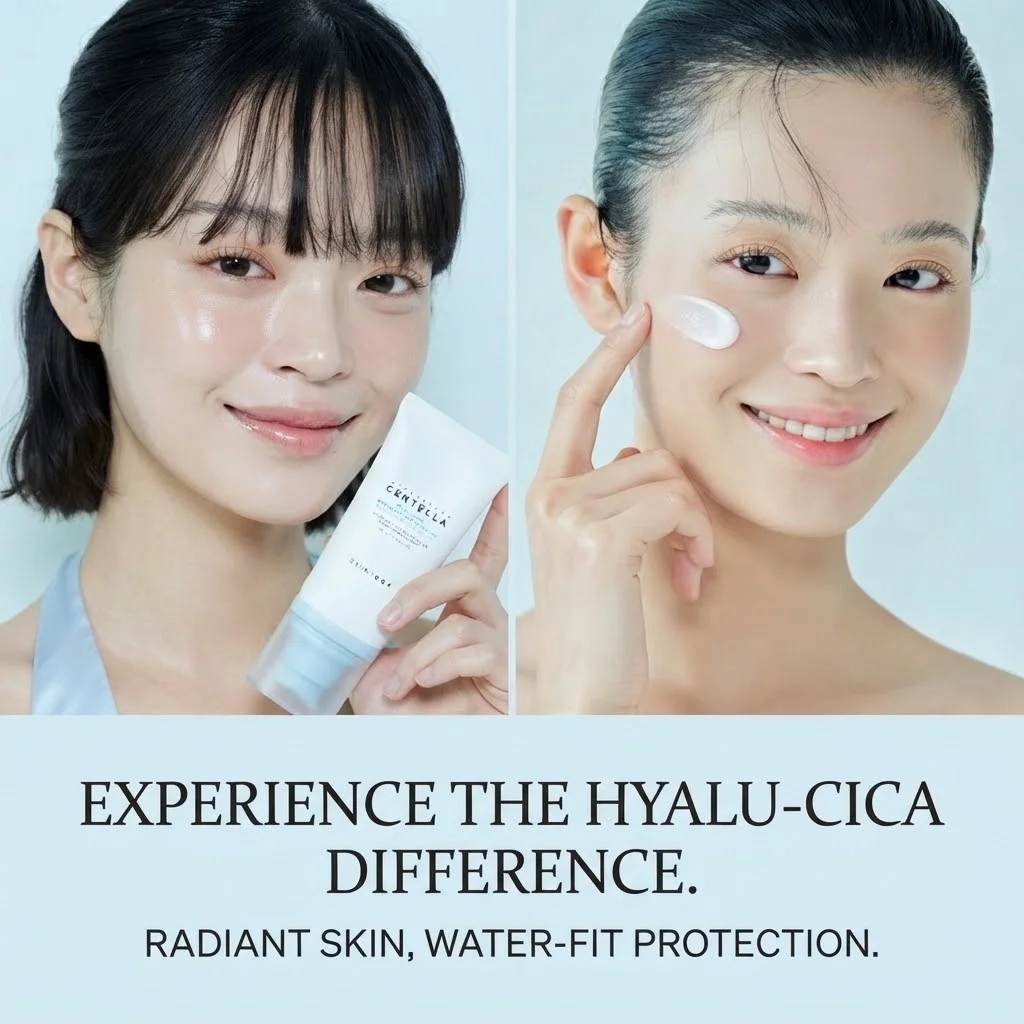
Madagascar Centella Hyalu-Cica Water-Fit Sun Serum UV SPF50
SKIN1004 Madagascar Centella Hyalu-Cica Water-Fit Sun Serum UV SPF50 combines broad-spectrum sun protection with the lightweight feel of a hydrating facial serum. The current U.S. formula provides Broad Spectrum SPF 50 protection using four organic UV filters while adding panthenol, Centella asiatica, multiple forms of hyaluronic acid, green tea, rice, oat, and soybean extracts to the supporting skincare base.
Its 1.69 oz / 50 ml format is designed primarily for everyday facial sun protection, with a thin serum-like consistency that SKIN1004 describes as quick-absorbing, minimally sticky, and free from a noticeable white cast. Shoppers building a broader routine can compare it with products throughout HotScope’s Skincare collection rather than treating SPF as a completely separate part of skincare.
Madagascar Centella Hyalu-Cica Water-Fit Sun Serum UV SPF50 Features
- Brand: SKIN1004
- Collection: Madagascar Centella Hyalu-Cica
- Product type: Daily facial sunscreen serum
- Protection: Broad Spectrum SPF 50
- Size: 1.69 oz / 50 ml
- Sunscreen type: Organic-filter sunscreen
- Active UV filters: Avobenzone 2.7%, Homosalate 13.6%, Octisalate 4.5%, Octocrylene 9%
- Texture: Lightweight, watery serum-like cream
- Finish: Fresh, luminous finish without a visible white cast
- Primary skincare ingredients: Panthenol, Centella asiatica extract, hyaluronic acid, sodium hyaluronate, hydrolyzed sodium hyaluronate, glycerin, green tea, rice, oat, and soybean extracts
- Skin positioning: Dry and normal skin, with the brand also listing combination skin in its detailed product information
- Main purpose: Everyday UVA and UVB protection with added hydration
- Ulta item number: 2650029
The current U.S. formula is important here because older or international versions of Hyalu-Cica Water-Fit Sun Serum may display SPF50+ PA++++ and can use a different sunscreen-filter system. The U.S. Sun Serum UV version lists the four active ingredients above and should be evaluated according to its own Drug Facts rather than assuming formulas sold in different markets are identical.
Broad Spectrum SPF 50 Is The Core Function
Despite the word “serum” in the name, this is first and foremost a sunscreen.
Its current U.S. formulation contains avobenzone, homosalate, octisalate, and octocrylene as active sunscreen ingredients. SKIN1004 identifies the finished product as Broad Spectrum SPF 50, meaning it is intended to protect against both UVA and UVB radiation.
The distinction between UVA and UVB matters. UVB is strongly associated with sunburn, while UVA penetrates more deeply and contributes to premature skin aging as well as skin damage. The FDA’s current sunscreen guidance recommends broad-spectrum sun protection rather than judging a sunscreen only by its SPF number.
The FDA also explains that a product passing the U.S. Broad Spectrum Test demonstrates UVA protection in addition to UVB protection. Higher Broad Spectrum SPF values indicate correspondingly greater tested protection within that labeling system.
Four UV Filters Work As A System
The sunscreen protection does not come from Centella, hyaluronic acid, or the botanical extracts. It comes from the four listed sunscreen actives.
Avobenzone at 2.7% provides an important part of the UVA protection. Homosalate at 13.6% and octisalate at 4.5% contribute strongly to UVB absorption, while octocrylene at 9% contributes additional UV protection and supports the overall filter system. The exact percentages are provided in SKIN1004’s current U.S. active-ingredient declaration.
Calling these “chemical” or “organic” filters refers to their chemistry and the way the formulation handles ultraviolet radiation. It does not mean the product is automatically harsher or less effective than a mineral sunscreen.
What matters more for daily protection is whether the sunscreen provides an appropriate broad-spectrum SPF, whether enough is applied, and whether it is reapplied when needed.
Centella Gives The Formula Its Skincare Identity
Centella asiatica extract is one of the ingredients connecting the sunscreen to SKIN1004’s Madagascar Centella range.
The plant has a long history of use in topical formulations and contains compounds such as asiaticoside, madecassoside, asiatic acid, and madecassic acid. A scientific review available through the National Library of Medicine discusses Centella’s biological properties and its long-standing use in skin-related applications.
In this sunscreen, Centella should be viewed as a supporting skincare ingredient rather than a UV filter. It does not replace the SPF actives and should not be credited with providing the product’s measured SPF 50 protection.
SKIN1004 positions the extract around helping sensitive-looking skin appear calmer and supporting a comfortable skin barrier.
For routines centered on redness or easily uncomfortable skin, HotScope’s Skin Redness Recovery Moisturizer represents a different moisture-focused step that can be compared separately from sunscreen.
Three Forms Of Hyaluronic Acid Support Hydration
The current ingredient list contains more than one hyaluronic-acid-related ingredient:
Hydrolyzed Sodium Hyaluronate, Sodium Hyaluronate, and Hyaluronic Acid.
Hyaluronic acid is a humectant, meaning it interacts strongly with water. In topical skincare, humectants are used to help maintain hydration at the skin surface and improve the feeling of suppleness.
A scientific review indexed by PubMed on hyaluronic acid in skin discusses its important relationship with skin hydration and the continuing development of topical hyaluronic-acid formulations.
This helps explain why the product behaves more like a hydrating skincare serum than many traditional dense sunscreen creams.
It also means someone with dry skin may not automatically need to layer several additional hydrating serums underneath it. The better choice depends on how the skin feels after cleansing and whether a separate moisturizer is needed.
HotScope’s Moisturisers collection offers richer options when the sunscreen alone does not provide enough comfort for dry skin.
Panthenol Has A Bigger Role In The Reformulated Version
Panthenol appears relatively high in the current U.S. inactive-ingredient list.
Also known as provitamin B5, panthenol is commonly incorporated into moisturizers and barrier-supportive formulations because of its humectant and skin-conditioning properties.
SKIN1004 specifically highlights panthenol as part of the updated Sun Serum UV formulation alongside rice, oat, and soybean extracts.
This is one reason it is useful to distinguish the newer U.S. formula from older online ingredient lists. Reformulation can change the supporting skincare experience even when the familiar Hyalu-Cica product name remains recognizable.
Rice, Oat And Soybean Form The Botanical Support System
Lower in the ingredient list are Oryza Sativa Rice Extract, Avena Sativa Oat Meal Extract, and Glycine Max Soybean Seed Extract. The formula also contains Portulaca oleracea extract and Camellia sinensis green-tea leaf extract.
SKIN1004 groups several of these botanical ingredients into what it calls its Baby Green Complex.
These extracts contribute to the product’s skincare positioning, but their presence should not distract from the main sun-protection requirement. Sunscreen performance is established through the finished SPF formulation, not by adding antioxidant-rich plant extracts.
That distinction is especially useful when comparing sunscreen-serum products. A long botanical list can improve the cosmetic story of a formula, but the broad-spectrum SPF remains the part responsible for protecting against ultraviolet radiation.
Why The Texture Feels More Like A Serum
Many people avoid facial sunscreen because they associate SPF with a heavy, greasy, or chalky layer.
SKIN1004 takes the opposite formulation approach here. The company describes the Sun Serum UV as light, watery, quickly absorbed, minimally sticky, and non-greasy, with a luminous finish.
Several ingredients help create that feel. Propanediol and pentylene glycol contribute to the solvent and humectant phase, while caprylyl methicone adds slip. Polymethylsilsesquioxane and silica can alter the way the formula spreads and feels after application, while silicone elastomers help create a smoother finish.
That texture can be particularly useful under makeup because a very heavy sunscreen layer may interact poorly with primer or foundation.
HotScope shoppers who apply cosmetics after SPF can browse the Makeup collection separately, keeping sun protection as the final skincare layer before moving into complexion products.
No White Cast Is Easier To Understand From The Filter System
The current formula does not use zinc oxide or titanium dioxide as its active sunscreen filters. Instead, it uses four soluble organic UV filters.
That helps explain the brand’s no-white-cast positioning.
Traditional visible white residue is commonly associated with mineral particulate filters when they remain noticeable on the skin. A transparent organic-filter system is less likely to create that particular chalky appearance.
“No white cast,” however, does not guarantee that the finish will look identical on every skin type. Skincare underneath, the amount applied, facial hair, dry patches, makeup, and the way the formula sets can all influence its final appearance.
Where The Sun Serum Fits In A Morning Routine
Madagascar Centella Hyalu-Cica Water-Fit Sun Serum UV SPF50 belongs after the main leave-on skincare steps and before makeup.
A practical morning sequence may include cleansing, treatment serum if one is used, moisturizer when needed, and then sunscreen as the final skincare layer.
Someone using a separate hydrating serum such as HotScope’s Mila Moursi Rejuvenating Serum can allow that product to settle before adding sunscreen rather than mixing both products together in the hand. Keeping layers separate avoids unintentionally diluting or disturbing the sunscreen film.
SKIN1004 directs users to spread the Sun Serum UV evenly over UV-exposed areas including the face, neck, arms, and legs.
The amount used matters. Applying only a very thin decorative layer may not provide the protection represented by the labeled SPF because sunscreen testing is performed using a standardized application amount.
SPF Still Needs Reapplication
A high SPF number does not turn sunscreen into an all-day single application.
The American Academy of Dermatology’s sunscreen application guidance recommends reapplying sunscreen approximately every two hours while outdoors and after swimming or sweating.
The FDA gives similar advice, recommending broad-spectrum sunscreen as part of a larger sun-protection approach and reapplication at least every two hours, with more frequent reapplication around swimming or heavy sweating.
HotScope’s SPF 50+ Hydrating Glow Mist Top Up represents a different sunscreen format designed around portable top-ups. It should still be used according to its own labeled directions rather than assuming a mist and a serum require the same application technique.
Water Resistance Should Not Be Assumed
The current SKIN1004 and Ulta information reviewed for Madagascar Centella Hyalu-Cica Water-Fit Sun Serum UV SPF50 identifies broad-spectrum SPF 50 protection, but it does not present a 40-minute or 80-minute water-resistance claim in the product information reviewed.
That matters for beach days, outdoor sport, swimming, or heavy sweating.
The American Academy of Dermatology’s sunscreen-selection guidance recommends choosing a water-resistant sunscreen when swimming or sweating and explains that U.S. labels specify either 40 or 80 minutes when a product has qualified for that claim.
For that reason, this serum is most straightforwardly positioned as an everyday facial sunscreen, rather than automatically advertising it as a sport or swimming sunscreen.
Dry Skin May Appreciate The Hydrating Base
SKIN1004 lists dry and normal skin as core skin types for the current Sun Serum UV and also includes combination skin in its expanded product details.
The presence of panthenol, glycerin, multiple hyaluronic-acid forms, glycols, Centella, and several emollient or texture-supporting ingredients explains the moisture-focused positioning.
Someone with very dry skin may still want moisturizer underneath. Someone with combination skin may find the sunscreen’s own hydrating base sufficient during warmer weather.
A richer evening product such as CeraVe Skin Renewing Face Night Cream can also keep heavier barrier-focused moisturization in the nighttime routine rather than making the daytime SPF layer unnecessarily dense.
Sensitive Skin Still Needs Ingredient Awareness
Centella and panthenol are often chosen for soothing skincare formulas, but no sunscreen is guaranteed to suit every individual.
The active filters themselves, preservatives, botanical extracts, glycols, or another formulation component can occasionally be unsuitable for a particular person’s skin.
The current product precautions state that the sunscreen is for external use, should not be placed on damaged or broken skin, should be kept away from the eyes, and should be discontinued if irritation occurs.
Someone with a history of reactions to sunscreen filters should pay particular attention to the active Drug Facts panel rather than choosing only on the basis of marketing terms such as Centella or hyaluronic acid.
Current Active And Inactive Ingredients
The current U.S. active sunscreen ingredients are:
Avobenzone 2.7%, Homosalate 13.6%, Octisalate 4.5%, Octocrylene 9%.
The current inactive ingredient declaration includes:
Water, Butyloctyl Salicylate, Propanediol, Polymethylsilsesquioxane, C20-22 Alkyl Phosphate, C20-22 Alcohols, Panthenol, 1,2-Hexanediol, Caprylyl Methicone, Pentylene Glycol, Dimethicone/Vinyl Dimethicone Crosspolymer, Cetyl Alcohol, VP/Eicosene Copolymer, Glyceryl Stearate, Tromethamine, Polyacrylate Crosspolymer-6, Ammonium Acryloyldimethyltaurate/VP Copolymer, Silica, Butylene Glycol, Centella Asiatica Extract, Ethylhexylglycerin, Hydrolyzed Sodium Hyaluronate, Sodium Hyaluronate, Tocopherol, Glycerin, Portulaca Oleracea Extract, Camellia Sinensis Leaf Extract, Hyaluronic Acid, Oryza Sativa Rice Extract, Avena Sativa Oat Meal Extract, and Glycine Max Soybean Seed Extract.
Because sunscreen formulas can differ by market and can be reformulated, the Drug Facts and ingredient panel printed on the specific product being purchased should remain the final reference.
What Makes Madagascar Centella Hyalu-Cica Water-Fit Sun Serum UV SPF50 Different
The most useful feature of this SKIN1004 sunscreen is the way it combines serious daily SPF protection with the sensory profile of lightweight skincare.
Its four-filter Broad Spectrum SPF 50 system provides the actual UV protection, while Centella, panthenol, hyaluronic acid, glycerin, green tea, rice, oat, soybean, and other supporting ingredients shape the hydrating skincare experience.
The 50 ml bottle, quick-absorbing texture, luminous finish, and lack of a noticeable mineral-style white cast make it particularly suited to everyday facial wear. It should not, however, be confused with a water-resistant sport sunscreen unless the package specifically carries an appropriate water-resistance claim.
For a broader daily routine, it can sit alongside products from HotScope’s Skincare collection and Moisturisers range, while a product such as the SPF 50+ Hydrating Glow Mist Top Up represents an alternative sunscreen format for reapplication needs.
Final Note
Madagascar Centella Hyalu-Cica Water-Fit Sun Serum UV SPF50 is best understood as a Broad Spectrum SPF 50 facial sunscreen with serum-like skincare qualities, not simply a hydrating serum that happens to contain SPF.
The current U.S. version uses avobenzone, homosalate, octisalate, and octocrylene for UVA and UVB protection, while panthenol, Centella asiatica, three hyaluronic-acid-related ingredients, glycerin, and botanical extracts support hydration and a comfortable finish.
Its real advantage is practical: if a lightweight, non-chalky sunscreen feels comfortable enough to wear consistently and reapply appropriately, it becomes easier to make high-level sun protection part of an ordinary morning skincare routine.
:::

Reviews
There are no reviews yet.