

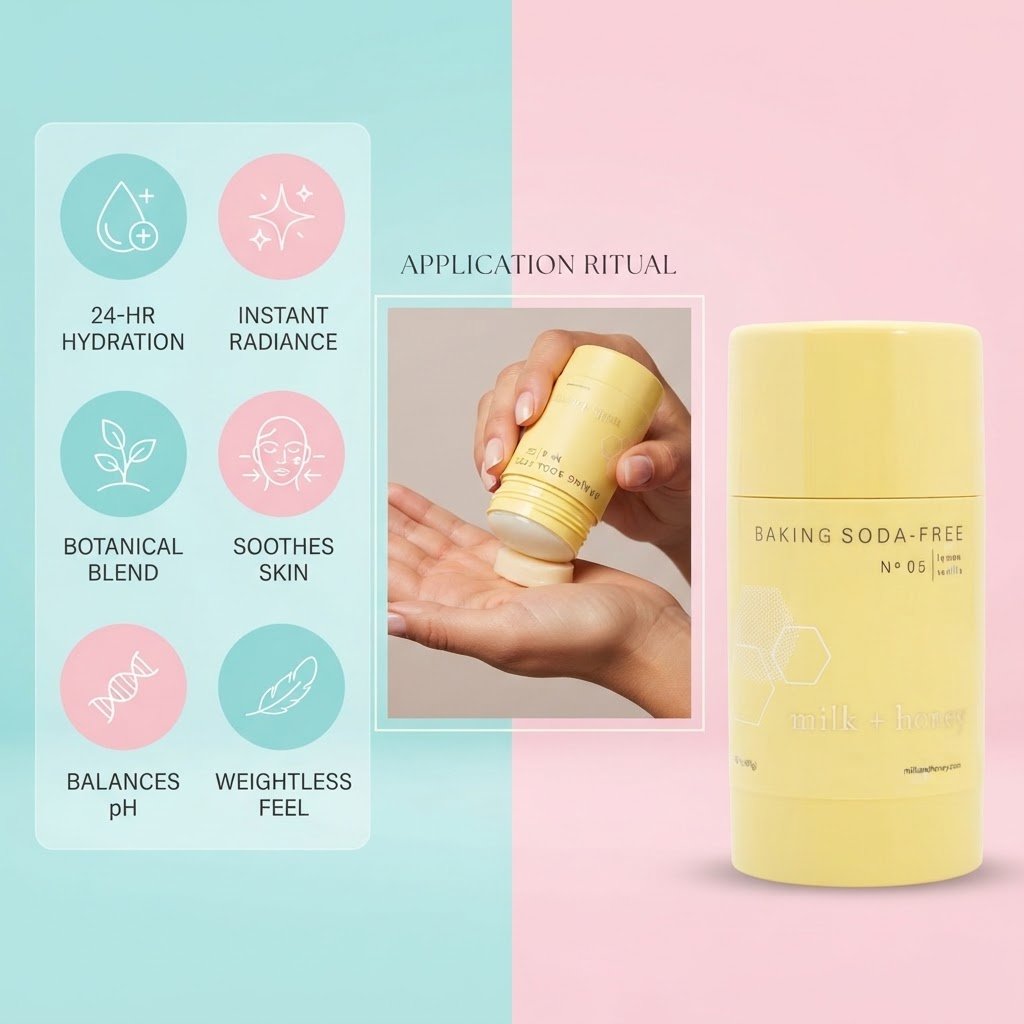
Baking Soda Free Deodorant
milk + honey Baking Soda Free Deodorant is an aluminum-free solid deodorant created for people who prefer to avoid sodium bicarbonate, particularly when conventional baking-soda deodorants leave the underarm area feeling uncomfortable. The current manufacturer formula uses magnesium hydroxide and arrowroot powder for odor and moisture management, supported by sunflower wax, cocoa butter, beeswax, jojoba esters, vitamin E, and scent-specific botanical oils.
The current milk + honey range comes in two scent blends: Nº 05 Lemon + Vanilla and Nº 09 Lavender + Tea Tree. The manufacturer’s current product page lists both as 3 oz sticks, although some retailer inventory still displays earlier 2.5 oz or 2.6 oz specifications, making the label on the individual stick the best final size reference.
For a broader body-care routine on Erothots, the deodorant can sit naturally after cleansing with Body Shower Gel, while dry body skin can be handled separately with products such as Pineapple Whipped Body Cream. Erothots also groups complementary personal-care products within its Beauty Wellness collection.
About Baking Soda Free Deodorant
The defining feature of this deodorant is what it leaves out.
Many non-antiperspirant deodorant sticks use sodium bicarbonate, or baking soda, because its alkaline character can help create an environment that is less favorable to the processes responsible for noticeable underarm odor. Some people, however, find high-baking-soda formulas uncomfortable.
milk + honey replaces baking soda with magnesium hydroxide as its central odor-control mineral. The manufacturer specifically positions this version for sensitive underarms and people who have experienced problems with baking-soda deodorants.
That does not make the formula universally non-irritating. Lavender, tea tree, lemon, and other aromatic botanical oils can still matter for reactive skin, so “baking soda free” should be treated as one formulation characteristic rather than a guarantee that every sensitive underarm will tolerate both scent versions equally well.
Baking Soda Free Deodorant Features
- Brand: milk + honey
- Product type: Solid underarm deodorant
- Current manufacturer size: 3 oz
- Scent options: Nº 05 Lemon + Vanilla and Nº 09 Lavender + Tea Tree
- Baking soda: None in the current manufacturer formulas
- Aluminum antiperspirant salts: None
- Primary odor-control ingredient: Magnesium hydroxide
- Moisture-absorbing ingredient: Organic arrowroot root powder
- Solid structure: Sunflower seed wax, cocoa butter, organic beeswax, and jojoba esters
- Supporting emollient: Caprylic/capric triglyceride in the current manufacturer formulas
- Antioxidant ingredient: Tocopherol, or vitamin E
- Nº 05 aromatics: Vanilla fruit oil and organic lemon peel oil
- Nº 09 aromatics: Organic lavender oil and organic tea tree leaf oil
- Parabens: Marketed as paraben-free
- Antiperspirant: No
- Manufacturing: Current Ulta information states that the product is made in Austin, Texas
The ingredient formulas currently published by milk + honey differ slightly from some retailer listings, so the ingredient declaration printed on the actual product remains the most reliable reference if a particular ingredient needs to be avoided.
Deodorant And Antiperspirant Are Not The Same Thing
This is one of the most important details about Baking Soda Free Deodorant.
It is a deodorant, not an antiperspirant.
Deodorants primarily address odor. Antiperspirants are designed to reduce the amount of sweat reaching the skin and typically use aluminum-based active ingredients to do so. The American Academy of Dermatology explains that deodorants without antiperspirant actives do not stop the body from producing sweat. AAD guidance on deodorant and perspiration makes that distinction clearly.
milk + honey’s formula contains no aluminum antiperspirant active, so someone using it should still expect normal perspiration.
Arrowroot powder may absorb some moisture present at the skin surface, which can make the underarm area feel less wet, but absorbing surface moisture is not equivalent to reducing sweat-gland output.
That makes this product more suitable for someone whose priority is odor management without antiperspirant salts than for someone specifically looking for maximum sweat reduction.
Why Underarm Sweat Develops An Odor
Freshly produced sweat is not the whole explanation for underarm odor.
Research on the axillary microbiome shows that characteristic underarm malodor is strongly connected with microorganisms on the skin converting components of sweat secretions into volatile odor molecules. Research mapping odor-producing underarm bacteria provides the biological background.
That is why deodorant products can reduce odor without preventing sweating itself.
milk + honey uses magnesium hydroxide as the principal odor-control ingredient in this formula rather than relying on baking soda or aluminum antiperspirant salts. The product therefore addresses a different part of the underarm environment from an antiperspirant.
Magnesium Hydroxide Replaces Baking Soda
Magnesium hydroxide appears near the beginning of both current formulas.
milk + honey describes the mineral as its alternative for neutralizing odor in people who do not tolerate baking soda well.
Its importance here is practical rather than trendy. Removing sodium bicarbonate would leave a gap in the formula if there were no other ingredient designed around odor control.
Magnesium hydroxide fills that role while arrowroot powder addresses surface moisture.
A broader scientific review of deodorant technologies notes that modern deodorants can manage malodor through several strategies, including altering the environment in which odor-producing bacteria operate, absorbing moisture, introducing antimicrobial materials, or masking odor with fragrance. The review of deodorant and antiperspirant technologies helps explain why aluminum-free products do not all rely on the same chemistry.
Arrowroot Helps Manage Surface Moisture
Organic Manihot Esculenta arrowroot root powder is the second ingredient in the current manufacturer’s formulas.
Powders like arrowroot can absorb moisture and oil at the skin surface, helping the underarm area feel drier.
Again, that should not be confused with an antiperspirant effect.
The distinction matters when evaluating performance. Someone may notice that the skin feels less damp because some surface moisture has been absorbed while still producing normal perspiration underneath.
A person whose main issue is clinically excessive sweating would therefore be dealing with a different problem. The AAD distinguishes ordinary deodorant from treatments for hyperhidrosis, where reducing sweat production itself becomes the objective. AAD hyperhidrosis information provides that distinction.
The Base Is More Balm-Like Than A Gel Deodorant
The current formula contains no water at the beginning of the ingredient list.
Instead, it uses caprylic/capric triglyceride, arrowroot, magnesium hydroxide, sunflower seed wax, cocoa seed butter, beeswax, and jojoba esters.
That gives the stick a solid balm-like construction.
Sunflower wax and beeswax help keep the deodorant firm inside the package, while cocoa butter and jojoba esters influence glide and the conditioned feel left behind.
Caprylic/capric triglyceride is an emollient derived from fatty-acid chemistry and gives the formula additional slip.
This structure explains why the manufacturer recommends briefly warming the stick against the underarm before spreading it. The warmth helps soften the outer surface without requiring a liquid roll-on or gel base.
For shoppers who enjoy richer body products, the texture concept has more in common with a balm than with a watery body serum. Erothots’ Moisturisers collection provides other examples of oil-, cream-, and balm-style skin products for areas where additional softness is needed.
Lemon + Vanilla And Lavender + Tea Tree Use Different Aromatics
The two versions share most of their structural ingredients but finish differently.
Nº 05 Lemon + Vanilla
The current manufacturer formula contains Vanilla Planifolia Fruit Oil and organic Citrus Limonum Lemon Peel Oil after the base ingredients.
The result is designed around a sweeter citrus profile rather than the herbal character of Nº 09.
Lemon peel oil is aromatic, so this version should not be interpreted as fragrance-free simply because no generic “parfum” appears in the current ingredient declaration.
Nº 09 Lavender + Tea Tree
The second variation contains organic lavender oil and organic tea tree leaf oil.
This gives it a more herbal scent profile.
Tea tree is often associated with cleansing personal-care products, but it should not be turned into a claim that this deodorant medically treats bacterial or fungal skin conditions. In this product it remains part of a cosmetic deodorant formulation.
Both scent variations contain aromatic plant materials, so someone looking specifically for a truly fragrance-free underarm product would need a different formula.
Baking Soda Free Can Matter For Reactive Underarms
Underarm skin experiences a combination of friction, moisture, hair removal, and leave-on products, which can make irritation particularly noticeable.
The AAD notes that contact dermatitis can occur after exposure to personal-care ingredients and that fragrance in deodorants can be one possible trigger. AAD information on contact dermatitis explains that an itchy or irritated rash can result from either irritant or allergic reactions.
Removing baking soda may therefore help someone whose irritation was specifically connected with alkaline sodium-bicarbonate deodorants.
It does not remove every potential irritant.
Nº 05 contains lemon and vanilla oils. Nº 09 contains lavender and tea tree oils. Individual sensitivity can still occur, especially on recently shaved or already irritated skin.
For people with known skin conditions around the underarms, a simpler fragrance-free deodorant may sometimes be preferable. The AAD’s current guidance for hidradenitis suppurativa, for example, specifically advises looking for deodorants without baking soda and fragrance when irritation is a concern.
Baking Soda Free Does Not Mean Fragrance Free
This distinction deserves its own place on the page because the two terms are easy to merge mentally.
Neither scent is truly fragrance-free.
The aroma comes from identifiable botanical oils instead of an unspecified fragrance mixture. For Nº 05 these are lemon and vanilla oils. For Nº 09 they are lavender and tea tree oils.
Some people prefer that formulation approach.
Someone with a confirmed fragrance allergy, however, should not assume botanical fragrance materials are automatically safer simply because they come from plants.
Sensitive skin responds to chemistry, not to whether an ingredient sounds natural.
The Coconut Oil Information Is Currently Inconsistent
There is a useful ingredient-label detail worth knowing before purchase.
milk + honey’s current product page still describes organic coconut oil in its ingredient highlights, and Ulta’s Lemon + Vanilla listing also shows a coconut-oil-based version. However, the current complete ingredient lists published by milk + honey for both Nº 05 and Nº 09 do not list coconut oil. Instead, both begin with caprylic/capric triglyceride followed by arrowroot and magnesium hydroxide.
This likely reflects formula or inventory differences, but the available pages do not give enough information to say exactly when each version changed.
For someone avoiding coconut oil specifically, the safe approach is to read the ingredient panel on the stick being purchased rather than relying on the older ingredient highlight.
This is also why the product page should not simply state that coconut oil is a universal ingredient in Baking Soda Free Deodorant.
Application And Wear Notes
The current manufacturer directions recommend briefly warming the solid stick against the underarm and then spreading enough product for coverage. Reapplication can be made according to individual odor-control needs.
Because this is not an antiperspirant, continued sweating during hot weather, exercise, or stress is expected.
It is also sensible not to repeatedly drag a dry, firm stick over irritated skin simply to increase the amount applied. The wax-and-butter format is designed to soften slightly from body warmth.
If the underarm has been freshly shaved and already feels sore, waiting until the skin feels comfortable can reduce the number of potential irritants being introduced at once.
There Is No Need To Think Of The Switch As A “Detox”
Some older retailer copy around aluminum-free deodorants describes a period in which the underarms supposedly “detox” after antiperspirant use.
That explanation should be treated carefully.
Sweating has an essential role in thermoregulation, particularly evaporative cooling when body temperature increases. A major physiology review describes heat loss as the primary function of eccrine sweating. Research on human sweat-gland physiology provides the relevant biological context.
Switching from an antiperspirant to an aluminum-free deodorant can certainly feel different because the new product no longer suppresses perspiration in the same way.
That does not require the idea that the underarms are undergoing a special cleansing process or releasing stored toxins.
The simpler explanation is that a deodorant and an antiperspirant perform different jobs.
Sweat And Odor Can Change From Day To Day
Performance with an aluminum-free deodorant is not necessarily identical every day.
Exercise, temperature, clothing, stress, washing habits, and individual skin microbiology can all influence underarm moisture and odor.
This is especially relevant when comparing reviews. One person’s experience of “all-day” odor control does not establish an exact wear duration for every user.
The manufacturer describes the deodorant as providing day-long freshness, but reapplication is also included in its current directions when necessary.
That is a more realistic way to position performance than promising a fixed number of hours that milk + honey does not currently publish as the result of a controlled clinical wear study.
Current Ingredient Profiles
The current Nº 05 Lemon + Vanilla manufacturer formula is Caprylic/Capric Triglyceride, Organic Manihot Esculenta (Arrowroot) Root Powder, Magnesium Hydroxide, Helianthus Annuus (Sunflower) Seed Wax, Theobroma Cacao (Cocoa) Seed Butter, Organic Beeswax, Jojoba Esters, Vanilla Planifolia (Vanilla) Fruit Oil, Organic Citrus Limonum (Lemon) Peel Oil, and Tocopherol (Vitamin E).
The current Nº 09 Lavender + Tea Tree formula is Caprylic/Capric Triglyceride, Organic Manihot Esculenta (Arrowroot) Root Powder, Magnesium Hydroxide, Helianthus Annuus (Sunflower) Seed Wax, Theobroma Cacao (Cocoa) Seed Butter, Organic Beeswax, Jojoba Esters, Tocopherol (Vitamin E), Organic Lavandula Intermedia (Lavender) Oil, and Organic Melaleuca Alternifolia (Tea Tree) Leaf Oil.
Both formulas contain beeswax, so they should not be described as vegan.
The manufacturer also states that ingredient lists can change and advises checking the actual product label for the most current declaration.
Where It Fits In A Body-Care Routine
Baking Soda Free Deodorant works best when its role remains simple: odor control for the underarms.
A cleanser such as Erothots’ Body Shower Gel handles sweat, oil, and everyday surface residue during bathing. Deodorant follows as a leave-on personal-care product rather than replacing washing.
If surrounding skin is dry, a body moisturizer can be used separately rather than relying on deodorant to moisturize the entire area. Pineapple Whipped Body Cream represents the richer body-moisturizing side of Erothots’ current skincare selection.
This separation makes it easier to change one product if irritation appears rather than using one heavily fragranced multipurpose formula for cleansing, moisturizing, and deodorizing.
What Makes Baking Soda Free Deodorant Different
The strongest distinction is the combination of no baking soda and no aluminum antiperspirant salts while still maintaining an actual odor-management system.
Magnesium hydroxide handles the main odor-control positioning, arrowroot helps absorb surface moisture, and a wax-and-butter base creates the solid stick. The two scent profiles then change only the aromatic end of the formula: vanilla and lemon for Nº 05, lavender and tea tree for Nº 09.
That makes the product particularly relevant to someone who previously liked the concept of an aluminum-free solid deodorant but found baking-soda-heavy formulas uncomfortable.
Its limits are equally important. It does not prevent perspiration like an antiperspirant, it is not fragrance-free, and a baking-soda-free label does not guarantee compatibility with every sensitive skin type.
Final Note
milk + honey Baking Soda Free Deodorant is best understood as a 3 oz aluminum-free deodorant stick centered on magnesium hydroxide and arrowroot rather than sodium bicarbonate. The solid base combines sunflower wax, cocoa butter, beeswax, jojoba esters, vitamin E, and emollients, with a choice between Lemon + Vanilla and Lavender + Tea Tree.
Its most useful advantage is straightforward: it gives people who prefer to avoid baking soda another way to manage underarm odor without moving to an aluminum antiperspirant.
The expectations should remain equally straightforward. It will not stop normal sweating, because it is a deodorant rather than an antiperspirant. The aromatic plant oils also mean neither version is truly fragrance-free, so people whose underarms react to fragrance should consider that separately from baking-soda sensitivity.
For complementary body care on Erothots, shoppers can compare the Beauty Wellness collection, cleanse with Body Shower Gel, or add a dedicated moisturizer from the Moisturisers range instead of expecting one deodorant to perform every body-care function.
:::

Reviews
There are no reviews yet.