

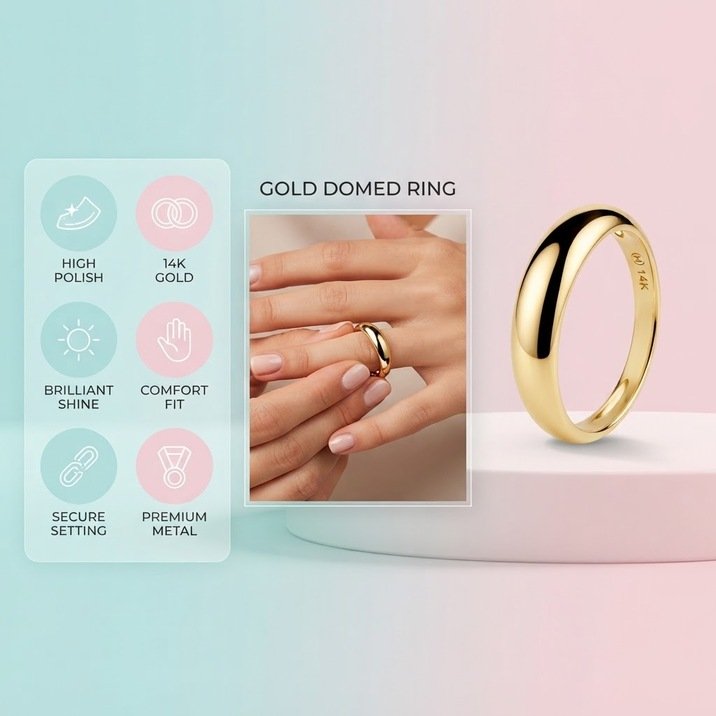
Thin Dôme Ring
The Thin Dôme Ring takes the rounded volume of a traditional dome ring and reduces it into a cleaner, lighter silhouette. Its polished upper surface measures approximately 6.2 mm wide, then narrows considerably into a 2 mm shank, creating noticeable presence from above without carrying the same width around the entire finger. The current verified version is crafted in 10k solid yellow gold, uses 90% recycled gold, and is offered in sizes 3 through 10.
The absence of gemstones is intentional. Shape, proportion, polish, and warm gold color provide all of the visual detail, making Thin Dôme Ring especially useful as either a standalone metal ring or the foundation of a more layered ring stack.
About Thin Dôme Ring
A conventional thin band tends to maintain a similar width around the finger. Thin Dôme Ring works differently. Its upper section expands into a smooth, convex form before tapering into the finer shank underneath.
That difference gives the ring two personalities depending on the viewing angle. From above, the 6.2 mm top looks substantial and sculptural. From the side and underside, the 2 mm shank keeps the design considerably leaner.
For shoppers comparing metal bands with stone-led designs, the Topaz Ring in Sterling Silver provides a useful internal contrast. It builds its identity around a colored center stone, whereas Thin Dôme Ring relies entirely on polished gold and curved form.
Thin Dôme Ring Features
- Jewelry type: Domed band ring
- Material: 10k solid yellow gold
- Top width: Approximately 6.2 mm
- Shank width: Approximately 2 mm
- Current size range: 3–10
- Gemstones: None
- Surface: Smooth polished finish
- Design: Wide rounded top tapering into a narrow shank
- Gold sourcing claim: 90% recycled gold
- Manufacturer positioning: Water resistant and hypoallergenic
- Stacking compatibility: Designed to coordinate with curved Dôme nesting rings.
The 6.2 mm Dome Creates Presence Without A Wide Full Band
The relationship between the two widths is one of the most important aspects of this ring.
At 6.2 mm, the upper section has enough metal area to create a clear visual statement. Yet the lower portion reduces to only 2 mm. A uniformly 6.2 mm band would feel and look very different because that width would continue between the fingers and around the underside of the hand.
Here, most of the visual volume is concentrated where it can be seen.
This is also what distinguishes Thin Dôme from the brand’s original Dôme Ring. The current sterling-silver Dôme Ring measures approximately 11 mm across the top, reaches about 5 mm in height, and has a 3.5 mm shank. Thin Dôme therefore retains the rounded design language while substantially reducing the overall scale.
Within your broader Jewellery collection, those proportions are useful when comparing bold bands, gemstone rings, pinky rings, and more delicate stacking pieces.
10k Solid Yellow Gold Construction
Thin Dôme Ring is made from 10k solid gold, not from a gold-colored coating applied over another base metal.
Karat measures the proportion of gold within a gold alloy. The Federal Trade Commission’s gold jewelry guidance explains that pure gold is 24 karat and that lower-karat jewelry combines gold with other metals to produce the specified alloy.
That distinction matters when comparing visually similar pieces. Solid 10k gold, 18k gold vermeil, gold-plated metal, and gold-filled jewelry can all have a yellow-gold appearance while having different underlying construction.
For this ring, the material itself is part of the design because there are no gemstones or contrasting elements covering the surface.
What 90% Recycled Gold Means
The manufacturer states that the 10k gold used for the current Thin Dôme Ring contains 90% recycled gold.
That statement refers to the origin of the gold used in producing the alloy. It does not change the ring’s 10k fineness, and it should not be broadened into unrelated environmental claims without separate evidence.
For wider context, the Responsible Jewellery Council maintains Chain of Custody standards addressing the movement and traceability of eligible precious metals through jewelry supply chains.
This makes the recycled-content statement more useful when kept precise: 90% recycled gold in the stated 10k alloy, rather than vague language about the entire product.
A Polished Surface Is The Main Decorative Detail
Without stones, engraving, texture, or charms, the polished dome becomes the visual centerpiece.
A convex surface catches light differently across its curve. One area can appear bright while another falls into softer reflection, helping the ring look dimensional even though the metal surface itself is uncomplicated.
The lack of additional decoration also makes it easier to coordinate with more detailed pieces elsewhere on the hand.
Someone wearing a gemstone-focused ring from the Jewellery selection can use Thin Dôme as the plain-metal counterpoint rather than adding a second competing gemstone setting.
Likewise, the ring-focused choices deeper in the Jewellery collection provide useful comparisons between sculptural bands, pinky styles, mixed metals, and more decorative ring constructions.
Thin Dôme Ring As A Standalone Piece
Although it is designed with stacking in mind, Thin Dôme does not require another ring to look complete.
The 6.2 mm upper width provides enough visible gold to function as the primary ring on a hand. This is particularly useful when other jewelry, such as earrings or a necklace, already contains gemstones or detailed ornamentation.
Wearing the ring alone emphasizes its silhouette. The transition from broad dome to narrow shank is easier to see, and the polished surface remains uninterrupted by neighboring bands.
It can also be used as a simple gold anchor when several slimmer rings are distributed across other fingers.
Built With Ring Stacking In Mind
The manufacturer specifically positions Thin Dôme Ring as compatible with its Organic Dôme Nesting Rings. Those nesting pieces use curved profiles designed to follow the shape of Dôme rings instead of behaving like perfectly straight bands.
That relationship is important because domed rings do not always sit flush against ordinary straight stacking bands.
For example, the Organic Dôme Thin Nesting Ring has a curved top measuring about 3.3 mm, a 1.7 mm shank, and a small lab-grown diamond. Its shape is deliberately different from a standard straight eternity band.
A carefully chosen curved ring can therefore frame the dome rather than leaving an accidental-looking gap.
Mixing It With Diamond Rings
A plain polished dome can also provide useful contrast beside pavé jewelry.
The related Pavé Diamond Thin Dôme Ring takes the same general design family in a very different direction, using 14k yellow gold, natural diamonds, a minimum 0.43 ct diamond weight, and a 4 mm top width.
The comparison demonstrates how surface treatment changes the character of a ring. Plain Thin Dôme emphasizes polished gold and volume. Pavé introduces repeated points of light and considerably more surface detail.
Within your store, the Topaz Ring in Sterling Silver provides another useful comparison because it shifts attention away from metal shape and toward gemstone color.
A ring wardrobe does not need every piece to use the same design language. Combining plain metal, pavé, and larger gemstones can make each structure easier to distinguish.
Size 3 Through 10 Gives It Wider Finger Options
The current 10k yellow-gold configuration is offered in sizes 3 through 10. That range means the ring does not need to be restricted to one particular finger.
Smaller sizes can work for a pinky depending on individual measurements, while larger sizes make the design suitable for conventional ring, middle, or index-finger placement.
Actual sizing is especially important with a ring that has a broader upper surface. Although the shank narrows to 2 mm, the dome occupies more space above the finger than an ultra-fine stacking band.
Finger size can also vary with temperature and time of day, so an accurate measurement is more useful than selecting a size purely from another ring that has a very different band width.
Styling The Dome Across Different Fingers
Changing fingers changes the visual effect considerably.
On the ring finger, Thin Dôme can function as a refined standalone band. Moving it to the middle or index finger gives the 6.2 mm top a slightly more assertive position within the hand.
A pinky placement creates another direction when the correct smaller size is available. It gives the compact finger a broader polished surface without introducing the traditional flat face associated with signet rings.
For shoppers interested specifically in smaller-finger jewelry, the Jewellery ring selection provides additional context through pinky and sculptural ring styles.
Coordinating A Plain Gold Ring With Other Jewelry
Because Thin Dôme has no gemstone color to match, coordination can be based largely around metal tone and proportion.
Yellow-gold earrings or a fine gold necklace can repeat its warmth. Alternatively, mixed-metal jewelry can create deliberate contrast.
A gemstone necklace or earrings can also pair easily with the ring because the hand remains relatively neutral. The polished dome contributes metal shine without introducing another colored stone.
This makes the ring particularly useful in a collection where several accessories already have strong individual identities.
Surface Marks Are Normal On A Polished Ring
A smooth high-polish ring makes its metal surface very visible. That means small marks accumulated through normal contact can also become visible over time.
Gold jewelry can encounter desks, door handles, bags, other rings, and countless everyday surfaces. Those contacts may gradually change a perfectly mirror-like finish.
This is not unique to Thin Dôme, but a broad polished surface can make fine scratches easier to notice than a highly textured design.
For general jewelry maintenance, GIA’s jewelry care guidance recommends gentle handling and appropriate cleaning rather than harsh treatment.
Caring For The Thin Dôme Ring
A soft cloth is useful for removing oils and ordinary surface residue after wear. For more thorough cleaning, mild soap and warm water can be used conservatively, followed by careful rinsing and drying.
Avoid abrasive household cleaners or rough polishing materials unless a jewelry professional specifically recommends them for the finish.
Storage matters as well. The Canadian Conservation Institute’s metal care guidance notes the importance of reducing moisture, contaminants, and damaging contact when preserving metal surfaces.
For everyday jewelry storage, the practical version of that principle is simple: keep the ring dry and give it its own soft compartment where harder gemstones and sharp settings cannot repeatedly rub against its polished dome.
Why Thin Dôme Ring Works As A Core Band
Thin Dôme Ring is visually simple, but its measurements prevent it from becoming anonymous.
The 6.2 mm upper surface gives the ring presence, while the 2 mm shank keeps the construction noticeably lighter than a uniformly broad band. The current 10k solid yellow-gold version combines that silhouette with a polished, stone-free finish and sizes ranging from 3 through 10.
Its strongest role is versatility. It can remain the only ring on the hand, provide a smooth gold counterpoint to gemstone jewelry, or become the central piece in a curved Dôme stack.
For additional comparisons, the main Jewellery collection, the ring and diamond selection, the sculptural and pinky-ring selection, and the Topaz Ring in Sterling Silver offer different ways to compare metal color, band width, stone placement, and overall ring scale.





Reviews
There are no reviews yet.