

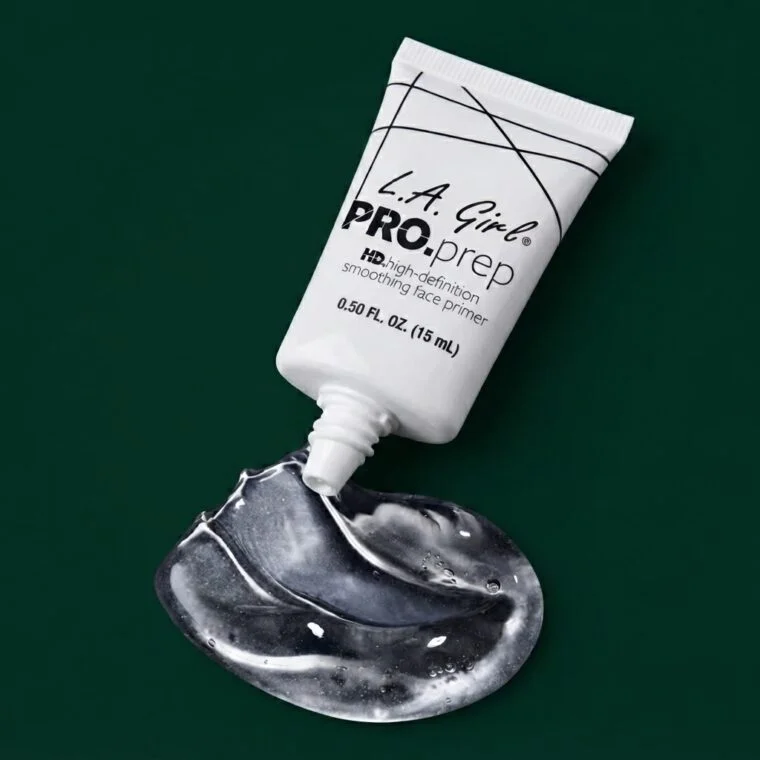
Pro Prep HD Face Primer
L.A. Girl Pro Prep HD Face Primer is a lightweight, translucent makeup primer designed to create a smoother-looking surface before foundation and other complexion products. Instead of relying on a long skincare ingredient list, it uses a compact silicone-based formula built around cyclopentasiloxane and dimethicone crosspolymer, with silica for texture and tocopheryl acetate, a form of vitamin E, as a supporting skin-conditioning ingredient.
The current Ulta version contains 0.5 oz / approximately 15 ml and is marketed as fragrance-free, lightweight, and designed to soften the appearance of pores and fine lines while helping makeup wear more evenly.
For shoppers comparing other complexion products, HotScope’s Makeup collection provides the most relevant broader category, while skincare preparation can be considered separately through the Skincare collection.
Pro Prep HD Face Primer Features
- Brand: L.A. Girl
- Product type: Silicone-based face primer
- Finish: Translucent, smoothing makeup base
- Size: 0.5 oz / approximately 15 ml
- Primary purpose: Preparing the skin surface before complexion makeup
- Texture: Lightweight silicone gel
- Notable ingredients: Cyclopentasiloxane, dimethicone crosspolymer, silica and tocopheryl acetate
- Fragrance: Fragrance-free
- Parabens: Paraben-free according to L.A. Girl
- Skin effect: Temporarily softens the visible appearance of pores and fine surface texture
- Makeup role: Helps create a smoother surface for foundation
- Color: Clear or translucent
- Ulta item number: 2504751
The short ingredient list is one of this primer’s most defining characteristics. L.A. Girl identifies light-diffusing particles and vitamin E as supporting features, while Ulta describes the formula as lightweight and intended to reduce the visible appearance of pores and fine lines.
A Silicone-Led Formula Rather Than A Skincare Serum
Pro Prep HD Face Primer is better understood as a surface-smoothing makeup product than as a moisturizing treatment.
Cyclopentasiloxane and dimethicone crosspolymer form the foundation of the formula. These silicone-based ingredients help the primer spread in a thin, even layer and create the soft, slippery finish commonly associated with blurring primers.
The effect is primarily cosmetic. The primer does not physically remove pores, permanently erase fine lines, or change the underlying structure of the skin. Instead, it creates a temporary film across uneven surface texture so that light reflects differently and makeup can sit on a more uniform base.
This distinction becomes useful when comparing primer with products from HotScope’s Moisturisers collection. A moisturizer is intended primarily to support skin hydration and comfort, whereas this primer is designed mainly to change the way the skin surface looks and feels before makeup.
The American Academy of Dermatology’s guidance on skincare order similarly places moisturizer and sunscreen before makeup, supporting the idea that primer should not automatically replace basic skincare.
What The Five Main Ingredients Actually Do
The ingredient declaration is unusually concise:
Cyclopentasiloxane, Dimethicone Crosspolymer, Silica, Phenoxyethanol, Tocopheryl Acetate.
Cyclopentasiloxane is a volatile silicone frequently used to improve spreadability. It helps a product glide across the face without requiring a heavy oil phase and gradually evaporates after application, contributing to the lighter finish.
Dimethicone crosspolymer is a silicone elastomer. In makeup primers, elastomers create the soft, cushiony texture associated with pore-blurring products. They can visually smooth small differences in surface texture without acting like a skin-resurfacing treatment.
Silica contributes to texture modification and the soft-focus character of the finished primer. It can also help reduce an overly greasy sensory feel.
Phenoxyethanol functions as a preservative. Even formulas with relatively few ingredients still require appropriate preservation and manufacturing controls.
Tocopheryl acetate is a stable vitamin E derivative commonly used as a skin-conditioning ingredient in cosmetics. It supports the skincare side of the formulation but should not be interpreted as making this primer a concentrated vitamin E treatment.
The FDA explains that cosmetic products are regulated differently from drugs and, aside from specific categories such as color additives, do not generally receive FDA premarket approval. Its overview of cosmetic regulation is useful when interpreting ingredient and marketing claims.
What “Blurring” Means On The Skin
The phrase blurred pores is common in primer marketing, but the mechanism is optical and temporary.
Visible pores create small changes in skin topography. Fine lines do the same. When foundation is applied directly over an uneven surface, pigment can settle differently across those areas and sometimes make texture more noticeable.
A silicone primer creates a thin layer over that surface. Silica and the silicone elastomer further alter the way light interacts with the skin. The result can make texture appear softer to the eye and provide a more consistent surface for foundation.
L.A. Girl also describes the product as containing light-diffusing particles, which supports this soft-focus positioning.
That does not mean pores have closed or disappeared. Pore size is influenced by anatomy, sebum, genetics, aging and other factors that a makeup primer cannot permanently change.
For someone choosing makeup specifically because visible texture is a concern, browsing HotScope’s Makeup collection alongside skin-preparation products makes more sense than expecting primer alone to solve both skincare and makeup concerns.
Primer And Moisturizer Perform Different Jobs
A common problem with silicone primers occurs when they are applied to skin that is already dry or flaky.
A primer can make the surface feel smoother, but it does not provide the same moisture-support system as a conventional facial moisturizer. If dry patches are already present, foundation can still collect around them even when primer has been applied.
A moisturizer should therefore remain part of the preparation routine when the skin needs one. HotScope’s Mila Moursi Rejuvenating Serum represents a separate leave-on skincare step, while products in the site’s moisturizer category provide more direct hydration support.
The American Academy of Dermatology recommends applying moisturizer and sunscreen before makeup in a standard skincare sequence.
The practical distinction is simple: moisturizer addresses the condition of the skin, while primer adjusts the immediate cosmetic surface onto which makeup will be placed.
Building A Smooth Base Before Foundation
L.A. Girl recommends applying Pro Prep to clean or moisturized skin before makeup.
A small amount is usually more appropriate than coating the entire face in a thick silicone layer. The primer can be spread thinly over areas where foundation tends to catch or where visible pores and texture are most noticeable.
Allowing skincare underneath to settle first can also improve layering.
If a moisturizer, sunscreen and primer are rubbed together before previous layers have set, the formulas may begin to roll into small particles, commonly called pilling. This does not necessarily mean that any individual product is defective. It can happen because of the amount applied, rubbing technique, polymer compatibility or simply placing too many film-forming layers on top of one another.
Using thinner layers and pressing rather than aggressively rubbing the primer across textured areas can produce a more controlled surface.
Once the primer has settled, foundation, concealer or other complexion products can be applied over it.
Silicone Compatibility With Foundation
The composition of the primer matters when choosing what goes over it.
Pro Prep HD is strongly silicone-led. Foundations that also contain silicones often layer comfortably over this type of surface, although ingredient compatibility cannot be predicted from one ingredient alone.
Water-based foundations can also work over silicone primers. The simplified internet rule that “water-based foundation must only go over water-based primer” is too rigid because nearly all liquid complexion formulas contain mixtures of water, silicones, oils, polymers, powders and emulsifiers.
Application technique often matters just as much.
When a foundation separates over primer, possible causes include excessive skincare underneath, too much primer, insufficient setting time, heavy rubbing, very dry skin or an incompatible combination of film-forming ingredients.
Testing a thin layer before an event is more useful than assuming that two products will either work or fail solely because one contains silicone.
Fragrance-Free Is A Practical Feature For Reactive Skin
L.A. Girl identifies Pro Prep HD Face Primer as fragrance-free.
That is useful information because fragrance is a recognized source of cosmetic sensitivity for some people. The FDA’s cosmetic allergen guidance lists fragrances among common categories associated with allergic reactions.
The American Academy of Dermatology also recommends fragrance-free products for people whose skin is easily irritated, particularly in conditions such as rosacea.
Fragrance-free does not mean irritation is impossible. Phenoxyethanol, silicones, vitamin E derivatives or another component may still be unsuitable for an individual.
Anyone who experiences persistent burning, swelling, itching or redness should stop using the product rather than continuing simply because it carries a fragrance-free claim.
What It May Feel Like On Oily Skin
The combination of volatile silicone, dimethicone crosspolymer and silica can make Pro Prep particularly appealing to someone who dislikes heavy, oily primers.
Cyclopentasiloxane helps create slip without relying on a rich oil base, while the elastomer gives the surface a smoother, more powder-like character after spreading.
Silica can further contribute to a less greasy feel.
That does not make the primer a medical treatment for excess sebum, nor does it guarantee that makeup will remain matte throughout a long day. Skin oil production continues after makeup is applied.
The AAD’s guidance for oily skin recommends choosing makeup products that suit oily skin and avoiding sleeping in makeup.
Someone with oily but dehydrated skin may still need a lightweight moisturizer beneath this primer rather than skipping hydration entirely.
Dry Skin May Need More Preparation
A silicone primer can reduce the visible edges of small textural irregularities, but it cannot supply missing moisture to severely dry skin.
If the face feels tight after cleansing or shows visible flaking, preparing the skin with an appropriate moisturizer can create a better base before Pro Prep is added.
HotScope’s Moisturisers collection includes products for that separate step, while the Skincare collection provides broader options for building a routine around the condition of the skin rather than makeup alone.
Dry skin also benefits from restraint. Too many layers of serum, cream, sunscreen and primer can sometimes create a thick surface that makes foundation less stable instead of more stable.
The most effective preparation is therefore not necessarily the routine with the greatest number of products.
Pro Prep HD Face Primer Does Not Contain SPF
There is no sunscreen active listed in the five-ingredient formula.
That means the primer should not replace a daily sunscreen simply because it creates a smooth protective-feeling film over the face.
If sunscreen is part of the morning routine, it belongs before makeup and should be allowed to form its intended film before primer is layered over it.
This is particularly worth clarifying because L.A. Girl now sells other primers that do contain SPF, including a separate PRO Perfect Multi-Tasking Invisible Primer with Broad Spectrum SPF 30. That is not the same product as Pro Prep HD Face Primer.
Keeping those products separate prevents an important labeling mistake on an ecommerce page.
Full Ingredient Profile
The current ingredient list is:
Cyclopentasiloxane, Dimethicone Crosspolymer, Silica, Phenoxyethanol, Tocopheryl Acetate (Vitamin E).
The short formula makes this product relatively easy to understand compared with primers containing multiple botanical extracts, color correctors, sunscreen filters or moisturizing actives.
It is predominantly a texture-engineering formula. Cyclopentasiloxane provides spread, dimethicone crosspolymer supplies the characteristic smoothing effect, silica contributes to the finish, phenoxyethanol preserves the formula, and tocopheryl acetate supplies a small skincare-oriented element.
Ingredient lists can change when products are reformulated, so the package being purchased should remain the final reference for known allergies or sensitivities.
What Makes Pro Prep HD Face Primer Different
Pro Prep HD Face Primer does not try to combine every possible makeup-preparation feature into one tube.
There is no tint for color correction, no SPF system, no long list of plant extracts and no complicated multi-acid skincare blend. Instead, L.A. Girl uses a short silicone-led formula to target a very specific cosmetic problem: creating a smoother-feeling surface before complexion makeup.
Its strongest distinctions are the 0.5 oz format, translucent finish, fragrance-free and paraben-free positioning, light-diffusing effect, vitamin E derivative and simple five-ingredient formula.
That makes it particularly straightforward to place within a routine. Skincare from HotScope’s Skincare collection can address hydration and other skin needs first, a product such as Mila Moursi Rejuvenating Serum can serve as a separate treatment layer when appropriate, and Pro Prep can then provide the final smoothing bridge between skincare and products from the Makeup collection.
Final Note
L.A. Girl Pro Prep HD Face Primer is best viewed as a lightweight silicone smoothing primer, not a pore treatment or replacement for moisturizer.
Its compact formula uses cyclopentasiloxane, dimethicone crosspolymer and silica to alter the immediate texture and optical appearance of the skin, with tocopheryl acetate adding a vitamin E-derived conditioning component. The fragrance-free formula can also be a useful consideration for people who prefer makeup without added scent.
Applied in a thin layer over appropriately prepared skin, its role is simple: create a more even cosmetic surface so foundation and other complexion products have a smoother base on which to sit.
:::

Reviews
There are no reviews yet.