Tallow & Honey Balm
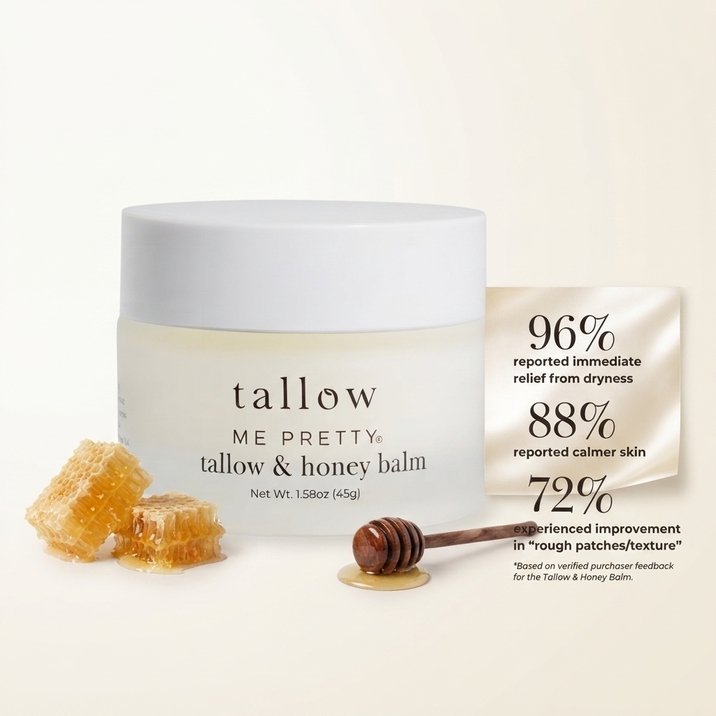
Tallow Me Pretty Tallow & Honey Balm is a rich, anhydrous-style moisturizer built around grass-fed and grass-finished beef tallow, organic beeswax, jojoba oil, raw honey, and a blend of botanical essential oils. The current 1.58 oz formula is positioned as a multi-purpose balm for dry, rough, or uncomfortable-feeling skin rather than as a lightweight everyday lotion.
Its dense oil-and-wax structure makes it particularly suited to moisture sealing. Instead of supplying the water-rich feel of a lotion, it leaves an emollient layer over the skin that can help reduce the tight, rough sensation associated with dryness. Someone comparing richer moisturizers can browse HotScope’s Moisturisers collection, while lighter facial products remain available through the broader Skincare collection.
Tallow & Honey Balm Features
- Brand: Tallow Me Pretty
- Product type: Rich face and body moisturizing balm
- Size: 1.58 oz
- Primary base: Grass-fed, grass-finished beef tallow
- Supporting emollients: Organic beeswax and jojoba seed oil
- Honey: Organic raw honey
- Botanical oils: Lavender, sweet orange, grapefruit, tangerine, tea tree, and rosemary oils
- Texture: Dense balm that softens as it contacts warm skin
- Primary cosmetic role: Moisture sealing and softening dry-feeling skin
- Face and body positioning: Multi-purpose
- Artificial fragrance: None listed
- Essential oils: Yes
- Parabens, phthalates, sulfates, synthetic dyes and petroleum derivatives: Excluded according to the current product positioning
- Animal-derived: Yes, because beef tallow and beeswax are central ingredients
- Retail item number: 77006304
The short ingredient list gives the balm a very different formulation profile from conventional emulsified moisturizers containing water, humectants, emulsifiers, preservatives, and multiple texture modifiers.
Tallow Creates The Rich Emollient Base
Rendered beef tallow is composed predominantly of triglycerides and fatty acids, which is why it behaves more like an oil-rich balm base than a water-based cream. In this formula, it is the first ingredient and forms most of the product’s emollient structure.
Tallow skincare has received significant attention online, but the scientific evidence deserves more restraint than many social-media claims suggest. A 2024 scoping review found potential reasons for further investigation of tallow in topical skincare, while also identifying substantial gaps in the available evidence. A later analysis of beef-tallow skincare claims concluded that evidence remains insufficient to support many of the stronger dermatologic claims circulating online. The current review of tallow and skin compatibility provides useful background, while newer research on beef-tallow skincare claims highlights the limitations of the evidence.
For a product page, this means tallow can reasonably be described as a rich emollient ingredient that helps soften and coat dry skin, but it should not automatically be called a proven treatment for eczema, psoriasis, acne, wounds, or other medical conditions.
Why A Balm Can Feel More Protective Than A Lotion
Tallow & Honey Balm contains very little of the watery structure associated with standard lotions. That changes how the product feels and what it does best.
The American Academy of Dermatology notes that creams and ointment-style moisturizers are generally more effective for very dry skin than thin lotions because richer products do a better job of holding water in the skin. Its guidance for choosing a moisturizer specifically recommends richer textures when dryness is substantial.
A balm does not need to add large quantities of water itself to be useful. When applied over skin that already contains some moisture, its oils and waxes can create a surface layer that slows moisture loss and improves softness.
That is why Tallow & Honey Balm fits a different need from a lighter product such as HotScope’s Face Cream Lucky Blue. The face cream is positioned as a lightweight daily moisturizer, while the tallow balm is considerably more lipid-rich and occlusive in character.
Raw Honey Adds A Humectant Element
Organic raw honey appears after tallow, beeswax, and jojoba oil in the current ingredient declaration.
Honey is interesting in skincare because its composition allows it to interact with water, giving it humectant properties. It also contains a complex mixture of sugars and naturally occurring compounds that have been investigated in dermatology. A scientific review of honey in dermatology and skincare discusses its long history of topical use and its incorporation into cosmetic preparations.
The distinction between cosmetic honey and medical-grade honey is important, however. Evidence involving specially prepared wound dressings or medical-grade honey should not be transferred directly to a jar of cosmetic balm.
In Tallow & Honey Balm, raw honey is better described as a moisture-supporting component of the overall formula rather than as an independent treatment for infections, wounds, or inflammatory skin disease.
Beeswax Helps The Balm Seal In Moisture
Organic Cera Alba, or beeswax, is the second listed ingredient.
Beeswax gives balm formulations body and helps keep them solid at room temperature. On the skin, it contributes to the protective, moisture-sealing character of the finished product.
This is why a beeswax-containing balm generally feels different from a lotion. A lotion is designed to spread a water-and-oil emulsion quickly across a larger area, while a wax-rich balm deposits a more persistent surface layer.
That can be useful around particularly dry areas such as hands, elbows, knees, or other rough patches where a thin lotion disappears quickly.
For body-focused hydration with a lighter whipped texture, HotScope’s Pineapple Whipped Body Cream provides a useful internal comparison. A whipped cream and a tallow-and-beeswax balm can both address dryness while creating noticeably different finishes on the skin.
Jojoba Oil Adds Slip Without Changing The Balm Format
Simmondsia Chinensis Seed Oil, commonly called jojoba oil, is another major ingredient in the formula.
Jojoba is technically a liquid wax ester rather than a conventional triglyceride vegetable oil. In skincare it functions primarily as an emollient, helping improve spreadability and soften the skin surface.
The American Academy of Dermatology includes jojoba oil among ingredients that can be useful in moisturizers for dry skin. AAD dry-skin recommendations also emphasize choosing moisturizer texture according to the severity of dryness.
Within this formula, jojoba likely helps balance the very dense character of tallow and beeswax, making a small amount easier to spread across the skin.
The Essential-Oil Blend Means This Is Not Fragrance-Free
Tallow Me Pretty states that the balm contains no artificial fragrance, but that is not the same as being fragrance-free.
The ingredient list contains several aromatic botanical oils:
Lavender essential oil, sweet orange oil, grapefruit peel oil, tangerine oil, white grapefruit essential oil, tea tree leaf oil, and rosemary leaf oil.
These plant oils naturally contain aromatic compounds and give the product fragrance even without a conventional synthetic parfum ingredient.
That distinction matters for sensitive skin. The FDA notes that fragrance ingredients can trigger allergic reactions or sensitivities in some people and recommends checking ingredient lists carefully when fragrance sensitivity is a concern. Its guidance on fragrances in cosmetics applies to natural as well as synthetic fragrance components.
The AAD similarly recommends fragrance-free products for people with very dry or easily irritated skin.
Someone specifically seeking a minimal, fragrance-free barrier balm should therefore not assume this product qualifies simply because the packaging emphasizes natural ingredients.
Natural Does Not Automatically Mean Hypoallergenic
The formula is short and heavily plant-and-animal-derived, but ingredient origin does not determine whether skin can react to it.
The FDA identifies fragrances among the common categories associated with cosmetic contact allergies. FDA information on cosmetic allergens explains that reactions may appear as itching, redness, or contact dermatitis even when the ingredient involved is tolerated by most people.
Tea tree, citrus, lavender, rosemary, honey, beeswax, and other naturally derived materials can therefore still be unsuitable for an individual.
The AAD makes the same broader point when discussing moisturizers: an “all natural” label does not mean a formula is automatically appropriate for sensitive skin.
This is particularly worth considering because a rich balm remains on the skin rather than being immediately rinsed away.
Dry Skin Is The Clearest Match
The strongest case for this product is straightforward dryness.
Tallow, beeswax, and jojoba provide an oil-rich surface layer, while honey adds a humectant component. That combination makes more formulation sense for rough, tight, flaky-feeling skin than for someone whose primary concern is excess oil.
Dermatologists generally recommend richer creams and ointments when skin is very dry because they retain moisture more effectively than thinner lotions.
This does not mean someone with oily skin can never use a balm. It does mean that covering an already oily face in a heavy lipid layer may not produce the same experience as using a lighter moisturizer.
HotScope’s Moisturisers collection gives shoppers a useful way to compare rich creams, lotions, and lighter moisturizers instead of assuming that one texture is universally best.
Acne-Prone Skin Needs A More Individual Approach
The current product information emphasizes dry and irritated-feeling skin but does not provide a verified non-comedogenic claim in the product details reviewed.
That makes acne-prone facial use more individual.
The AAD recommends that people prone to breakouts look for products labeled non-comedogenic or formulated not to clog pores. Its acne skincare guidance also points out that some skin and hair products can contribute to breakouts in susceptible people.
It would therefore be inappropriate to promise that beef tallow “cannot clog pores” or that this balm treats acne simply because some people tolerate it well.
Someone whose skin becomes congested easily may prefer to compare the balm with a lighter face moisturizer before using a rich wax-and-fat formula across the entire face.
Face And Body Use Have Different Texture Expectations
Tallow & Honey Balm is positioned as multi-purpose rather than strictly as a facial moisturizer.
That versatility makes sense from a formulation perspective.
On rough elbows, hands, knees, heels, or dry body patches, the heavier tallow-and-beeswax texture can provide a persistent coating without feeling unusually rich for the area.
On the face, the same formula may feel substantially heavier, particularly beneath sunscreen or makeup.
Someone using a separate treatment product such as Mila Moursi Rejuvenating Serum would generally be comparing two very different skincare formats. The serum provides a lighter treatment layer, while the tallow balm functions primarily as the lipid-rich moisture-sealing stage.
Where Tallow & Honey Balm Fits In A Routine
A balm is most logically placed toward the end of a skincare routine because its waxes and oils create a more occlusive surface than most watery treatments.
After cleansing, lighter water-based products can be allowed to settle before a small amount of balm is spread over areas that need additional moisture sealing.
For very dry body skin, applying an emollient after bathing can also make sense because the skin still contains moisture that the richer layer can help retain. The AAD recommends moisturizing soon after bathing for precisely this reason.
The balm contains no listed sunscreen active ingredients, so it does not replace daytime SPF.
Its rich protective feel may resemble an ointment, but physical richness should never be confused with ultraviolet protection.
It Is A Cosmetic Moisturizer, Not A Medical Skin Treatment
Some marketing language surrounding tallow skincare uses words such as healing, repairing, antibacterial, regenerative, or anti-inflammatory.
Those terms need context.
Under U.S. cosmetic regulation, moisturization and skin-softening are ordinary cosmetic functions. Claims that a product treats or prevents disease can change its regulatory status. The FDA’s cosmetic labeling guidance explains this distinction between cosmetic and therapeutic intended use.
Tallow & Honey Balm can reasonably be sold as a moisturizer for dry, rough-feeling skin.
Persistent rashes, open wounds, infected skin, severe dermatitis, unexplained itching, or worsening irritation should not simply be covered repeatedly with a cosmetic balm under the assumption that natural ingredients will treat the underlying problem.
Full Ingredient Profile
The current ingredient declaration is:
Grass Fed & Finished Beef Tallow, Organic Cera Alba (Beeswax), Organic Simmondsia Chinensis (Jojoba) Seed Oil, Organic Raw Honey, Organic Lavandula Angustifolia (Lavender) Essential Oil, Organic Citrus Sinensis (Sweet Orange) Oil, Organic Citrus Grandis Peel Oil, Organic Citrus Reticulata (Tangerine) Oil, Citrus Paradisi (White Grapefruit) Essential Oil, Organic Melaleuca Alternifolia (Tea Tree) Leaf Oil, Organic Rosmarinus Officinalis (Rosemary) Leaf Oil.
This is a comparatively short ingredient list, but short does not necessarily mean better or safer for every skin type. The seven aromatic botanical oils are particularly relevant for anyone with known fragrance or essential-oil sensitivities.
Because cosmetic formulas can change, the ingredient panel printed on the jar being purchased should remain the final reference.
What Makes Tallow & Honey Balm Different
The defining characteristic of Tallow & Honey Balm is its lipid-heavy simplicity.
Instead of beginning with water and building an emulsion around it, the product begins with beef tallow and beeswax, then adds jojoba oil and honey before finishing with a concentrated group of botanical oils.
That gives it a dense balm character particularly suited to moisture sealing and rough, dry-feeling areas.
The formulation also means it differs significantly from conventional HotScope facial moisturizers. Face Cream Lucky Blue represents a lighter cream-style approach, while products in the Moisturisers collection cover several other textures for shoppers who do not necessarily need a wax-rich balm.
The biggest limitation is the essential-oil blend. Someone choosing tallow specifically because their skin is highly reactive should notice that this particular formula is not an unscented tallow-only product.
Final Note
Tallow Me Pretty Tallow & Honey Balm is best understood as a rich multi-purpose emollient balm for dry-feeling face and body skin, built around grass-fed beef tallow, beeswax, jojoba oil, and raw honey.
The ingredient architecture supports its ability to coat and soften dry skin, but the broader evidence for beef tallow as a therapeutic skincare ingredient remains limited. Current research does not justify turning a moisturizing balm into a proven treatment for eczema, acne, psoriasis, wounds, or skin aging.
Its essential oils also deserve as much attention as its tallow and honey. Lavender, citrus, tea tree, and rosemary oils give the balm a naturally fragranced profile, which may be perfectly comfortable for many users but less appropriate for someone who specifically needs fragrance-free skincare.
For shoppers comparing rich moisture options on HotScope, the most useful question is therefore not whether tallow is universally better than conventional moisturizer. It is whether a dense, oil-and-wax balm with added aromatic botanical oils matches the person’s skin type, preferred texture, and tolerance better than a lighter cream or lotion.
:::


Reviews
There are no reviews yet.